
题目
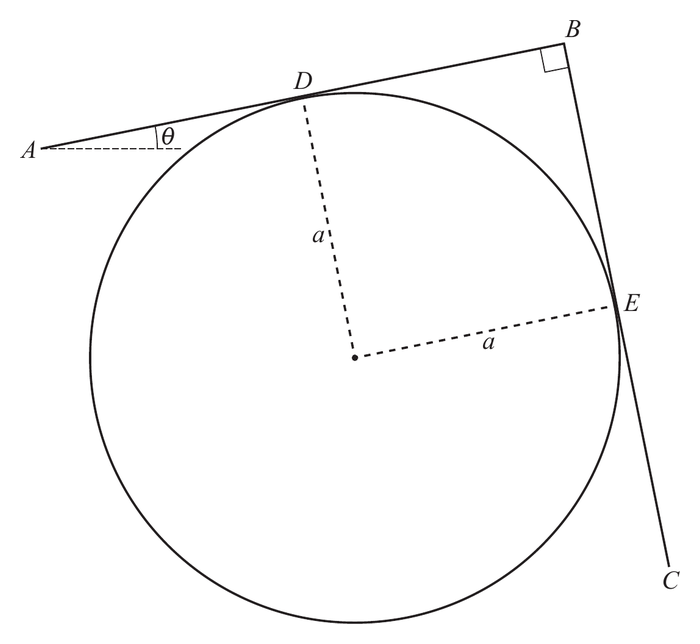
A uniform cylinder with a rough surface and of radius is fixed with its axis horizontal. Two identical uniform rods and , each of weight and length , are rigidly joined at with perpendicular to . The rods rest on the cylinder in a vertical plane perpendicular to the axis of the cylinder with at an angle to the horizontal. and are the midpoints of and respectively and also the points of contact of the rods with the cylinder (see diagram). The rods are about to slip in a clockwise direction. The coefficient of friction between each rod and the cylinder is .
The normal reaction between and the cylinder is and the normal reaction between and the cylinder is .
(a) Find the ratio in terms of .
(b) Given that , find the value of .
题目中文翻译
一个表面粗糙、半径为 的均匀圆柱体被固定,其轴水平。两根相同的均匀杆 和 在 点刚性连接,且 垂直于 ;每根杆的重量均为 ,长度均为 。两杆靠在圆柱体上,位于垂直于圆柱体轴的竖直平面内,且 与水平方向成 角。 和 分别为 和 的中点,同时也是两杆与圆柱体的接触点(见图)。两杆即将沿顺时针方向滑动。每根杆与圆柱体之间的摩擦系数均为 。
与圆柱体之间的法向反作用力为 , 与圆柱体之间的法向反作用力为 。
(a) 求比值 ,用 表示。
(b) 已知 ,求 的值。
原卷通用作答要求
Answer all questions. You should use a calculator where appropriate.
You must show all necessary working clearly; no marks will be given for unsupported answers from a calculator.
Give non-exact numerical answers correct to 3 significant figures, or 1 decimal place for angles in degrees, unless a different level of accuracy is specified in the question.
请回答所有题目。适当时应使用计算器。必须清楚展示所有必要的计算过程;仅给出计算器答案而没有过程,不予评分。除非题目另有精度要求,非精确数值答案保留 3 位有效数字,以度为单位的角度保留 1 位小数。
Where a numerical value for the acceleration due to gravity () is needed, use .
需要使用重力加速度 的数值时,取 。
解答
(a)
解法一
思路
展开
在两个接触点,摩擦力都反抗图示的顺时针滑动。沿 及其垂直方向列平衡方程,再绕接头 取矩。
答题过程
展开
Take one axis along from to , and the other perpendicular to towards the upper side of the diagram. The reaction is along the first positive axis and along the second. The limiting friction at is opposite the first axis with magnitude , while the limiting friction at is along the second axis with magnitude . Force balance gives
Taking moments about , the friction forces have zero moment since they lie along the rods. Balancing the moments of the reactions and the weights gives
Substituting the force balances gives
Hence .
解法二
思路
展开
也可分别绕两个接触点取矩。在每个方程中,该接触点的反力与摩擦力,以及该杆的重力,均不产生力矩。
答题过程
展开
Let the two perpendicular axes be as in the first solution. Relative to , point is a distance along the first axis and opposite the second. The reaction and friction at therefore produce moments in the same sense with total magnitude . The weight at produces the opposite moment of magnitude . Hence
Taking moments about , the reaction at has moment , opposed by the moment of its friction and the moment of the weight there. Thus
Eliminating the common right-hand side gives .
(b)
解法一
思路
展开
代入 得到两个支持力的比例,再将沿杆和垂直于杆的平衡式相除。
答题过程
展开
At , part (a) gives . The force balances then give