题目
Problem
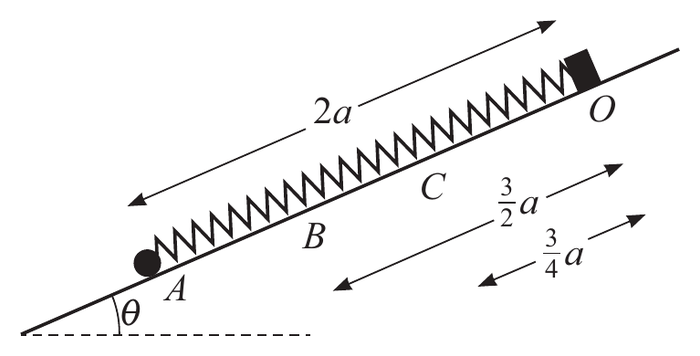
A light spring of natural length a and modulus of elasticity kmg is attached to a fixed point O on a smooth plane inclined to the horizontal at an angle θ, where sinθ=43. A particle of mass m is attached to the lower end of the spring and is held at the point A on the plane, where OA=2a and OA is along a line of greatest slope of the plane (see diagram).
The particle is released from rest and is moving with speed V when it passes through the point B on the plane, where OB=23a. The speed of the particle is 21V when it passes through the point C on the plane, where OC=43a.
Find the value of k.
(7)
题目中文翻译
一根原长为 a、弹性模量为 kmg 的轻弹簧连接在光滑斜面上的固定点 O。斜面与水平方向成角 θ,其中 sinθ=43。质量为 m 的质点连接在弹簧的下端,并被保持在斜面上的点 A 处,其中 OA=2a,且 OA 沿斜面的一条最大坡度线(见图)。
将质点由静止释放。当它经过斜面上的点 B 时,其速率为 V,其中 OB=23a。当质点经过斜面上的点 C 时,其速率为 21V,其中 OC=43a。
求 k 的值。
(7)
原卷通用作答要求
Answer all questions. You should use a calculator where appropriate.
You must show all necessary working clearly; no marks will be given for unsupported answers from a calculator.
Give non-exact numerical answers correct to 3 significant figures, or 1 decimal place for angles in degrees, unless a different level of accuracy is specified in the question.
请回答所有题目。适当时应使用计算器。必须清楚展示所有必要的计算过程;仅给出计算器答案而没有过程,不予评分。除非题目另有精度要求,非精确数值答案保留 3 位有效数字,以度为单位的角度保留 1 位小数。
Where a numerical value for the acceleration due to gravity (g) is needed, use 10ms−2.
需要使用重力加速度 g 的数值时,取 10ms−2。
解答
解法一
思路
展开
取弹簧的自然长度为基准,三个位置的形变量分别为 a、a/2 和 −a/4。分别从 A 到 B、从 A 到 C 用能量守恒,再消去 V2。
答题过程
展开
The elastic potential energy at signed extension s is kmgs2/(2a). The rise from A to B is (a/2)(3/4)=3a/8, and the rise from A to C is (5a/4)(3/4)=15a/16. Conservation of energy gives
21mV2===81mV2===2akmg(a2−4a2)−mg2asinθ83kmga−83mga83mga(k−1),2akmg(a2−16a2)−mg45asinθ3215kmga−1615mga3215mga(k−2).
The second kinetic energy is one quarter of the first, so 15(k−2)=3(k−1). Thus 15k−30=3k−3, giving 12k=27 and k=9/4.
解法二
思路
展开
也可以比较 B 与 C 两个经过点。弹簧的势能减少,但质点上升且速率减半,从这两点的能量差可再得到一个关于 V2 的式子。
答题过程
展开
From B to C the change in kinetic energy is −83mV2, the change in gravitational potential energy is mg(3a/4)(3/4)=9mga/16, and the decrease in elastic potential energy is
2akmg(4a2−16a2)=323kmga.
The energy equation is therefore
−83mV2+mg43asinθ=−12V2+18ag=V2=323kmga,3kag,41ag(6−k).
From A to B, energy conservation gives V2=43ag(k−1), as in the first method. Equating gives 6−k=3(k−1), so 4k=9 and k=9/4.
