(a) Show that C has no vertical asymptotes and state the equation of the horizontal asymptote of C.
(3)
(b) Find the coordinates of the stationary points on C.
(4)
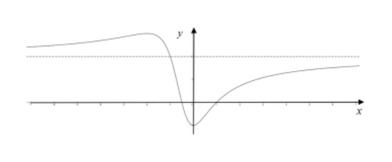
(c) Sketch C, stating the coordinates of the intersections with the axes.
(3)
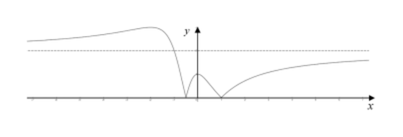
(d) Sketch the curve with equation y=x2+x+12x2−x−1 and state the set of values of k for which x2+x+12x2−x−1=k has 4 distinct real solutions.
(2)
题目中文翻译
曲线 C 的方程为 y=x2+x+12x2−x−1。
(a) 证明 C 没有竖直渐近线,并写出 C 的水平渐近线方程。
(3)
(b) 求 C 上驻点的坐标。
(4)
(c) 画出 C 的草图,并写出曲线与坐标轴交点的坐标。
(3)
(d) 画出方程为 y=x2+x+12x2−x−1 的曲线的草图,并写出使方程 x2+x+12x2−x−1=k 有 4 个不同实数解的 k 的取值集合。
(2)
原卷通用作答要求
Answer all questions. You should use a calculator where appropriate.
You must show all necessary working clearly; no marks will be given for unsupported answers from a calculator.
Give non-exact numerical answers correct to 3 significant figures, or 1 decimal place for angles in degrees, unless a different level of accuracy is specified in the question.
The denominator is positive. Thus stationary points occur at x=−2 and x=0. Substitution gives
y(−2)=4−2+18+2−1=3,y(0)=−1.
The derivative is positive for x<−2, negative for −2<x<0, and positive for x>0. Therefore the stationary points are
(−2,3) (maximum),(0,−1) (minimum).
解法二
思路
展开
另把曲线改写成关于 x 的二次方程。驻点对应水平线与曲线相切,即二次方程有重根。
答题过程
展开
Rearrange the curve equation as
F(x,y)=(y−2)x2+(y+1)x+(y+1)=0.
Here Fy=x2+x+1>0. Implicit differentiation gives Fx+Fydy/dx=0, so at a stationary point Fx=0 as well as F=0.
For y=2, this means the quadratic in x has a repeated root. Its discriminant is
Δ==(y+1)2−4(y−2)(y+1)−3(y+1)(y−3).
Thus Δ=0 gives y=−1 or y=3. For y=−1, the equation is −3x2=0, giving x=0. For y=3, it is (x+2)2=0, giving x=−2.
The exceptional value y=2 gives F=3x+3 and Fx=3=0, so it supplies no stationary point. Hence the stationary points are
(0,−1),(−2,3).
(c)
解法一
思路
展开
结合渐近线、驻点和截距作图,并检查从水平渐近线的哪一侧接近。
答题过程
展开
For the x-intercepts,
2x2−x−1=(2x+1)(x−1)=0.
Hence the axis intersections are
(−21,0),(1,0),(0,−1).
Also,
y−2=x2+x+1−3(x+1).
The curve approaches y=2 from above as x→−∞, rises to (−2,3), then falls through (−1,2) and (−1/2,0) to (0,−1). It then rises through (1,0) towards y=2 from below as x→∞.
(d)
解法一
思路
展开
绝对值只把横轴下方的一段反射到上方。数水平线与反射后曲线的交点,注意中央峰顶只能算一个交点。
答题过程
展开
Reflect the portion −1/2<x<1 of C in the x-axis, leaving the rest unchanged. The reflected curve has cusps at (−1/2,0) and (1,0), a central maximum at (0,1), and the unchanged maximum at (−2,3). Its horizontal asymptote remains y=2.
For 0<k<1, the line y=k meets the central arch twice and the two outer portions once each, giving four distinct intersections. At k=0 there are only the two cusps, and at k=1 the two central intersections merge. For k>1 there are no central intersections, and the outer portions together give at most two. Negative k gives no intersection.