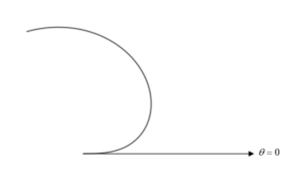
The curve C has polar equation r2=tan−1(21θ), where 0≤θ≤2.
(a) Sketch C and state, in exact form, the greatest distance of a point on C from the pole.
(3)
(b) Find the exact value of the area of the region bounded by C and the half-line θ=2.
(5)
Now consider the part of C where 0≤θ≤21π.
(c) Show that, at the point furthest from the half-line θ=21π,
(θ2+4)tan−1(21θ)sinθ−cosθ=0
and verify that this equation has a root between 0.6 and 0.7.
(5)
题目中文翻译
曲线 C 的极坐标方程为 r2=tan−1(21θ),其中 0≤θ≤2。
(a) 画出 C 的草图,并用精确形式写出 C 上的点到极点的最大距离。
(3)
(b) 求由 C 与射线 θ=2 所围区域面积的精确值。
(5)
现在考虑 C 上满足 0≤θ≤21π 的部分。
(c) 证明在距离射线 θ=21π 最远的点处,
(θ2+4)tan−1(21θ)sinθ−cosθ=0
并验证此方程在 0.6 与 0.7 之间有一个根。
(5)
原卷通用作答要求
Answer all questions. You should use a calculator where appropriate.
You must show all necessary working clearly; no marks will be given for unsupported answers from a calculator.
Give non-exact numerical answers correct to 3 significant figures, or 1 decimal place for angles in degrees, unless a different level of accuracy is specified in the question.
As θ increases from 0 to 2, tan−1(θ/2) increases from 0 to π/4. The curve starts at the pole on the positive initial line, curves anticlockwise through the first quadrant, and ends in the second quadrant on the half-line θ=2.
Since r≥0, its greatest distance from the pole is
rmax=tan−1(1)=2π.
Near the pole, r2∼θ/2, so x∼θ/2 and y∼θθ/2, giving y∼2x3. Thus the initial tangent is horizontal. For θ>0,
dxdy=r′=r′cosθ−rsinθr′sinθ+rcosθ,r(θ2+4)1.
At θ=2, this gradient is
cos2−2πsin2sin2+2πcos2≈0.278>0.
The endpoint tangent therefore slopes upwards to the right. Label the maximum radius at this endpoint and mark the initial line and the half-line θ=2.
(b)
解法一
思路
展开
极坐标面积要积 r2。反正切的积分用分部积分,剩下的一项可直接识别成对数导数。
答题过程
展开
The required area is
A=21∫02tan−1(2θ)dθ.
Integrate by parts, taking u=tan−1(θ/2) and dv=dθ. Then