Skip to content
CalcGospel 國際數學圖譜
返回

CIE 9231 2022 June Paper 13 Q6

A Level / CIE / FP1

CIE 9231 2022 June Paper 13 Paper · Question 6

题目

Problem

The curve CC has Cartesian equation x2+xy+y2=ax^2+xy+y^2=a, where aa is a positive constant.

(a) Show that the polar equation of CC is r2=2a2+sin⁡2θr^2=\dfrac{2a}{2+\sin2\theta}.

(3)

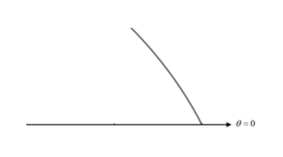
(b) Sketch the part of CC for 0≤θ≤14π0\le\theta\le\frac14\pi.

(2)

The region RR is enclosed by this part of CC, the initial line and the half-line θ=14π\theta=\frac14\pi.

(c) It is given that sin⁡2θ\sin2\theta may be expressed as 2tan⁡θ1+tan⁡2θ\dfrac{2\tan\theta}{1+\tan^2\theta}. Use this result to show that the area of RR is

12a∫0π/41+tan⁡2θ1+tan⁡θ+tan⁡2θ dθ\frac12a\int_0^{\pi/4}\frac{1+\tan^2\theta}{1+\tan\theta+\tan^2\theta}\,\mathrm d\theta

and use the substitution t=tan⁡θt=\tan\theta to find the exact value of this area.

(8)
题目中文翻译

曲线 CC 的直角坐标方程为 x2+xy+y2=ax^2+xy+y^2=a,其中 aa 是正常数。

(a) 证明 CC 的极坐标方程为 r2=2a2+sin⁡2θr^2=\dfrac{2a}{2+\sin2\theta}。

(3)

(b) 画出 CC 在 0≤θ≤14π0\le\theta\le\frac14\pi 范围内的部分的草图。

(2)

区域 RR 由 CC 的这一部分、极轴和射线 θ=14π\theta=\frac14\pi 围成。

(c) 已知 sin⁡2θ\sin2\theta 可表示为 2tan⁡θ1+tan⁡2θ\dfrac{2\tan\theta}{1+\tan^2\theta}。利用这个结果,证明 RR 的面积为

12a∫0π/41+tan⁡2θ1+tan⁡θ+tan⁡2θ dθ\frac12a\int_0^{\pi/4}\frac{1+\tan^2\theta}{1+\tan\theta+\tan^2\theta}\,\mathrm d\theta

并利用代换 t=tan⁡θt=\tan\theta 求此面积的精确值。

(8)
原卷通用作答要求

Answer all questions. You should use a calculator where appropriate.

You must show all necessary working clearly; no marks will be given for unsupported answers from a calculator.

Give non-exact numerical answers correct to 3 significant figures, or 1 decimal place for angles in degrees, unless a different level of accuracy is specified in the question.

请回答所有题目。适当时应使用计算器。必须清楚展示所有必要的计算过程;仅给出计算器答案而没有过程,不予评分。除非题目另有精度要求,非精确数值答案保留 3 位有效数字,以度为单位的角度保留 1 位小数。

解答

(a)

解法一

思路

展开

代入 x=rcos⁡θx=r\cos\theta、y=rsin⁡θy=r\sin\theta,用平方和与二倍角恒等式消去直角坐标。

答题过程

展开

Substituting x=rcos⁡θx=r\cos\theta, y=rsin⁡θy=r\sin\theta into x2+xy+y2=ax^2+xy+y^2=a gives

 r2cos⁡2θ+r2sin⁡θcos⁡θ +r2sin⁡2θ=a,r2(1+sin⁡θcos⁡θ)= a,r2(1+12sin⁡2θ)= a.\begin{align*} &\,r^2\cos^2\theta+r^2\sin\theta\cos\theta\\[4mm] &\,\hspace{2pt}+r^2\sin^2\theta=a,\\[4mm] r^2(1+\sin\theta\cos\theta)=&\,a,\\[4mm] r^2\bigg(1+\frac12\sin2\theta\bigg)=&\,a. \end{align*}

Therefore

r2=2a2+sin⁡2θ.\boxed{r^2=\frac{2a}{2+\sin2\theta}}.

(b)

解法一

思路

展开

曲线是第一象限内的一段椭圆弧,半径严格递减。端点切线既不能随意画成水平,也不能画成竖直。

答题过程

展开

As θ\theta increases from 00 to π/4\pi/4, sin⁡2θ\sin2\theta increases from 00 to 11, so rr decreases strictly from a\sqrt a to 2a/3\sqrt{2a/3}. The endpoints in Cartesian coordinates are

 (a,0), (a3,a3).\begin{align*} &\,(\sqrt a,0),\\[4mm] &\,\bigg(\sqrt{\frac a3},\sqrt{\frac a3}\bigg). \end{align*}

Implicit differentiation of x2+xy+y2=ax^2+xy+y^2=a gives

dydx=−2x+yx+2y,\frac{\mathrm{d}y}{\mathrm{d}x}=-\frac{2x+y}{x+2y},

so the endpoint gradients are −2-2 and −1-1 respectively. The arc slopes downwards to the right and is concave down; indeed d2y/dx2=−6a/(x+2y)3<0\mathrm{d}^2y/\mathrm{d}x^2=-6a/(x+2y)^3<0 in this quadrant. Draw only the arc between the initial line and θ=π/4\theta=\pi/4, marking the pole and these bounding rays.

(c)

解法一

思路

展开

先将极坐标面积式化成题目指定形式,再完整替换积分上下限。分母配方后使用反正切积分。

答题过程

展开

The polar area formula and part (a) give

R= 12∫0π/4r2 dθ= a∫0π/412+sin⁡2θ dθ= a2∫0π/411+tan⁡θ1+tan⁡2θ dθ= a2∫0π/41+tan⁡2θ1+tan⁡θ+tan⁡2θ dθ,\begin{align*} R=&\,\frac12\int_0^{\pi/4}r^2\,\mathrm{d}\theta\\[4mm] =&\,a\int_0^{\pi/4}\frac1{2+\sin2\theta}\,\mathrm{d}\theta\\[4mm] =&\,\frac a2\int_0^{\pi/4}\frac1{1+\frac{\tan\theta}{1+\tan^2\theta}}\,\mathrm{d}\theta\\[4mm] =&\,\frac a2\int_0^{\pi/4}\frac{1+\tan^2\theta}{1+\tan\theta+\tan^2\theta}\,\mathrm{d}\theta, \end{align*}

as required. Now let t=tan⁡θt=\tan\theta. Then dt=(1+tan⁡2θ) dθ\mathrm{d}t=(1+\tan^2\theta)\,\mathrm{d}\theta, and the limits are t=0,1t=0,1. Thus

R= a2∫011t2+t+1 dt= a2∫011(t+1/2)2+3/4 dt= a3[tan⁡−1(2t+13)]01= a3(π3−π6)= πa63.\begin{align*} R=&\,\frac a2\int_0^1\frac1{t^2+t+1}\,\mathrm{d}t\\[4mm] =&\,\frac a2\int_0^1\frac1{(t+1/2)^2+3/4}\,\mathrm{d}t\\[4mm] =&\,\frac a{\sqrt3}\bigg[\tan^{-1}\bigg(\frac{2t+1}{\sqrt3}\bigg)\bigg]_0^1\\[4mm] =&\,\frac a{\sqrt3}\bigg(\frac\pi3-\frac\pi6\bigg)\\[4mm] =&\,\boxed{\frac{\pi a}{6\sqrt3}}. \end{align*}