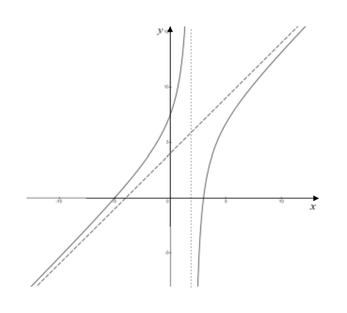
(c) Sketch C, stating the coordinates of the intersections with the axes.
(3)
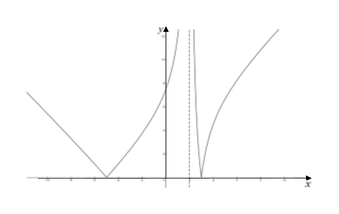
(d) Sketch the curve with equation y=x−2x2−2x−15.
(2)
(e) Find the set of values of x for which x−22x2+4x−30<15.
(4)
题目中文翻译
曲线 C 的方程为 y=x−2x2+2x−15。
(a) 求 C 的渐近线方程。
(3)
(b) 证明 C 没有驻点。
(3)
(c) 画出 C 的示意图,并写出它与坐标轴的交点坐标。
(3)
(d) 画出方程为 y=x−2x2−2x−15 的曲线的示意图。
(2)
(e) 求满足 x−22x2+4x−30<15 的 x 的取值集合。
(4)
原卷通用作答要求
Answer all questions. You should use a calculator where appropriate.
You must show all necessary working clearly; no marks will be given for unsupported answers from a calculator.
Give non-exact numerical answers correct to 3 significant figures, or 1 decimal place for angles in degrees, unless a different level of accuracy is specified in the question.
A stationary point would require x2−4x+11=0. Its discriminant is (−4)2−4(11)=−28<0, so there are no real solutions and no stationary points.
(c)
解法一
思路
展开
求三处轴交点,再用余项符号判断两支相对斜渐近线的位置;两支都严格上升。
答题过程
展开
Since x2+2x−15=(x+5)(x−3), the intercepts are
(−5,0),(3,0),(0,15/2).
Label x=2 and y=x+4. For x<2, sketch an increasing branch above the oblique asymptote, passing through (−5,0) and (0,15/2) and tending to +∞ as x→2−. For x>2, sketch an increasing branch below the oblique asymptote, tending from −∞ as x→2+ through (3,0) and then to +∞.
Under the +2x interpretation identified in the warning above, sketch
y=x−2x2+2x−15.
Reflect the portions of C below the x-axis in that axis, keeping the other portions unchanged.
The graph has sharp minima at (−5,0) and (3,0), passes through (0,15/2) and tends to +∞ on both sides of x=2. Its outer asymptotes are y=−x−4 as x→−∞ and y=x+4 as x→+∞.
(e)
解法一
思路
展开
先将绝对值式化成原函数在正负二分之十五之间的条件,分别求两条水平边界的交点,再按两支单调性判区间。
答题过程
展开
Let f(x)=x−2x2+2x−15 for x=2. The inequality is equivalent to
−215<f(x)<215.
For the upper boundary,
f(x)=215⟹⟹2x2+4x−30=15x−30x(2x−11)=0,
giving x=0,11/2.
For the lower boundary,
f(x)=−215⟹⟹2x2+4x−30=−15x+30(x+12)(2x−5)=0,
giving x=−12,5/2.
Since f is strictly increasing on each side of x=2, the values between the two horizontal levels occur for
−12<x<0or25<x<211.
All endpoints are excluded because the inequality is strict; neither interval includes x=2.