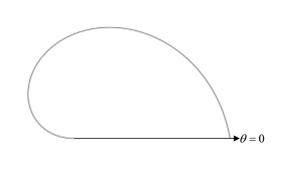
The curve C has polar equation r2=(π−θ)tan−1(π−θ), for 0⩽θ⩽π.
(a) Sketch C and state the polar coordinates of the point of C furthest from the pole.
(3)
(b) Using the substitution u=π−θ, or otherwise, find the area of the region enclosed by C and the initial line.
(7)
(c) Show that, at the point of C furthest from the initial line,
2(π−θ)tan−1(π−θ)cotθ−1+(π−θ)2π−θ−tan−1(π−θ)=0
and verify that this equation has a root for θ between 1.2 and 1.3.
(5)
题目中文翻译
曲线 C 的极坐标方程为 r2=(π−θ)tan−1(π−θ),其中 0⩽θ⩽π。
(a) 画出 C 的草图,并写出 C 上距离极点最远的点的极坐标。
(3)
(b) 使用代换 u=π−θ 或其他方法,求 C 与极轴所围区域的面积。
(7)
(c) 证明:在 C 上距离极轴最远的点处,
2(π−θ)tan−1(π−θ)cotθ−1+(π−θ)2π−θ−tan−1(π−θ)=0
并验证这个方程在 θ 为 1.2 与 1.3 之间时有一个根。
(5)
原卷通用作答要求
Answer all questions. You should use a calculator where appropriate.
You must show all necessary working clearly; no marks will be given for unsupported answers from a calculator.
Give non-exact numerical answers correct to 3 significant figures, or 1 decimal place for angles in degrees, unless a different level of accuracy is specified in the question.
Thus r decreases as θ increases from 0 to π. Sketch an upper-half-plane curve starting on the positive initial line at r=πtan−1π, passing across the positive y-axis and into the second quadrant, then reaching the pole at θ=π with tangent along the initial line.
The furthest point from the pole has polar coordinates
(πtan−1π,0)(≈(1.99,0)).
(b)
解法一
思路
展开
极坐标面积先换元为u乘反正切u的积分,再用分部积分。剩余的有理式先拆成1减去标准反正切导数。
答题过程
展开
The required area is
A=21∫0π(π−θ)tan−1(π−θ)dθ.
Using u=π−θ, dθ=−du, the limits change from (0,π) to (π,0), giving
A=21∫0πutan−1udu.
Integrating by parts with v=u2/2 and d(tan−1u)/du=1/(1+u2),
The perpendicular distance from the initial line is y=rsinθ. At both endpoints it is zero, and it is positive for 0<θ<π. Hence the furthest point lies in the interior, where r>0 and sinθ>0.
Setting its derivative to zero,
dθdrsinθ+rcosθ=0.
Multiply by 2r/sinθ and substitute the expressions above:
2utan−1ucotθ−1+u2u−tan−1u=0.
Thus, with u=π−θ,
2(π−θ)tan−1(π−θ)cotθ−1+(π−θ)2π−θ−tan−1(π−θ)=0,
as required.
Let F(θ) denote the left-hand side. In radians,
F(1.2)=F(1.3)=0.1511598…>0,−0.3951967…<0.
The function is continuous on [1.2,1.3], so there is a root in (1.2,1.3).