
题目
The curve has equation , where .
(a) Find the equations of the asymptotes of .
(b) Show that has no stationary points.
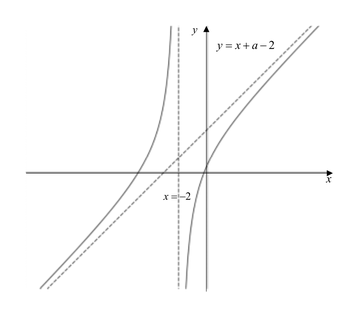
(c) Sketch , stating the coordinates of the point of intersection with the -axis and labelling the asymptotes.
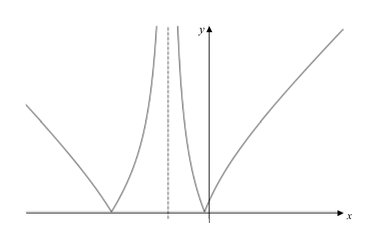
(d) (i) Sketch the curve with equation .
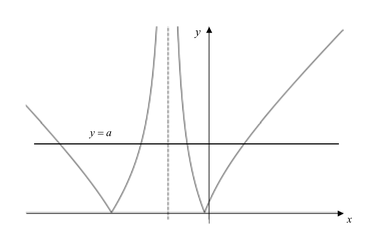
(ii) On your sketch in part (i), draw the line .
(iii) It is given that for and .
Find the value of .
题目中文翻译
曲线 的方程为 ,其中 。
(a) 求 的渐近线方程。
(b) 证明 没有驻点。
(c) 画出 的草图,写出它与 轴交点的坐标,并标明渐近线。
(d) (i) 画出方程为 的曲线的草图。
(ii) 在 (i) 的草图上画出直线 。
(iii) 已知当 以及 时,。
求 的值。
原卷通用作答要求
Answer all questions. You should use a calculator where appropriate.
You must show all necessary working clearly; no marks will be given for unsupported answers from a calculator.
Give non-exact numerical answers correct to 3 significant figures, or 1 decimal place for angles in degrees, unless a different level of accuracy is specified in the question.
请回答所有题目。适当时应使用计算器。必须清楚展示所有必要的计算过程;仅给出计算器答案而没有过程,不予评分。除非题目另有精度要求,非精确数值答案保留 3 位有效数字,以度为单位的角度保留 1 位小数。
解答
(a)
解法一
思路
展开
多项式除法分出斜渐近线与余项。参数条件确保x=−2处分子不为零。
答题过程
展开
Division gives
Since , the remainder is nonzero. Therefore the asymptotes are
(b)
解法一
思路
展开
从除法结果求导,参数条件使额外的分式为正,导数恒大于1。
答题过程
展开
Differentiating the expression in (a),
For , the denominator is positive and . Hence , so has no stationary points.
解法二
思路
展开
也可从商法则得到导数分子的二次式,证明其判别式为负,因此没有导数为零的实数点。
答题过程
展开
The quotient rule gives
A stationary point would require . Its discriminant is
since . Thus there are no real solutions and no stationary points.
(c)
解法一
思路
展开
两支都严格上升。余项符号决定左支在斜渐近线上方、右支在下方;横轴交点分居竖直渐近线两侧。
答题过程
展开
At , , so the required -intercept is .
Label the asymptotes and . Sketch two increasing branches:
- For , the curve lies above the oblique asymptote and rises from to as .
- For , it lies below the oblique asymptote, rising from as , through , and onwards to .
The -intercepts are , with . Both tails approach the oblique asymptote. Its intersection with the vertical asymptote is , whose height depends on .
(d)(i)
解法一
思路
展开
把原曲线横轴以下的部分向上反射,横轴以上不变。两个原横轴交点成为尖点,竖直渐近线两侧都趋于正无穷。
答题过程
展开
Reflect the negative parts of in the -axis, retaining the nonnegative parts.
The graph has sharp minima at and , where . The -intercept remains , and both sides tend to at .
At the far left the graph approaches ; at the far right it approaches .
(d)(ii)
解法一
思路
展开
a大于二分之五,所以水平线在纵轴截距上方,并与两个尖点的两侧各交一次。
答题过程
展开
On the sketch from (i), draw the horizontal line . Since , it lies above and intersects the four arms once each.
(d)(iii)
解法一
思路
展开
利用已知右端点3对应曲线与水平线的交点,先求a,再核对其余三个端点,保证没有误用正负分支。
答题过程
展开
At the rightmost boundary , the original function is positive, so
Thus , giving .
To check all endpoints, when the equations and become, respectively,
Their roots are and . They are ordered
Using the two reflected minima from (i), the regions below are exactly
matching the given intervals; is valid.