题目
Problem
The curve C has polar equation r=θe81θ, for 0⩽θ⩽2π.
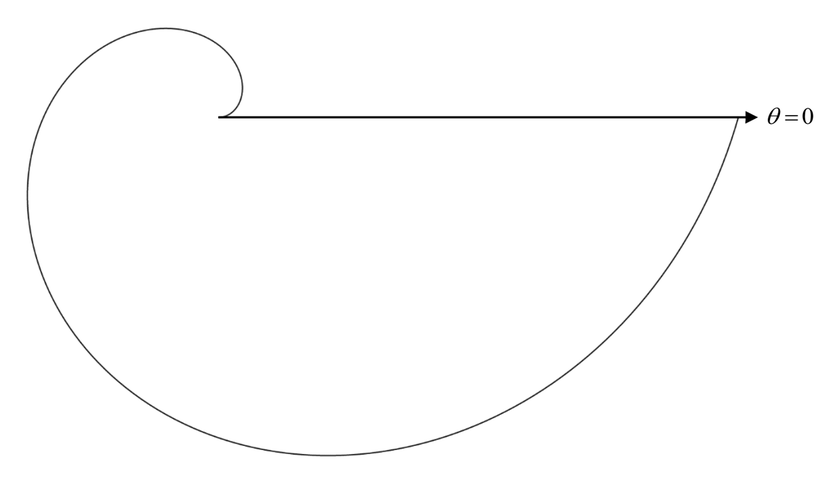
(a) Sketch C.
(2)
(b) Find the area of the region bounded by C and the initial line, giving your answer in the form
(pπ2+qπ+r)e21π+s,
where p, q, r and s are integers to be determined.
(6)
(c) Show that, at the point of C furthest from the initial line,
θcosθ+(81θ+1)sinθ=0
and verify that this equation has a root between 5 and 5.05.
(5)
题目中文翻译
曲线 C 的极坐标方程为 r=θe81θ,其中 0⩽θ⩽2π。
(a) 画出 C 的草图。
(2)
(b) 求由 C 与极轴围成的区域的面积,答案写成
(pπ2+qπ+r)e21π+s
的形式,其中 p、q、r 和 s 为待求的整数。
(6)
(c) 证明:在 C 上距离极轴最远的点处,
θcosθ+(81θ+1)sinθ=0,
并验证该方程在 5 与 5.05 之间有一个根。
(5)
原卷通用作答要求
Answer all questions. You should use a calculator where appropriate.
You must show all necessary working clearly; no marks will be given for unsupported answers from a calculator.
Give non-exact numerical answers correct to 3 significant figures, or 1 decimal place for angles in degrees, unless a different level of accuracy is specified in the question.
请回答所有题目。适当时应使用计算器。必须清楚展示所有必要的计算过程;仅给出计算器答案而没有过程,不予评分。除非题目另有精度要求,非精确数值答案保留 3 位有效数字,以度为单位的角度保留 1 位小数。
解答
(a)
解法一
思路
展开
半径严格递增,角度从0走到2π,画一圈向外展开的螺线,并标清起终点的初始线交点。
答题过程
展开
Since
dθdr=eθ/8(1+θ/8)>0,
the radius increases strictly as θ increases. Sketch one anticlockwise turn of an outward spiral, beginning at the pole when θ=0 and ending on the positive initial line at r=2πeπ/4 when θ=2π.
The curve is tangent to the initial line at the pole and crosses it obliquely at its final point. Mark the pole and initial line.
(b)
解法一
思路
展开
面积积分中要先平方r,所以指数变为θ/4。分部积分两次,并在最后代上下限。
答题过程
展开
The area is
A=21∫02πθ2eθ/4dθ.
For the first integration by parts,
=∫θ2eθ/4dθ4θ2eθ/4−8∫θeθ/4dθ.
For the remaining integral,
∫θeθ/4dθ==4θeθ/4−4∫eθ/4dθ4θeθ/4−16eθ/4+C.
Therefore
A==[(2θ2−16θ+64)eθ/4]02π(8π2−32π+64)eπ/2−64.
Thus p=8, q=−32, r=64, s=−64.
(c)
解法一
思路
展开
离初始线的垂直距离是纵坐标的绝对值。最大距离在非零纵坐标的内点出现,因此可令纵坐标导数为零。
答题过程
展开
The signed vertical coordinate is
y=rsinθ=θeθ/8sinθ.
The distance from the initial line is ∣y∣. It is zero at the endpoints and at θ=π, so its positive global maximum occurs at an interior point with y=0. At such a point dy/dθ=0.
Differentiating,
dθdy=θeθ/8cosθ+eθ/8(1+8θ)sinθ.
Since the exponential factor is positive, the required condition is
θcosθ+(1+θ/8)sinθ=0,
as required.
Let f(θ) be the left-hand side. In radians,
f(5)=f(5.05)=−0.1399410190…,0.1335675315….
The function is continuous, so the change of sign verifies a root between 5 and 5.05.
