(b) Find the coordinates of any stationary points on C.
(4)
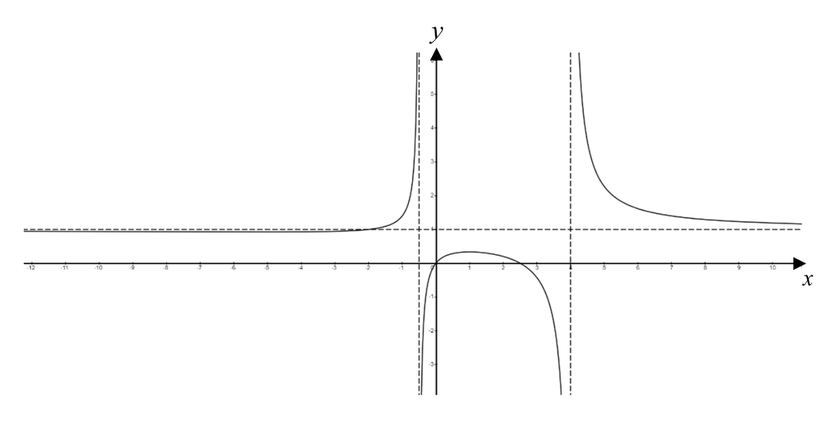
(c) Sketch C, stating the coordinates of the intersections with the axes.
(3)
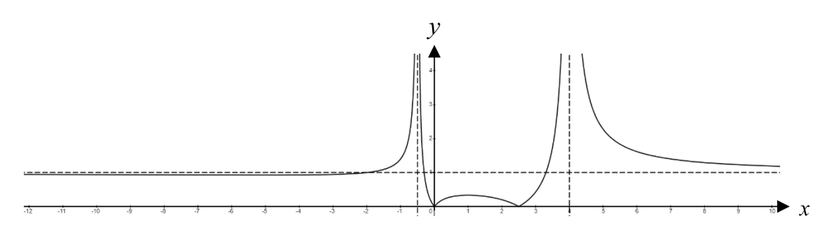
(d) Sketch the curve with equation y=2x2−7x−42x2−5x.
(1)
(e) Find in exact form the set of values of x for which 2x2−7x−42x2−5x<91.
(5)
题目中文翻译
曲线 C 的方程为 y=2x2−7x−42x2−5x。
(a) 求 C 的渐近线方程。
(2)
(b) 求 C 上所有驻点的坐标。
(4)
(c) 画出 C 的草图,并写出它与坐标轴交点的坐标。
(3)
(d) 画出方程为 y=2x2−7x−42x2−5x 的曲线的草图。
(1)
(e) 求满足 2x2−7x−42x2−5x<91 的 x 的取值集合,用精确形式表示。
(5)
原卷通用作答要求
Answer all questions. You should use a calculator where appropriate.
You must show all necessary working clearly; no marks will be given for unsupported answers from a calculator.
Give non-exact numerical answers correct to 3 significant figures, or 1 decimal place for angles in degrees, unless a different level of accuracy is specified in the question.
The derivative changes from negative to positive at −5 and from positive to negative at 1, so these are a local minimum and local maximum, respectively.
(c)
解法一
思路
展开
除两条竖直渐近线外,还要标明曲线与水平渐近线的交点,左支的极小值略低于1。
答题过程
展开
The axis intersections are (0,0) and (5/2,0). Also
y−1=2x2−7x−42x+4,
so the curve crosses y=1 at (−2,1).
Sketch three branches, labelling x=−1/2, x=4 and y=1:
On x<−1/2, the branch approaches 1 from below as x→−∞, has a minimum at (−5,25/27), crosses (−2,1) and tends to +∞ as x→(−1/2)−.
On −1/2<x<4, it tends to −∞ at both ends, crosses (0,0), rises to the maximum (1,1/3), then falls through (5/2,0).
On x>4, it decreases from +∞ towards 1 from above.
(d)
解法一
思路
展开
把两个横轴下方的区间反射到上方,两个原横轴交点都形成尖点。
答题过程
展开
Reflect the portions with −1/2<x<0 and 5/2<x<4 in the x-axis. Leave the remaining portions unchanged.
The transformed graph lies on or above the x-axis, has sharp minima at (0,0) and (5/2,0), and retains the vertical asymptotes x=−1/2, x=4 and horizontal asymptote y=1.
Write N=2x2−5x and D=2x2−7x−4=0. The boundary equations are
DN=91⟺DN=−91⟺16x2−38x+4=0,20x2−52x−4=0.
Their roots are, respectively,
a±=b±=1619±333,1013±321.
Since both sides of ∣N/D∣<1/9 are non-negative, squaring and multiplying by 81D2>0 is valid. It gives
(9N−D)(9N+D)<0,
or
(16x2−38x+4)(20x2−52x−4)<0.
The four simple roots are ordered b−<a−<a+<b+. The product has positive leading coefficient, so it is negative between the first two and the last two roots. Neither interval contains x=−1/2 or x=4.