
题目
The curve has polar equation , for .
(a) Find the polar coordinates of the point on that is furthest from the pole, giving your answers correct to decimal places.
(b) Find the polar coordinates of the point on that is furthest from the half-line , giving your answers correct to decimal places.
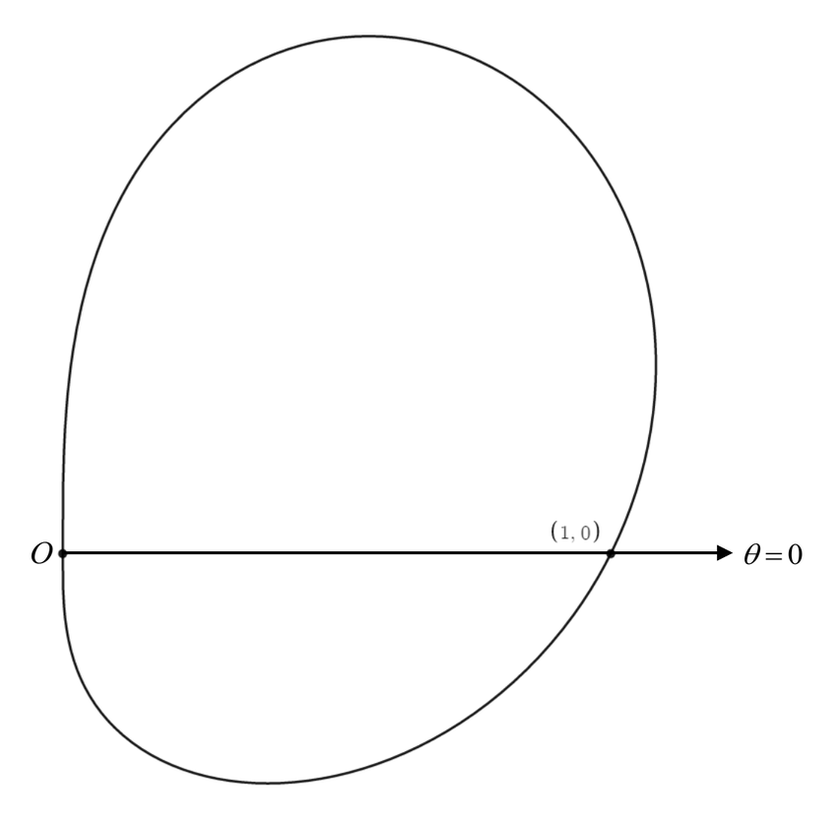
(c) Sketch .
(d) Find the area of the region bounded by , giving your answer in exact form.
题目中文翻译
曲线 的极坐标方程为 ,其中 。
(a) 求 上距离极点最远的点的极坐标,答案精确到小数点后 位。
(b) 求 上距离射线 最远的点的极坐标,答案精确到小数点后 位。
(c) 画出 的草图。
(d) 求 所围区域的面积,答案用精确形式表示。
原卷通用作答要求
Answer all questions. You should use a calculator where appropriate.
You must show all necessary working clearly; no marks will be given for unsupported answers from a calculator.
Give non-exact numerical answers correct to 3 significant figures, or 1 decimal place for angles in degrees, unless a different level of accuracy is specified in the question.
请回答所有题目。适当时应使用计算器。必须清楚展示所有必要的计算过程;仅给出计算器答案而没有过程,不予评分。除非题目另有精度要求,非精确数值答案保留 3 位有效数字,以度为单位的角度保留 1 位小数。
解答
(a)
解法一
思路
展开
最大半径也对应最大半径平方。对r平方求导,化成sinθ的二次方程,舍掉范围外的根。
答题过程
展开
Let . Then
At a maximum,
Thus . Rejecting the value less than ,
The derivative is positive before this angle and negative afterwards, while at both endpoints. Substitution gives .
Hence the polar coordinates, to decimal places, are
(b)
解法一
思路
展开
到竖直方向的垂直距离是横坐标。对x平方求导可避免根号;最后仍要回求极坐标中的r,而不是把x当作r。
答题过程
展开
The horizontal coordinate is . Its square is
Differentiating,
At the interior maximum,
Solving gives
The other quadratic root is outside . Hence , and substitution into the polar equation gives .
The derivative changes from positive to negative at this point. For , distance from the upward half-line is at most , whereas this point in the upper half-plane has . Thus it also gives the greatest distance from the stated half-line.
The polar coordinates to decimal places are
(c)
解法一
思路
展开
曲线在右半平面,从极点出发再回到极点,上半部比下半部大。标初始线交点及极点处竖直切向。
答题过程
展开
At , , while at the point is . Since and , the curve lies entirely in the right half-plane.
Sketch a single closed loop through the pole and , with more of the loop above the initial line than below it. Both approaches to the pole have vertical tangent direction. At the tangent has positive gradient; in fact there. The rightmost point corresponds to (b), and the point with greatest radius to (a).
(d)
解法一
思路
展开
极坐标面积积分恰好是e的sinθ次方乘cosθ,直接识别复合函数的导数。
答题过程
展开
The enclosed area is