(b) Show that, for all real values of x, −717⩽y<1.
(4)
(c) Find the coordinates of any stationary points of C.
(3)
(d) Sketch C, stating the coordinates of the intersections with the axes.
(3)
(e) Sketch the graph with equation y=∣x∣2+∣x∣+2∣x∣2+∣x∣−4 and find the set of values of x for which
∣x∣2+∣x∣+2∣x∣2+∣x∣−4<−21.
(5)
题目中文翻译
曲线 C 的方程为 y=x2+x+2x2+x−4。
(a) 写出 C 的渐近线方程。
(1)
(b) 证明:对所有实数 x,−717⩽y<1。
(4)
(c) 求 C 上所有驻点的坐标。
(3)
(d) 画出 C 的草图,并写出它与坐标轴交点的坐标。
(3)
(e) 画出方程为 y=∣x∣2+∣x∣+2∣x∣2+∣x∣−4 的图像,并求满足
∣x∣2+∣x∣+2∣x∣2+∣x∣−4<−21
的 x 的取值集合。
(5)
原卷通用作答要求
Answer all questions. You should use a calculator where appropriate.
You must show all necessary working clearly; no marks will be given for unsupported answers from a calculator.
Give non-exact numerical answers correct to 3 significant figures, or 1 decimal place for angles in degrees, unless a different level of accuracy is specified in the question.
The value y=1 would give 6=0, so is impossible. For any other attainable value of y, this quadratic has a real root, hence
Δ==(y−1)2−4(y−1)(2y+4)−(y−1)(7y+17)⩾0.
Therefore −717⩽y⩽1. Excluding the impossible value y=1 gives
−717⩽y<1.
解法二
思路
展开
改写成1减去正分式。分母配方得到最小值,正分式相应得到最大值,于是直接夹出值域。
答题过程
展开
Write
y=1−x2+x+26,
where
x2+x+2=(x+21)2+47⩾47.
It follows that
0<x2+x+26⩽724.
Subtracting from 1 gives
−717⩽y<1.
Equality at the lower bound occurs at x=−21; the upper bound is approached as ∣x∣→∞.
(c)
解法一
思路
展开
对1减正分式求导更简短。分母恒正,只有导数分子为零给出驻点。
答题过程
展开
Differentiating y=1−6/(x2+x+2),
dxdy=(x2+x+2)26(2x+1).
This is zero only when x=−21, giving y=−717. Thus the only stationary point is
(−21,−717).
The derivative changes from negative to positive there, so it is a minimum.
(d)
解法一
思路
展开
先求三个截距,结合最低点、对称轴和水平渐近线画图。分母配方显示曲线关于x=−1/2对称。
答题过程
展开
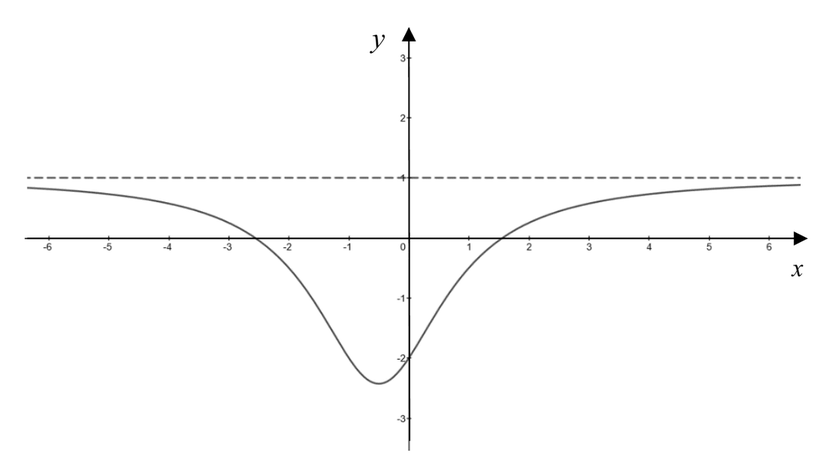
At x=0, y=−2. At an x-intercept the numerator vanishes:
x2+x−4=0⟹x=2−1±17.
Thus the intercepts are
(0,−2),(2−1−17,0),(2−1+17,0).
Sketch a smooth curve symmetric about x=−21, decreasing to (−21,−717) and then increasing. It approaches y=1 from below as x→±∞ and has no vertical asymptote.
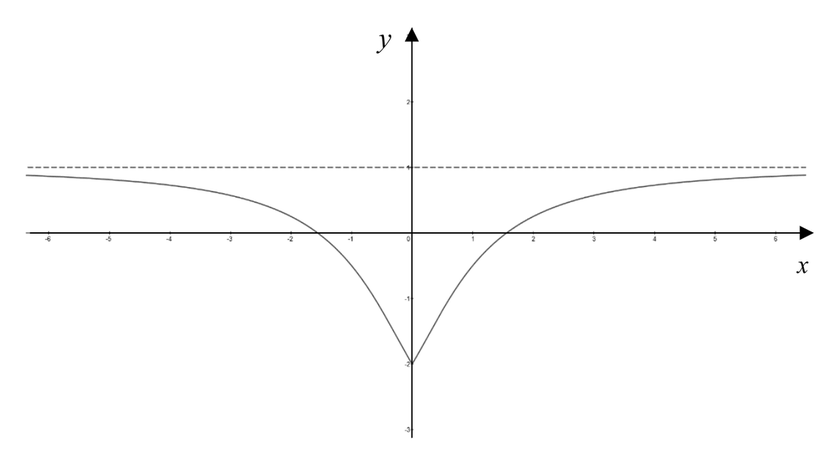
Let f(x)=(x2+x−4)/(x2+x+2). For y=f(∣x∣), keep the part of C with x⩾0 and reflect it in the y-axis.
The graph is symmetric about the y-axis, with minimum (0,−2) and intercepts
(0,−2),(±217−1,0).
It rises on each side away from the origin and tends to y=1 from below. Since f′(0)=23, its one-sided gradients at x=0 are −23 and 23, so there is a sharp corner at (0,−2).