
题目
The curve has equation .
(a) Find the equations of the asymptotes of .
(b) Find the coordinates of any stationary points on .
(c) Sketch .
(d) Sketch the curve with equation .
(e) Find in exact form the set of values of for which .
题目中文翻译
曲线 的方程为 。
(a) 求 的渐近线方程。
(b) 求 上所有驻点的坐标。
(c) 画出 的草图。
(d) 画出方程为 的曲线的草图。
(e) 求满足 的 值的集合,用精确形式表示。
原卷通用作答要求
Answer all questions. You should use a calculator where appropriate.
You must show all necessary working clearly; no marks will be given for unsupported answers from a calculator.
Give non-exact numerical answers correct to 3 significant figures, or 1 decimal place for angles in degrees, unless a different level of accuracy is specified in the question.
请回答所有题目。适当时应使用计算器。必须清楚展示所有必要的计算过程;仅给出计算器答案而没有过程,不予评分。除非题目另有精度要求,非精确数值答案保留 3 位有效数字,以度为单位的角度保留 1 位小数。
解答
(a)
解法一
思路
展开
先用多项式除法拆出直线和趋零的分式余项;分母为零而分子非零处给出竖直渐近线。
答题过程
展开
Since
we can write
The remainder term tends to zero as , giving the oblique asymptote .
At the denominator is zero but the numerator is , so the vertical asymptote is .
(b)
解法一
思路
展开
利用拆分后的形式求导,求驻点并代回原函数得到坐标。
答题过程
展开
Differentiating the expression in (a),
At a stationary point,
Substitution gives and . Thus the stationary points are
The derivative is positive for and , and negative for and . Hence is a local maximum and a local minimum.
(c)
解法一
思路
展开
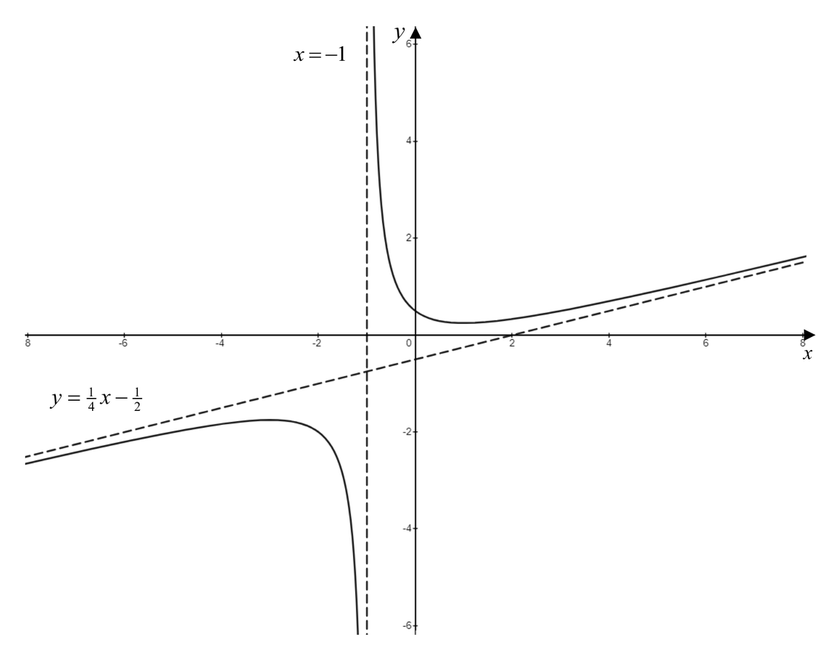
草图标清两条渐近线及驻点。分子恒正,因此左支全在横轴下方,右支全在横轴上方。
答题过程
展开
Sketch two branches with asymptotes and :
- For , the branch is below the oblique asymptote, has a smooth maximum at , and tends to as .
- For , the branch is above the oblique asymptote, tends to as , and has a smooth minimum at .
- Mark the -intercept . There are no -intercepts, since .
(d)
解法一
思路
展开
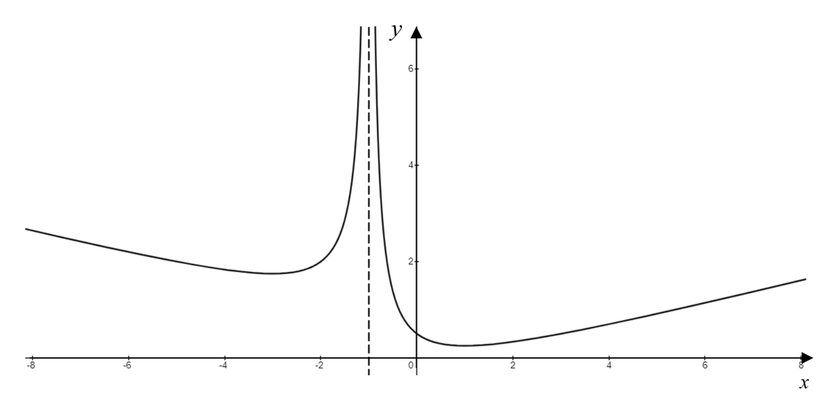
对整个函数取绝对值,保留横轴上方的右支,把横轴下方的左支反射到横轴上方。
答题过程
展开
Keep the branch for unchanged. Reflect the entire branch for in the -axis, so its maximum becomes a minimum .
Both branches are now above the -axis and tend to on their respective sides of . Retain the vertical asymptote . At the left-hand end the reflected oblique asymptote is ; at the right-hand end it remains .
(e)
解法一
思路
展开
按分母符号分左右两支。左支为负,只需解y>−2;右支为正,只需解y<2。乘负分母时必须反向不等号。
答题过程
展开
The numerator is positive for all real .
For , , so is equivalent to . Since ,
This gives , entirely within .
For , , so is equivalent to . Multiplying by the positive denominator,
Its roots are , so this gives the interval between them. The lower root is greater than .
Therefore the required set is