The curve C has polar equation r2=1+tan2θa for 0⩽θ<41π, where a is a positive constant.
(a) Show that, at the point on C furthest from the initial line,
cosθ−cos2θ(sin2θ+cos2θ)sinθ=0
and verify that this equation has a root between 0.5 and 0.6.
(6)
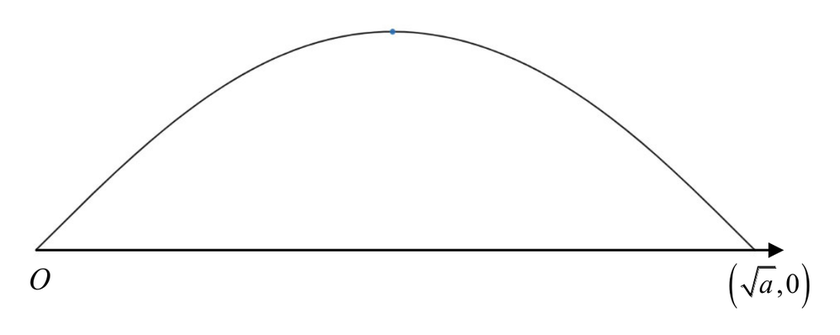
(b) Sketch C.
(2)
(c) Use the substitution v=tan2θ to show that the area enclosed by C and the initial line is
41a∫0∞(1+v)(1+v2)1dv
and find the exact value of this area.
(9)
题目中文翻译
曲线 C 的极坐标方程为 r2=1+tan2θa,其中 0⩽θ<41π,a 为正常数。
(a) 证明:在 C 上距离极轴最远的点处,
cosθ−cos2θ(sin2θ+cos2θ)sinθ=0
并验证此方程在 0.5 与 0.6 之间有一个根。
(6)
(b) 画出 C 的草图。
(2)
(c) 使用代换 v=tan2θ,证明 C 与极轴所围成的面积为
41a∫0∞(1+v)(1+v2)1dv
并求此面积的精确值。
(9)
原卷通用作答要求
Answer all questions. You should use a calculator where appropriate.
You must show all necessary working clearly; no marks will be given for unsupported answers from a calculator.
Give non-exact numerical answers correct to 3 significant figures, or 1 decimal place for angles in degrees, unless a different level of accuracy is specified in the question.
Using sec22θ/(1+tan2θ)=1/[cos2θ(sin2θ+cos2θ)] gives the required equation. Its left-hand side has values 0.2354162034… and −0.3785037476… at 0.5 and 0.6, respectively, and is continuous between them. Thus a root lies in (0.5,0.6).
(b)
解法一
思路
展开
曲线在第一象限,从初始线上的半径√a处出发,再向极点靠近;画出单一拱形及其水平最高点。
答题过程
展开
At θ=0, r=a, giving (a,0). As θ→π/4−, r→0, so the curve approaches the pole.
Sketch a single smooth arch in the first quadrant joining (a,0) towards O, above the initial line. Mark the initial line and pole clearly, with a horizontal tangent at the highest point identified in (a). The tangent at (a,0) has gradient −1; near the pole the tangent approaches gradient 1.
(c)
解法一
思路
展开
先用极坐标面积公式,再完整处理题目指定的代换和无穷上限。分式分解后积分,对数项先合并再取极限。
答题过程
展开
The area is
A==21∫0π/4r2dθ2a∫0π/41+tan2θ1dθ.
Set v=tan2θ. Then
dθdv=2sec22θ=2(1+v2).
Therefore
dθ=2(1+v2)dv.
When θ=0, v=0; as θ→π/4−, v→∞. Hence
A=4a∫0∞(1+v)(1+v2)1dv,
as required.
For partial fractions, write
(1+v)(1+v2)1=1+vC+1+v2Dv+E.
Equating coefficients in
1=C(1+v2)+(Dv+E)(1+v)
gives C+D=0, D+E=0, C+E=1, so C=E=1/2 and D=−1/2. Thus
(1+v)(1+v2)1=21(1+v1−1+v2v+1+v21).
Therefore
A=8aR→∞lim[ln(1+v)−21ln(1+v2)+tan−1v]0R.
Combine the logarithms before taking the limit:
ln(1+R)−21ln(1+R2)=ln1+R21+R⟶ln1=0.
Since tan−1R→π/2 and the lower endpoint contributes zero,