题目
The curve has equation , where
(a) Find the equations of the asymptotes of .
(b) Find the coordinates of any stationary points on , giving your answers correct to 1 decimal place.
(c) Sketch .
(d) Sketch the curve with equation and state the set of values for which .
题目中文翻译
曲线 的方程为 ,其中
(a) 求 的渐近线方程。
(b) 求 上所有驻点的坐标,答案精确到小数点后一位。
(c) 画出 的草图。
(d) 画出方程为 的曲线的草图,并写出满足 的值的集合。
原卷通用作答要求
Answer all questions. You should use a calculator where appropriate.
You must show all necessary working clearly; no marks will be given for unsupported answers from a calculator.
Give non-exact numerical answers correct to 3 significant figures, or 1 decimal place for angles in degrees, unless a different level of accuracy is specified in the question.
请回答所有题目。适当时应使用计算器。必须清楚展示所有必要的计算过程;仅给出计算器答案而没有过程,不予评分。除非题目另有精度要求,非精确数值答案保留 3 位有效数字,以度为单位的角度保留 1 位小数。
解答
(a)
解法一
思路
展开
分母有两个实零点且分子在两处都非零,因此有两条竖直渐近线。分子分母最高次项系数相同,水平渐近线为1。
答题过程
展开
The denominator is . The numerator equals at and at , so no factors cancel. Therefore the vertical asymptotes are
The ratio of the leading coefficients is , so the horizontal asymptote is .
(b)
解法一
思路
展开
商法则求导后令分子为零,求精确横坐标并代回,最后按题目要求保留一位小数。
答题过程
展开
By the quotient rule,
Thus the stationary points satisfy
The corresponding values are
Therefore, to decimal place, the stationary points are
(c)
解法一
思路
展开
先用函数减1确定与水平渐近线的交点及相对位置,再结合两条竖直渐近线画三支。
答题过程
展开
Since
the curve crosses the horizontal asymptote at . The numerator of is always positive because its discriminant is , so there are no -intercepts.
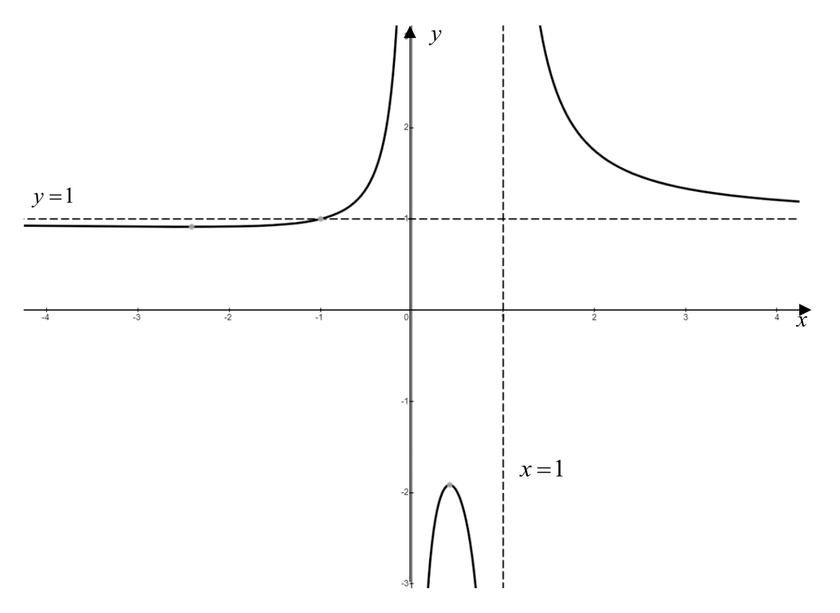
Sketch three branches, labelling , , :
- On , the branch approaches from below as , has a minimum near , crosses and tends to as .
- On , the branch is negative, tends to at both ends and has a maximum near .
- On , the branch decreases from to from above.