Skip to content
CalcGospel 國際數學圖譜
返回

CIE 9231 2026 June Paper 14 Q7

A Level / CIE / FP1

CIE 9231 2026 June Paper 14 Paper · Question 7

题目

Problem

(a) Show that the curve with Cartesian equation

(x2+y2)3/2=xy(x^2+y^2)^{3/2}=xy

has polar equation r=12sin⁡2θr=\frac12\sin2\theta.

(3)

The curves C1C_1 and C2C_2 have polar equations

r=12sin⁡2θandr2=1(θ−14π)2+5r=\frac12\sin2\theta\quad\text{and}\quad r^2=\frac{1}{(\theta-\frac14\pi)^2+5}

respectively, where 0⩽θ⩽12π0\leqslant\theta\leqslant\frac12\pi.

(b) Show that C1C_1 and C2C_2 intersect where

((θ−14π)2+5)sin⁡22θ=4\big((\theta-\tfrac14\pi)^2+5\big)\sin^22\theta=4

and verify by calculation that this equation has a root α\alpha between θ=0.5\theta=0.5 and θ=0.6\theta=0.6.

(3)

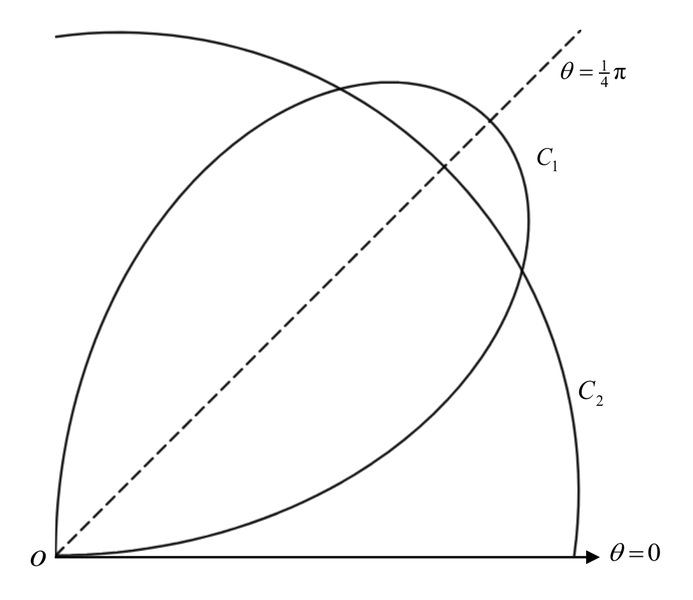
(c) Sketch C1C_1 and C2C_2 on the same diagram, clearly identifying each curve and any lines of symmetry.

(4)

(d) The region RR is enclosed by C1C_1 and C2C_2 and includes the pole. Show that the area of RR is given by

132(4α−sin⁡4α)+155tan⁡−1(155(14π−α)),\frac1{32}(4\alpha-\sin4\alpha)+\frac15\sqrt5\tan^{-1}\big(\tfrac15\sqrt5(\tfrac14\pi-\alpha)\big),

where α\alpha is the root found in 7(b).

(6)

题目中文翻译

(a) 证明直角坐标方程为

(x2+y2)3/2=xy(x^2+y^2)^{3/2}=xy

的曲线,其极坐标方程为 r=12sin⁡2θr=\frac12\sin2\theta。

(3)

曲线 C1C_1 和 C2C_2 的极坐标方程分别为

r=12sin⁡2θ和r2=1(θ−14π)2+5,r=\frac12\sin2\theta\quad\text{和}\quad r^2=\frac{1}{(\theta-\frac14\pi)^2+5},

其中 0⩽θ⩽12π0\leqslant\theta\leqslant\frac12\pi。

(b) 证明 C1C_1 与 C2C_2 的交点满足

((θ−14π)2+5)sin⁡22θ=4,\big((\theta-\tfrac14\pi)^2+5\big)\sin^22\theta=4,

并通过计算验证此方程在 θ=0.5\theta=0.5 与 θ=0.6\theta=0.6 之间有一个根 α\alpha。

(3)

(c) 在同一图中画出 C1C_1 和 C2C_2 的草图,清楚标明每条曲线及所有对称轴。

(4)

(d) 区域 RR 由 C1C_1 和 C2C_2 围成,且包含极点。证明 RR 的面积为

132(4α−sin⁡4α)+155tan⁡−1(155(14π−α)),\frac1{32}(4\alpha-\sin4\alpha)+\frac15\sqrt5\tan^{-1}\big(\tfrac15\sqrt5(\tfrac14\pi-\alpha)\big),

其中 α\alpha 是 7(b) 中求得的根。

(6)

原卷通用作答要求

Answer all questions. You should use a calculator where appropriate.

You must show all necessary working clearly; no marks will be given for unsupported answers from a calculator.

Give non-exact numerical answers correct to 3 significant figures, or 1 decimal place for angles in degrees, unless a different level of accuracy is specified in the question.

请回答所有题目。适当时应使用计算器。必须清楚展示所有必要的计算过程;仅给出计算器答案而没有过程,不予评分。除非题目另有精度要求,非精确数值答案保留 3 位有效数字,以度为单位的角度保留 1 位小数。

解答

(a)

解法一

思路

展开

代入x=r cosθ与y=r sinθ,注意r取非负值;对非极点约去r平方,极点则单独保留。

答题过程

展开

With x=rcos⁡θx=r\cos\theta, y=rsin⁡θy=r\sin\theta and r≥0r\ge0,

(x2+y2)3/2=r3,xy=r2sin⁡θcos⁡θ.(x^2+y^2)^{3/2}=r^3, \qquad xy=r^2\sin\theta\cos\theta.

Thus

r3=12r2sin⁡2θ,r2(r−12sin⁡2θ)=0.r^3=\frac12r^2\sin2\theta, \qquad r^2\bigg(r-\frac12\sin2\theta\bigg)=0.

For non-pole points, r>0r>0 and division by r2r^2 gives r=12sin⁡2θ\boxed{r=\frac12\sin2\theta}. The pole is also represented by this equation, for example at θ=0\theta=0 or π/2\pi/2, so it is retained.

(b)

解法一

思路

展开

交点处两个半径相同,先平方整理出指定方程,再代入两个角度验证变号。

答题过程

展开

At an intersection,

14sin⁡22θ=1(θ−π/4)2+5.\frac14\sin^22\theta =\frac1{(\theta-\pi/4)^2+5}.

Multiplying by the positive denominator gives

((θ−π/4)2+5)sin⁡22θ=4,\boxed{\big((\theta-\pi/4)^2+5\big)\sin^22\theta=4},

as required.

Let F(θ)F(\theta) be the left-hand side minus 44. In radians,

F(0.5)= −0.4019588335…,F(0.6)= 0.3733435533….\begin{align*} F(0.5)=&\,-0.4019588335\ldots,\\[4mm] F(0.6)=&\,0.3733435533\ldots. \end{align*}

Since FF is continuous, this change of sign verifies a root 0.5<α<0.6\boxed{0.5<\alpha<0.6}.

(c)

解法一

思路

展开

两条极坐标式都关于θ=π/4对称。C1是从极点出发又回到极点的花瓣,C2是与两轴相交的外侧弧线,两曲线交两次。

答题过程

展开

Both equations are unchanged by replacing θ\theta with π/2−θ\pi/2-\theta, so both curves are symmetric about θ=π/4\boxed{\theta=\pi/4}.

Sketch only the first-quadrant portions:

  • C1C_1: a rounded petal, starting and ending at the pole, tangent there to the two coordinate axes. Its greatest radius is 1/21/2 at θ=π/4\theta=\pi/4.
  • C2C_2: a symmetric convex arc with the pole on its concave side. It meets both axes at radius (5+π2/16)−1/2\big(5+\pi^2/16\big)^{-1/2} and has radius 1/51/\sqrt5 on the symmetry line.
  • Mark the two intersections at angles α\alpha and π/2−α\pi/2-\alpha. Near either axis C1C_1 is closer to the pole; on the symmetry line C2C_2 is closer.

Label both curves, the pole, the initial line and the symmetry line.

(d)

解法一

思路

展开

所求是包含极点的公共区域,径向边界取两曲线中较小的半径。利用对称只算0到π/4,并在交角α处分段。

答题过程

展开

By symmetry about θ=π/4\theta=\pi/4, the area of RR is twice its area for 0≤θ≤π/40\le\theta\le\pi/4. On [0,α][0,\alpha] the boundary is C1C_1; on [α,π/4][\alpha,\pi/4] it is C2C_2. Hence

A= 2(12∫0α14sin⁡22θ dθ +12∫απ/41(θ−π/4)2+5 dθ).\begin{align*} A=&\,2\bigg(\frac12\int_0^\alpha\frac14\sin^22\theta\,\mathrm{d}\theta \\[4mm] &\,\hspace{2pt}+\frac12\int_\alpha^{\pi/4} \frac1{(\theta-\pi/4)^2+5}\,\mathrm{d}\theta\bigg). \end{align*}

Using sin⁡22θ=(1−cos⁡4θ)/2\sin^22\theta=(1-\cos4\theta)/2, the first contribution is

14∫0αsin⁡22θ dθ=[θ8−sin⁡4θ32]0α=4α−sin⁡4α32.\frac14\int_0^\alpha\sin^22\theta\,\mathrm{d}\theta =\bigg[\frac\theta8-\frac{\sin4\theta}{32}\bigg]_0^\alpha =\frac{4\alpha-\sin4\alpha}{32}.

For the second contribution,

∫απ/41(θ−π/4)2+5 dθ= [15tan⁡−1θ−π/45]απ/4= 15tan⁡−1π/4−α5.\begin{align*} \int_\alpha^{\pi/4}\frac1{(\theta-\pi/4)^2+5}\,\mathrm{d}\theta =&\,\bigg[\frac1{\sqrt5}\tan^{-1}\frac{\theta-\pi/4}{\sqrt5}\bigg]_\alpha^{\pi/4} \\[4mm] =&\,\frac1{\sqrt5}\tan^{-1}\frac{\pi/4-\alpha}{\sqrt5}. \end{align*}

Therefore

A= 4α−sin⁡4α32 +55tan⁡−1(55(π/4−α)),\begin{align*} A=&\,\frac{4\alpha-\sin4\alpha}{32}\\[4mm] &\,+\frac{\sqrt5}{5}\tan^{-1}\bigg(\frac{\sqrt5}{5}(\pi/4-\alpha)\bigg), \end{align*}

as required.