respectively, where 0⩽θ⩽21π. The curves C1 and C2 intersect at the pole and at another point P.
(b) Find the polar coordinates of P.
(3)
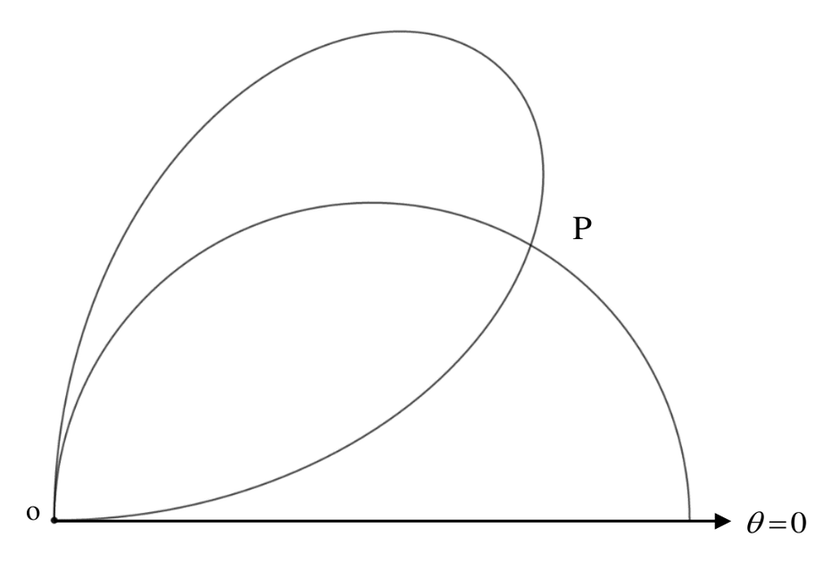
(c) In a single diagram sketch C1 and C2, clearly identifying each curve, and mark the point P.
(3)
(d) The region R is enclosed by C1 and C2 and includes the line OP.
Find, in exact form, the area of R.
(6)
题目中文翻译
(a) 证明:笛卡尔方程为
(x−21)2+y2=41
的曲线,其极坐标方程为 r=cosθ。
(3)
曲线 C1 和 C2 的极坐标方程分别为
r=r=cosθ,sin2θ.
其中 0⩽θ⩽21π。曲线 C1 和 C2 相交于极点和另一个点 P。
(b) 求 P 的极坐标。
(3)
(c) 在同一张图上画出 C1 和 C2 的草图,清楚标明每条曲线,并标出点 P。
(3)
(d) 区域 R 由 C1 和 C2 围成,且包含线段 OP。
求 R 的面积,以精确形式表示。
(6)
原卷通用作答要求
Answer all questions. You should use a calculator where appropriate.
You must show all necessary working clearly; no marks will be given for unsupported answers from a calculator.
Give non-exact numerical answers correct to 3 significant figures, or 1 decimal place for angles in degrees, unless a different level of accuracy is specified in the question.
For non-pole points, r=0, so r=cosθ. The pole is also represented, for example at θ=π/2, so it is retained.
(b)
解法一
思路
展开
除去极点后cosθ非零,可以约去该因子。解出角度后代回任一极径式。
答题过程
展开
At a common point,
cosθ=sin2θ=2sinθcosθ.
For P the point is not the pole, so r=cosθ=0. Dividing by cosθ gives sinθ=1/2.
In 0⩽θ⩽π/2, this gives θ=π/6 and r=cos(π/6)=3/2. Therefore
P=(23,6π).
(c)
解法一
思路
展开
给定角区间内,第一条曲线只画圆的上半圆;第二条曲线只画第一象限一个环,标明两条曲线及交点。
答题过程
展开
Sketch C1 as the upper semicircle with centre (1/2,0) and radius 1/2, running from (1,0) to the pole.
Sketch C2 as one first-quadrant loop, starting at the pole with horizontal tangent and returning to the pole with vertical tangent. Its maximum radius is 1 at θ=π/4.
Label both curves and mark their non-pole intersection P=(3/2,π/6); in Cartesian coordinates this is (3/4,3/4).