题目
Problem
The curve C C C y = f ( x ) y=\mathrm{f}(x) y = f ( x ) f ( x ) = x 2 x + 1 \mathrm{f}(x)=\dfrac{x^2}{x+1} f ( x ) = x + 1 x 2
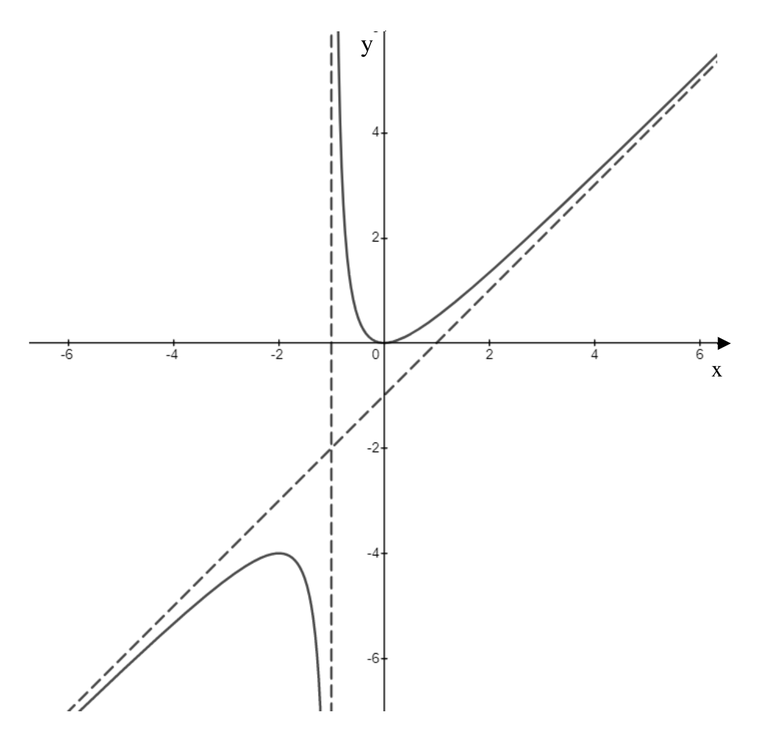
(a) Find the equations of the asymptotes of C C C
(3)
(b) Find the coordinates of any stationary points on C C C
(2)
(c) Sketch C C C
(3)
(d) Find the coordinates of any stationary points on the curve with equation y = 1 f ( x ) y=\dfrac{1}{\mathrm{f}(x)} y = f ( x ) 1
(2)
(e) Sketch the curve with equation y = 1 f ( x ) y=\dfrac{1}{\mathrm{f}(x)} y = f ( x ) 1 1 f ( x ) > f ( x ) \dfrac{1}{\mathrm{f}(x)}>\mathrm{f}(x) f ( x ) 1 > f ( x )
(6)
题目中文翻译
曲线 C C C y = f ( x ) y=\mathrm{f}(x) y = f ( x ) f ( x ) = x 2 x + 1 \mathrm{f}(x)=\dfrac{x^2}{x+1} f ( x ) = x + 1 x 2
(a) 求 C C C
(3)
(b) 求 C C C
(2)
(c) 画出 C C C
(3)
(d) 求方程为 y = 1 f ( x ) y=\dfrac{1}{\mathrm{f}(x)} y = f ( x ) 1
(2)
(e) 画出方程为 y = 1 f ( x ) y=\dfrac{1}{\mathrm{f}(x)} y = f ( x ) 1 1 f ( x ) > f ( x ) \dfrac{1}{\mathrm{f}(x)}>\mathrm{f}(x) f ( x ) 1 > f ( x )
(6)
原卷通用作答要求
Answer all questions. You should use a calculator where appropriate.
You must show all necessary working clearly; no marks will be given for unsupported answers from a calculator.
Give non-exact numerical answers correct to 3 significant figures, or 1 decimal place for angles in degrees, unless a different level of accuracy is specified in the question.
请回答所有题目。适当时应使用计算器。必须清楚展示所有必要的计算过程;仅给出计算器答案而没有过程,不予评分。除非题目另有精度要求,非精确数值答案保留 3 位有效数字,以度为单位的角度保留 1 位小数。
解答
(a)
解法一
思路
展开
先除多项式,得到斜渐近线与余项;分母零点处没有约消。
答题过程
展开
Division gives
f ( x ) = x 2 x + 1 = x − 1 + 1 x + 1 . f(x)=\frac{x^2}{x+1}=x-1+\frac1{x+1}. f ( x ) = x + 1 x 2 = x − 1 + x + 1 1 . Therefore the asymptotes are x = − 1 \boxed{x=-1} x = − 1 y = x − 1 \boxed{y=x-1} y = x − 1
(b)
解法一
思路
展开
由除法式求导,分子因式分解后得到两个驻点。
答题过程
展开
f ′ ( x ) = 1 − 1 ( x + 1 ) 2 = x ( x + 2 ) ( x + 1 ) 2 . f'(x)=1-\frac1{(x+1)^2}
=\frac{x(x+2)}{(x+1)^2}. f ′ ( x ) = 1 − ( x + 1 ) 2 1 = ( x + 1 ) 2 x ( x + 2 ) . Thus f ′ ( x ) = 0 f'(x)=0 f ′ ( x ) = 0 x = 0 x=0 x = 0 x = − 2 x=-2 x = − 2
( 0 , 0 ) and ( − 2 , − 4 ) . \boxed{(0,0)\quad\text{and}\quad(-2,-4)}. ( 0 , 0 ) and ( − 2 , − 4 ) . The derivative changes from positive to negative at x = − 2 x=-2 x = − 2 x = 0 x=0 x = 0
(c)
解法一
思路
展开
用余项符号决定曲线位于斜渐近线哪一侧。左支最高点仍在横轴下,右支最低点恰在原点。
答题过程
展开
Sketch the two branches with labelled asymptotes x = − 1 x=-1 x = − 1 y = x − 1 y=x-1 y = x − 1
For x < − 1 x<-1 x < − 1 ( − 2 , − 4 ) (-2,-4) ( − 2 , − 4 ) − ∞ -\infty − ∞ x → − 1 − x\to-1^- x → − 1 −
For x > − 1 x>-1 x > − 1 + ∞ +\infty + ∞ x → − 1 + x\to-1^+ x → − 1 + ( 0 , 0 ) (0,0) ( 0 , 0 ) x x x + ∞ +\infty + ∞
Both tails approach the oblique asymptote; ( 0 , 0 ) (0,0) ( 0 , 0 )
(d)
解法一
思路
展开
先保留倒数的共同定义域,再求化简式的导数。分子零点必须回查定义域。
答题过程
展开
The reciprocal is defined for x ≠ − 1 , 0 x\ne-1,0 x = − 1 , 0
g ( x ) = 1 f ( x ) = x + 1 x 2 = x − 1 + x − 2 . \begin{align*}
g(x)=&\,\frac1{f(x)}=\frac{x+1}{x^2}\\[4mm]
=&\,x^{-1}+x^{-2}.
\end{align*} g ( x ) = = f ( x ) 1 = x 2 x + 1 x − 1 + x − 2 . Hence
g ′ ( x ) = − x − 2 − 2 x − 3 = − x + 2 x 3 . g'(x)=-x^{-2}-2x^{-3}=-\frac{x+2}{x^3}. g ′ ( x ) = − x − 2 − 2 x − 3 = − x 3 x + 2 . The only zero is x = − 2 x=-2 x = − 2 g ( − 2 ) = − 1 / 4 g(-2)=-1/4 g ( − 2 ) = − 1/4
( − 2 , − 1 4 ) . \boxed{(-2,-\tfrac14)}. ( − 2 , − 4 1 ) .
(e)
解法一
思路
展开
不等式部分先移到同一边并因式分解。x平方和另一个二次式恒正,只剩一个二次因子与x+1的符号决定答案,另排除倒数无定义的0。
答题过程
展开
For the inequality, work on the common domain x ≠ − 1 , 0 x\ne-1,0 x = − 1 , 0
1 f ( x ) − f ( x ) = ( x + 1 ) 2 − x 4 x 2 ( x + 1 ) = − ( x 2 − x − 1 ) ( x 2 + x + 1 ) x 2 ( x + 1 ) . \begin{align*}
\frac1{f(x)}-f(x)
=&\,\frac{(x+1)^2-x^4}{x^2(x+1)}\\[4mm]
=&\,-\frac{(x^2-x-1)(x^2+x+1)}{x^2(x+1)}.
\end{align*} f ( x ) 1 − f ( x ) = = x 2 ( x + 1 ) ( x + 1 ) 2 − x 4 − x 2 ( x + 1 ) ( x 2 − x − 1 ) ( x 2 + x + 1 ) . Since x 2 > 0 x^2>0 x 2 > 0 x 2 + x + 1 = ( x + 1 / 2 ) 2 + 3 / 4 > 0 x^2+x+1=(x+1/2)^2+3/4>0 x 2 + x + 1 = ( x + 1/2 ) 2 + 3/4 > 0
x 2 − x − 1 x + 1 < 0. \frac{x^2-x-1}{x+1}<0. x + 1 x 2 − x − 1 < 0. The numerator roots are a = ( 1 − 5 ) / 2 a=(1-\sqrt5)/2 a = ( 1 − 5 ) /2 b = ( 1 + 5 ) / 2 b=(1+\sqrt5)/2 b = ( 1 + 5 ) /2 − 1 < a < 0 < b -1<a<0<b − 1 < a < 0 < b
Interval Sign of ( x 2 − x − 1 ) / ( x + 1 ) (x^2-x-1)/(x+1) ( x 2 − x − 1 ) / ( x + 1 ) ( − ∞ , − 1 ) (-\infty,-1) ( − ∞ , − 1 ) − - − ( − 1 , a ) (-1,a) ( − 1 , a ) + + + ( a , 0 ) (a,0) ( a , 0 ) − - − ( 0 , b ) (0,b) ( 0 , b ) − - − ( b , ∞ ) (b,\infty) ( b , ∞ ) + + +
Therefore the inequality holds for
x < − 1 or 1 − 5 2 < x < 0 or 0 < x < 1 + 5 2 . \begin{align*}
&\,\boxed{x<-1}\\[4mm]
\text{or}\quad&\,\boxed{\frac{1-\sqrt5}{2}<x<0}\\[4mm]
\text{or}\quad&\,\boxed{0<x<\frac{1+\sqrt5}{2}}.
\end{align*} or or x < − 1 2 1 − 5 < x < 0 0 < x < 2 1 + 5 .