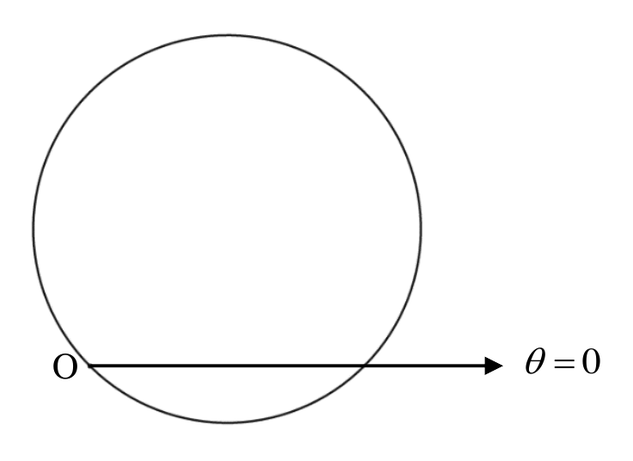
题目
Problem
The curve C 1 C_1 C 1 r = a ( cos θ + sin θ ) r=a(\cos\theta+\sin\theta) r = a ( cos θ + sin θ ) − 1 4 π ⩽ θ ⩽ 3 4 π -\frac14\pi\leqslant\theta\leqslant\frac34\pi − 4 1 π ⩽ θ ⩽ 4 3 π a a a
(a) Find a Cartesian equation for C 1 C_1 C 1
(4)
(b) Sketch C 1 C_1 C 1 C 1 C_1 C 1
(3)
The curve C 2 C_2 C 2 r = a θ r=a\theta r = a θ C 1 C_1 C 1 ( a ϕ , ϕ ) (a\phi,\phi) ( a ϕ , ϕ )
(c) Verify that 1.25 < ϕ < 1.26 1.25<\phi<1.26 1.25 < ϕ < 1.26
(2)
(d) Show that the area of the smaller region enclosed by C 1 C_1 C 1 C 2 C_2 C 2
1 2 a 2 ( 3 4 π + 1 3 ϕ 3 − ϕ + 1 2 cos 2 ϕ ) \frac12a^2\big(\tfrac34\pi+\tfrac13\phi^3-\phi+\tfrac12\cos2\phi\big) 2 1 a 2 ( 4 3 π + 3 1 ϕ 3 − ϕ + 2 1 cos 2 ϕ ) and deduce, in terms of a a a ϕ \phi ϕ C 1 C_1 C 1 C 2 C_2 C 2
(7)
题目中文翻译
曲线 C 1 C_1 C 1 r = a ( cos θ + sin θ ) r=a(\cos\theta+\sin\theta) r = a ( cos θ + sin θ ) − 1 4 π ⩽ θ ⩽ 3 4 π -\frac14\pi\leqslant\theta\leqslant\frac34\pi − 4 1 π ⩽ θ ⩽ 4 3 π a a a
(a) 求 C 1 C_1 C 1
(4)
(b) 画出 C 1 C_1 C 1 C 1 C_1 C 1
(3)
极坐标方程为 r = a θ r=a\theta r = a θ C 2 C_2 C 2 C 1 C_1 C 1 ( a ϕ , ϕ ) (a\phi,\phi) ( a ϕ , ϕ )
(c) 验证 1.25 < ϕ < 1.26 1.25<\phi<1.26 1.25 < ϕ < 1.26
(2)
(d) 证明:由 C 1 C_1 C 1 C 2 C_2 C 2
1 2 a 2 ( 3 4 π + 1 3 ϕ 3 − ϕ + 1 2 cos 2 ϕ ) , \frac12a^2\big(\tfrac34\pi+\tfrac13\phi^3-\phi+\tfrac12\cos2\phi\big), 2 1 a 2 ( 4 3 π + 3 1 ϕ 3 − ϕ + 2 1 cos 2 ϕ ) , 并由此求由 C 1 C_1 C 1 C 2 C_2 C 2 a a a ϕ \phi ϕ
(7)
原卷通用作答要求
Answer all questions. You should use a calculator where appropriate.
You must show all necessary working clearly; no marks will be given for unsupported answers from a calculator.
Give non-exact numerical answers correct to 3 significant figures, or 1 decimal place for angles in degrees, unless a different level of accuracy is specified in the question.
请回答所有题目。适当时应使用计算器。必须清楚展示所有必要的计算过程;仅给出计算器答案而没有过程,不予评分。除非题目另有精度要求,非精确数值答案保留 3 位有效数字,以度为单位的角度保留 1 位小数。
解答
(a)
解法一
思路
展开
极坐标式乘r后,利用r平方与r乘三角函数的直角坐标含义消去角度,再分别配方。
答题过程
展开
Multiplying the polar equation by r r r
r 2 = a r cos θ + a r sin θ . r^2=ar\cos\theta+ar\sin\theta. r 2 = a r cos θ + a r sin θ . Therefore
x 2 + y 2 = a x + a y , x^2+y^2=ax+ay, x 2 + y 2 = a x + a y , and completing the squares gives
( x − a 2 ) 2 + ( y − a 2 ) 2 = a 2 2 . \boxed{\big(x-\tfrac a2\big)^2+
\big(y-\tfrac a2\big)^2=\frac{a^2}{2}}. ( x − 2 a ) 2 + ( y − 2 a ) 2 = 2 a 2 . This is a circle with centre ( a 2 , a 2 ) \boxed{(\frac a2,\frac a2)} ( 2 a , 2 a ) a / 2 \boxed{a/\sqrt2} a / 2
(b)
解法一
思路
展开
圆过原点及两轴上的a点,圆心在第一象限;注意圆有一小段落在横轴下方。最大极径可用辅助角直接求出。
答题过程
展开
Sketch the circle with centre ( a 2 , a 2 ) (\frac a2,\frac a2) ( 2 a , 2 a ) a / 2 a/\sqrt2 a / 2 O O O ( a , 0 ) (a,0) ( a , 0 ) ( 0 , a ) (0,a) ( 0 , a ) O O O y = − x y=-x y = − x
Since
r = a 2 cos ( θ − π 4 ) , r=a\sqrt2\cos\big(\theta-\tfrac\pi4\big), r = a 2 cos ( θ − 4 π ) , the greatest distance from the pole is a 2 \boxed{a\sqrt2} a 2 θ = π 4 \theta=\frac\pi4 θ = 4 π
(c)
解法一
思路
展开
非极点交点的极径相等,消去正常数a得到连续函数,再计算区间两端的符号。
答题过程
展开
At the non-pole intersection,
a ϕ = a ( cos ϕ + sin ϕ ) . a\phi=a(\cos\phi+\sin\phi). a ϕ = a ( cos ϕ + sin ϕ ) . Since a > 0 a>0 a > 0 F ( t ) = cos t + sin t − t F(t)=\cos t+\sin t-t F ( t ) = cos t + sin t − t
F ( 1.25 ) = 0.01430698 … > 0 , F ( 1.26 ) = − 0.00209275 … < 0. \begin{align*}
F(1.25)=&\,0.01430698\ldots>0,\\[4mm]
F(1.26)=&\,-0.00209275\ldots<0.
\end{align*} F ( 1.25 ) = F ( 1.26 ) = 0.01430698 … > 0 , − 0.00209275 … < 0. Continuity gives a root in ( 1.25 , 1.26 ) (1.25,1.26) ( 1.25 , 1.26 ) 1.25 < ϕ < 1.26 \boxed{1.25<\phi<1.26} 1.25 < ϕ < 1.26
(d)
解法一
思路
展开
较小区域的边界先沿螺旋从极点到交点,再沿圆的后半段回到极点。因此两个面积积分相加;较大区域用整圆面积减去较小区域。
答题过程
展开
For 0 ⩽ θ ⩽ ϕ 0\leqslant\theta\leqslant\phi 0 ⩽ θ ⩽ ϕ r = a θ r=a\theta r = a θ ϕ ⩽ θ ⩽ 3 π 4 \phi\leqslant\theta\leqslant\frac{3\pi}{4} ϕ ⩽ θ ⩽ 4 3 π
A s = a 2 2 ∫ 0 ϕ θ 2 d θ + a 2 2 ∫ ϕ 3 π / 4 ( cos θ + sin θ ) 2 d θ = a 2 2 [ ϕ 3 3 + ∫ ϕ 3 π / 4 ( 1 + sin 2 θ ) d θ ] = a 2 2 [ ϕ 3 3 + [ θ − 1 2 cos 2 θ ] ϕ 3 π / 4 ] = a 2 2 ( 3 π 4 + ϕ 3 3 − ϕ + 1 2 cos 2 ϕ ) , \begin{align*}
A_s=&\,\frac{a^2}{2}\int_0^\phi\theta^2\,\mathrm{d}\theta\\[4mm]
&\,+\frac{a^2}{2}\int_\phi^{3\pi/4}(\cos\theta+\sin\theta)^2\,\mathrm{d}\theta\\[4mm]
=&\,\frac{a^2}{2}\bigg[\frac{\phi^3}{3}
+\int_\phi^{3\pi/4}(1+\sin2\theta)\,\mathrm{d}\theta\bigg]\\[4mm]
=&\,\frac{a^2}{2}\bigg[\frac{\phi^3}{3}
+\big[\theta-\tfrac12\cos2\theta\big]_\phi^{3\pi/4}\bigg]\\[4mm]
=&\,\boxed{\frac{a^2}{2}\bigg(\frac{3\pi}{4}
+\frac{\phi^3}{3}-\phi+\frac12\cos2\phi\bigg)},
\end{align*} A s = = = = 2 a 2 ∫ 0 ϕ θ 2 d θ + 2 a 2 ∫ ϕ 3 π /4 ( cos θ + sin θ ) 2 d θ 2 a 2 [ 3 ϕ 3 + ∫ ϕ 3 π /4 ( 1 + sin 2 θ ) d θ ] 2 a 2 [ 3 ϕ 3 + [ θ − 2 1 cos 2 θ ] ϕ 3 π /4 ] 2 a 2 ( 4 3 π + 3 ϕ 3 − ϕ + 2 1 cos 2 ϕ ) , as required.
The entire circle has area π ( a / 2 ) 2 = π a 2 / 2 \pi(a/\sqrt2)^2=\pi a^2/2 π ( a / 2 ) 2 = π a 2 /2
A l = π a 2 2 − A s = a 2 2 ( π 4 − ϕ 3 3 + ϕ − 1 2 cos 2 ϕ ) . \begin{align*}
A_l=&\,\frac{\pi a^2}{2}-A_s\\[4mm]
=&\,\boxed{\frac{a^2}{2}\bigg(\frac\pi4-\frac{\phi^3}{3}
+\phi-\frac12\cos2\phi\bigg)}.
\end{align*} A l = = 2 π a 2 − A s 2 a 2 ( 4 π − 3 ϕ 3 + ϕ − 2 1 cos 2 ϕ ) .
解法二
思路
展开
也可先算较大区域:取圆从起始极点角到交点的面积,减去螺旋从0到交点的面积。这个积分分区与先算小区域不同,最后用整圆补出另一块。
答题过程
展开
The larger region is the part swept out by the circle from θ = − π 4 \theta=-\frac\pi4 θ = − 4 π θ = ϕ \theta=\phi θ = ϕ 0 ⩽ θ ⩽ ϕ 0\leqslant\theta\leqslant\phi 0 ⩽ θ ⩽ ϕ
A l = a 2 2 ∫ − π / 4 ϕ ( cos θ + sin θ ) 2 d θ − a 2 2 ∫ 0 ϕ θ 2 d θ = a 2 2 ( [ θ − 1 2 cos 2 θ ] − π / 4 ϕ − ϕ 3 3 ) = a 2 2 ( π 4 + ϕ − 1 2 cos 2 ϕ − ϕ 3 3 ) . \begin{align*}
A_l=&\,\frac{a^2}{2}\int_{-\pi/4}^{\phi}(\cos\theta+\sin\theta)^2\,\mathrm{d}\theta\\[4mm]
&\,-\frac{a^2}{2}\int_0^\phi\theta^2\,\mathrm{d}\theta\\[4mm]
=&\,\frac{a^2}{2}\bigg(
\big[\theta-\tfrac12\cos2\theta\big]_{-\pi/4}^{\phi}
-\frac{\phi^3}{3}\bigg)\\[4mm]
=&\,\boxed{\frac{a^2}{2}\bigg(\frac\pi4+\phi
-\frac12\cos2\phi-\frac{\phi^3}{3}\bigg)}.
\end{align*} A l = = = 2 a 2 ∫ − π /4 ϕ ( cos θ + sin θ ) 2 d θ − 2 a 2 ∫ 0 ϕ θ 2 d θ 2 a 2 ( [ θ − 2 1 cos 2 θ ] − π /4 ϕ − 3 ϕ 3 ) 2 a 2 ( 4 π + ϕ − 2 1 cos 2 ϕ − 3 ϕ 3 ) . Subtracting from the whole-circle area gives
A s = π a 2 2 − A l = a 2 2 ( 3 π 4 + ϕ 3 3 − ϕ + 1 2 cos 2 ϕ ) , \begin{align*}
A_s=&\,\frac{\pi a^2}{2}-A_l\\[4mm]
=&\,\boxed{\frac{a^2}{2}\bigg(\frac{3\pi}{4}
+\frac{\phi^3}{3}-\phi+\frac12\cos2\phi\bigg)},
\end{align*} A s = = 2 π a 2 − A l 2 a 2 ( 4 3 π + 3 ϕ 3 − ϕ + 2 1 cos 2 ϕ ) , which is the stated smaller area.