题目
Problem
The curve C C C r 2 = tan 2 θ r^2=\tan2\theta r 2 = tan 2 θ 0 ⩽ θ ⩽ 1 8 π 0\leqslant\theta\leqslant\frac18\pi 0 ⩽ θ ⩽ 8 1 π
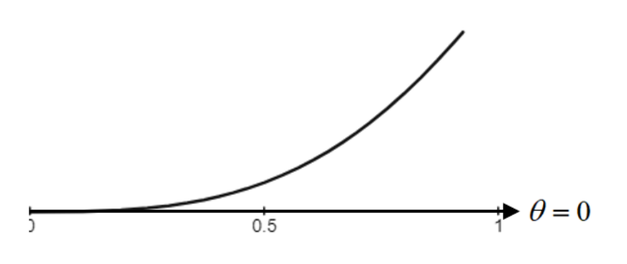
(a) Sketch C C C C C C
(2)
(b) Find the exact value of the area of the region bounded by C C C θ = 1 8 π \theta=\frac18\pi θ = 8 1 π
(4)
(c) Show that C C C x 4 − 2 x y − y 4 = 0 x^4-2xy-y^4=0 x 4 − 2 x y − y 4 = 0 0 ⩽ x ⩽ cos ( 1 8 π ) 0\leqslant x\leqslant\cos\big(\frac18\pi\big) 0 ⩽ x ⩽ cos ( 8 1 π ) 0 ⩽ y ⩽ sin ( 1 8 π ) 0\leqslant y\leqslant\sin\big(\frac18\pi\big) 0 ⩽ y ⩽ sin ( 8 1 π )
(4)
(d) Using your answer to (b) , deduce the exact value of the area bounded by C C C x x x x = cos ( 1 8 π ) x=\cos\big(\frac18\pi\big) x = cos ( 8 1 π )
(2)
题目中文翻译
曲线 C C C r 2 = tan 2 θ r^2=\tan2\theta r 2 = tan 2 θ 0 ⩽ θ ⩽ 1 8 π 0\leqslant\theta\leqslant\frac18\pi 0 ⩽ θ ⩽ 8 1 π
(a) 画出 C C C C C C
(2)
(b) 求由 C C C θ = 1 8 π \theta=\frac18\pi θ = 8 1 π
(4)
(c) 已知 0 ⩽ x ⩽ cos ( 1 8 π ) 0\leqslant x\leqslant\cos\big(\frac18\pi\big) 0 ⩽ x ⩽ cos ( 8 1 π ) 0 ⩽ y ⩽ sin ( 1 8 π ) 0\leqslant y\leqslant\sin\big(\frac18\pi\big) 0 ⩽ y ⩽ sin ( 8 1 π ) C C C x 4 − 2 x y − y 4 = 0 x^4-2xy-y^4=0 x 4 − 2 x y − y 4 = 0
(4)
(d) 利用你在 (b) 中的答案,推得由 C C C x x x x = cos ( 1 8 π ) x=\cos\big(\frac18\pi\big) x = cos ( 8 1 π )
(2)
原卷通用作答要求
Answer all questions. You should use a calculator where appropriate.
You must show all necessary working clearly; no marks will be given for unsupported answers from a calculator.
Give non-exact numerical answers correct to 3 significant figures, or 1 decimal place for angles in degrees, unless a different level of accuracy is specified in the question.
请回答所有题目。适当时应使用计算器。必须清楚展示所有必要的计算过程;仅给出计算器答案而没有过程,不予评分。除非题目另有精度要求,非精确数值答案保留 3 位有效数字,以度为单位的角度保留 1 位小数。
解答
(a)
解法一
思路
展开
半径平方在给定角度区间上递增,端点半径为1。草图从极点开始并向上弯曲。
答题过程
展开
As θ \theta θ 0 0 0 π / 8 \pi/8 π /8 r 2 = tan 2 θ r^2=\tan2\theta r 2 = tan 2 θ 0 0 0 1 1 1 1 \boxed{1} 1
Sketch the first-quadrant curve starting at the pole with a horizontal tangent and bending upwards to the endpoint r = 1 r=1 r = 1 θ = π / 8 \theta=\pi/8 θ = π /8
(b)
解法一
思路
展开
极坐标面积积分tan2θ,注意对数原函数中的二分之一来自链式代换。
答题过程
展开
The area is
A = 1 2 ∫ 0 π / 8 tan 2 θ d θ = − 1 4 [ ln ( cos 2 θ ) ] 0 π / 8 = − 1 4 ln 2 2 = 1 8 ln 2 . \begin{align*}
A=&\,\frac12\int_0^{\pi/8}\tan2\theta\,\mathrm{d}\theta \\[4mm]
=&\,-\frac14\big[\ln(\cos2\theta)\big]_0^{\pi/8} \\[4mm]
=&\,-\frac14\ln\frac{\sqrt2}{2}
=\boxed{\frac18\ln2}.
\end{align*} A = = = 2 1 ∫ 0 π /8 tan 2 θ d θ − 4 1 [ ln ( cos 2 θ ) ] 0 π /8 − 4 1 ln 2 2 = 8 1 ln 2 .
(c)
解法一
思路
展开
用正切倍角公式,再代入tanθ=y/x和r平方=x平方+y平方;极点需单独保留。
答题过程
展开
For a non-pole point,
tan 2 θ = 2 tan θ 1 − tan 2 θ = 2 ( y / x ) 1 − y 2 / x 2 = 2 x y x 2 − y 2 . \begin{align*}
\tan2\theta=&\,\frac{2\tan\theta}{1-\tan^2\theta}\\[4mm]
=&\,\frac{2(y/x)}{1-y^2/x^2}\\[4mm]
=&\,\frac{2xy}{x^2-y^2}.
\end{align*} tan 2 θ = = = 1 − tan 2 θ 2 tan θ 1 − y 2 / x 2 2 ( y / x ) x 2 − y 2 2 x y . Since r 2 = x 2 + y 2 r^2=x^2+y^2 r 2 = x 2 + y 2
( x 2 + y 2 ) ( x 2 − y 2 ) = 2 x y , (x^2+y^2)(x^2-y^2)=2xy, ( x 2 + y 2 ) ( x 2 − y 2 ) = 2 x y , and hence
x 4 − 2 x y − y 4 = 0 . \boxed{x^4-2xy-y^4=0}. x 4 − 2 x y − y 4 = 0 . The pole ( 0 , 0 ) (0,0) ( 0 , 0 ) 0 ≤ x ≤ cos ( π / 8 ) 0\le x\le\cos(\pi/8) 0 ≤ x ≤ cos ( π /8 ) 0 ≤ y ≤ sin ( π / 8 ) 0\le y\le\sin(\pi/8) 0 ≤ y ≤ sin ( π /8 )
(d)
解法一
思路
展开
按要求用(b)的面积:端点与原点形成的三角形面积,减掉极坐标区域,就是曲线下方所求面积。
答题过程
展开
The endpoint is ( cos ( π / 8 ) , sin ( π / 8 ) ) (\cos(\pi/8),\sin(\pi/8)) ( cos ( π /8 ) , sin ( π /8 )) θ = π / 8 \theta=\pi/8 θ = π /8
A △ = 1 2 cos π 8 sin π 8 = 1 4 sin π 4 = 2 8 . A_\triangle=\frac12\cos\frac\pi8\sin\frac\pi8
=\frac14\sin\frac\pi4=\frac{\sqrt2}{8}. A △ = 2 1 cos 8 π sin 8 π = 4 1 sin 4 π = 8 2 . Subtracting the area found in (b), the required area is
2 8 − 1 8 ln 2 = 2 − ln 2 8 . \boxed{\frac{\sqrt2}{8}-\frac18\ln2=\frac{\sqrt2-\ln2}{8}}. 8 2 − 8 1 ln 2 = 8 2 − ln 2 .