题目
Problem
The curve C has polar equation r=sin3θ, for 0⩽θ⩽31π.
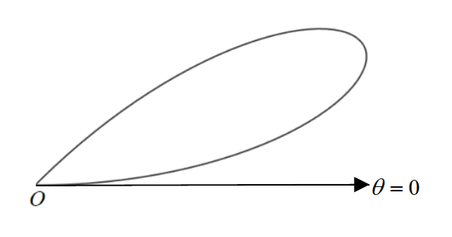
(a) Sketch C and state the equation of the line of symmetry.
(3)
(b) Find the exact value of the area of the region enclosed by C.
(4)
In parts (c) and (d) you may use the identity sin3θ≡3sinθ−4sin3θ.
(c) Find the maximum distance of a point on C from the initial line.
(5)
(d) Find a Cartesian equation for C.
(3)
题目中文翻译
曲线 C 的极坐标方程为 r=sin3θ,其中 0⩽θ⩽31π。
(a) 画出 C 的草图,并写出其对称轴的方程。
(3)
(b) 求 C 所围区域面积的精确值。
(4)
在 (c) 和 (d) 中,你可以使用恒等式 sin3θ≡3sinθ−4sin3θ。
(c) 求 C 上的点到始边的最大距离。
(5)
(d) 求 C 的一个直角坐标方程。
(3)
原卷通用作答要求
Answer all questions. You should use a calculator where appropriate.
You must show all necessary working clearly; no marks will be given for unsupported answers from a calculator.
Give non-exact numerical answers correct to 3 significant figures, or 1 decimal place for angles in degrees, unless a different level of accuracy is specified in the question.
请回答所有题目。适当时应使用计算器。必须清楚展示所有必要的计算过程;仅给出计算器答案而没有过程,不予评分。除非题目另有精度要求,非精确数值答案保留 3 位有效数字,以度为单位的角度保留 1 位小数。
解答
(a)
解法一
思路
展开
指定角度范围只画第一象限的一瓣;在π/6两侧角度互补,半径相同,因此该射线为对称轴。
答题过程
展开
For 0≤θ≤π/3, r=sin3θ≥0. It is zero at both endpoints and reaches its maximum r=1 at θ=π/6.
Sketch one smooth rounded loop in the first quadrant, starting at the pole tangent to θ=0 and returning to it tangent to θ=π/3. Mark the initial line and the pole.
Since sin(3(π/3−θ))=sin3θ, the line of symmetry is
θ=π/6.
(b)
解法一
思路
展开
用极坐标面积公式,平方三角函数用倍角公式积分。
答题过程
展开
The enclosed area is
A====21∫0π/3sin23θdθ41∫0π/3(1−cos6θ)dθ41[θ−61sin6θ]0π/312π.
(c)
解法一
思路
展开
最大距离是最大纵坐标,不是最大半径。用给定三倍角公式把纵坐标写成sinθ的多项式后求极值。
答题过程
展开
The perpendicular distance from the initial line is
y==rsinθ=sin3θsinθ3sin2θ−4sin4θ.
Differentiating,
dθdy==6sinθcosθ−16sin3θcosθ2sinθcosθ(3−8sin2θ).
For 0<θ<π/3, sinθcosθ>0, so the stationary point has sin2θ=3/8. The derivative changes from positive to negative there. The distance is zero at both endpoints, so this is the maximum:
ymax=383−4(83)2=169.
解法二
思路
展开
也可配方直接求最大纵坐标,但要检查使平方项为零的角度确实在范围内。
答题过程
展开
Using the given identity,
y===sin3θsinθ3sin2θ−4sin4θ169−4(sin2θ−83)2.
Thus y≤9/16. On 0≤θ≤π/3, sin2θ takes every value from 0 to 3/4, including 3/8. Hence equality is attained, and the maximum distance is 9/16.
(d)
解法一
思路
展开
用给定三倍角公式,再以y=r sinθ和r平方=x平方+y平方消去极坐标量。保留第一象限范围以对应原题只给的一瓣。
答题过程
展开
Using r=sin3θ=3sinθ−4sin3θ, multiply by r3:
r4=3(rsinθ)r2−4(rsinθ)3.
Substituting y=rsinθ and r2=x2+y2,
(x2+y2)2==3y(x2+y2)−4y3y(3x2−y2).
Thus a Cartesian equation is
(x2+y2)2=y(3x2−y2),
with x≥0 and y≥0.
The quadrant restrictions select the loop in the stated angular range; the pole is included.
