Skip to content
CalcGospel 國際數學圖譜
返回

CIE 9231 2025 November Paper 14 Q6

A Level / CIE / FP1

CIE 9231 2025 Nov Paper 14 Paper · Question 6

题目

Problem

The curve CC has polar equation r=cos⁡12θr=\cos\frac12\theta, for 0⩽θ⩽π0\leqslant\theta\leqslant\pi.

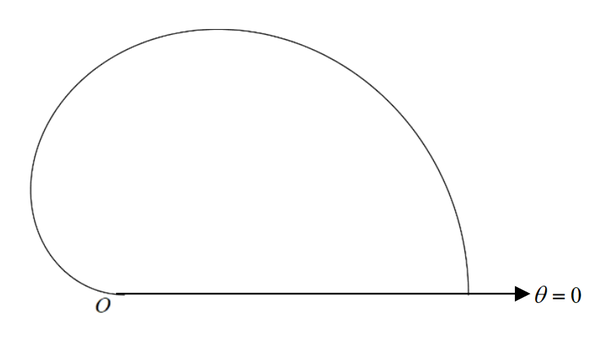
(a) Sketch CC.

(2)

In parts (b) and (c) you may use the identities sin⁡θ=2sin⁡12θcos⁡12θ\sin\theta=2\sin\frac12\theta\cos\frac12\theta and cos⁡θ=2cos⁡212θ−1\cos\theta=2\cos^2\frac12\theta-1.

(b) Find the exact value of the area of the region enclosed by CC and the initial line.

(4)

(c) Find the maximum distance of a point on CC from the initial line. Give your answer in the form pqp\sqrt q, where pp and qq are rational numbers to be determined.

(6)

题目中文翻译

曲线 CC 的极坐标方程为 r=cos⁡12θr=\cos\frac12\theta,其中 0⩽θ⩽π0\leqslant\theta\leqslant\pi。

(a) 画出 CC 的草图。

(2)

在 (b) 和 (c) 中,你可以使用恒等式 sin⁡θ=2sin⁡12θcos⁡12θ\sin\theta=2\sin\frac12\theta\cos\frac12\theta 和 cos⁡θ=2cos⁡212θ−1\cos\theta=2\cos^2\frac12\theta-1。

(b) 求由 CC 与始边围成的区域面积的精确值。

(4)

(c) 求 CC 上的点到始边的最大距离。答案写成 pqp\sqrt q 的形式,其中 pp 和 qq 是待求的有理数。

(6)

原卷通用作答要求

Answer all questions. You should use a calculator where appropriate.

You must show all necessary working clearly; no marks will be given for unsupported answers from a calculator.

Give non-exact numerical answers correct to 3 significant figures, or 1 decimal place for angles in degrees, unless a different level of accuracy is specified in the question.

请回答所有题目。适当时应使用计算器。必须清楚展示所有必要的计算过程;仅给出计算器答案而没有过程,不予评分。除非题目另有精度要求,非精确数值答案保留 3 位有效数字,以度为单位的角度保留 1 位小数。

解答

(a)

解法一

思路

展开

半径从1连续降到0,曲线依次经过第一、第二象限;不能只画第一象限。

答题过程

展开

The radius decreases from r=1r=1 at θ=0\theta=0 to r=0r=0 at θ=π\theta=\pi. Sketch one smooth arc in the upper half-plane, starting at (1,0)(1,0) with a vertical tangent, passing through (0,1/2)(0,1/\sqrt2) at θ=π/2\theta=\pi/2, then entering the second quadrant and ending at the pole with a horizontal tangent.

Mark the pole, initial line and endpoint (1,0)(1,0).

(b)

解法一

思路

展开

极坐标面积中对cos平方半角使用题目给定恒等式,保留面积公式外面的二分之一。

答题过程

展开

Using cos⁡2(θ/2)=(1+cos⁡θ)/2\cos^2(\theta/2)=(1+\cos\theta)/2,

A= 12∫0πcos⁡2θ2 dθ= 14∫0π(1+cos⁡θ) dθ= 14[θ+sin⁡θ]0π= π4.\begin{align*} A=&\,\frac12\int_0^\pi\cos^2\frac\theta2\,\mathrm{d}\theta \\[4mm] =&\,\frac14\int_0^\pi(1+\cos\theta)\,\mathrm{d}\theta \\[4mm] =&\,\frac14\big[\theta+\sin\theta\big]_0^\pi \\[4mm] =&\,\boxed{\frac\pi4}. \end{align*}

(c)

解法一

思路

展开

最大距离对应最大纵坐标。求导后用半角恒等式把条件化为cos平方半角的方程,并检查极大值。

答题过程

展开

The distance from the initial line is

y=rsin⁡θ=cos⁡θ2sin⁡θ.y=r\sin\theta=\cos\frac\theta2\sin\theta.

Differentiating,

dydθ=cos⁡θ2cos⁡θ−12sin⁡θ2sin⁡θ.\frac{\mathrm{d}y}{\mathrm{d}\theta} =\cos\frac\theta2\cos\theta -\frac12\sin\frac\theta2\sin\theta.

Using the given identities,

dydθ=cos⁡θ2(3cos⁡2θ2−2).\frac{\mathrm{d}y}{\mathrm{d}\theta} =\cos\frac\theta2\bigg(3\cos^2\frac\theta2-2\bigg).

For 0<θ<π0<\theta<\pi, the first factor is positive. Thus the interior stationary point has cos⁡2(θ/2)=2/3\cos^2(\theta/2)=2/3 and sin⁡(θ/2)=1/3\sin(\theta/2)=1/\sqrt3.

The derivative changes from positive to negative there, while the endpoint distances are zero. Therefore the greatest distance is

ymax⁡= 2cos⁡2θ2sin⁡θ2= 22313= 493.\begin{align*} y_{\max}=&\,2\cos^2\frac\theta2\sin\frac\theta2\\[4mm] =&\,2\frac23\frac1{\sqrt3}\\[4mm] =&\,\boxed{\frac49\sqrt3}. \end{align*}

Thus p=4/9p=4/9 and q=3q=3.