
题目
The curve has equation .
(a) Find the equations of the asymptotes of .
(b) Show that has no stationary points.
(c) Sketch , stating the coordinates of the points of intersection with the axes.
(d) Sketch the curve with equation .
(e) Given that for and , find the values of and .
题目中文翻译
曲线 的方程为 。
(a) 求 的渐近线方程。
(b) 证明 没有驻点。
(c) 画出 的草图,并写出曲线与坐标轴交点的坐标。
(d) 画出方程为 的曲线的草图。
(e) 已知当 和 时,,求 和 的值。
原卷通用作答要求
Answer all questions. You should use a calculator where appropriate.
You must show all necessary working clearly; no marks will be given for unsupported answers from a calculator.
Give non-exact numerical answers correct to 3 significant figures, or 1 decimal place for angles in degrees, unless a different level of accuracy is specified in the question.
请回答所有题目。适当时应使用计算器。必须清楚展示所有必要的计算过程;仅给出计算器答案而没有过程,不予评分。除非题目另有精度要求,非精确数值答案保留 3 位有效数字,以度为单位的角度保留 1 位小数。
解答
(a)
解法一
思路
展开
分母零点与分子不能约去。多项式除法给出斜渐近线,余项要写清楚。
答题过程
展开
Polynomial division gives
At , the numerator is , so the vertical asymptote is .
The remainder term tends to zero as , giving the oblique asymptote .
(b)
解法一
思路
展开
对拆分后的函数求导,导数可直接写成1加正数,因此不可能为零。
答题过程
展开
Differentiating the expression in (a),
for every . Thus the derivative never vanishes on the domain, and .
(c)
解法一
思路
展开
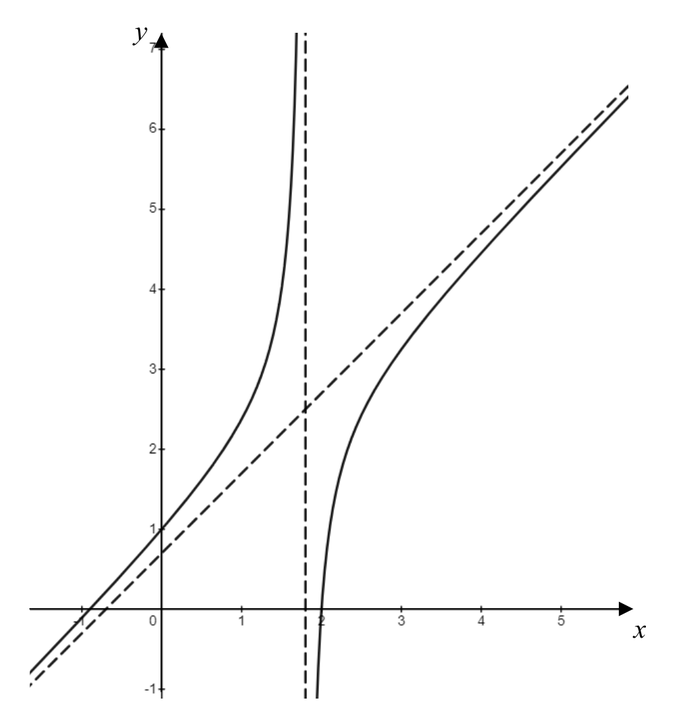
先因式分解分子求横轴交点,再用渐近线与严格递增性画两支。
答题过程
展开
The numerator factorises as
Hence the intercepts are , and .
Sketch two increasing branches with asymptotes and . The left branch lies above the oblique asymptote, crosses the axes at and , and tends to as . The right branch lies below the oblique asymptote, starts from as , crosses and increases towards the oblique asymptote.
(d)
解法一
思路
展开
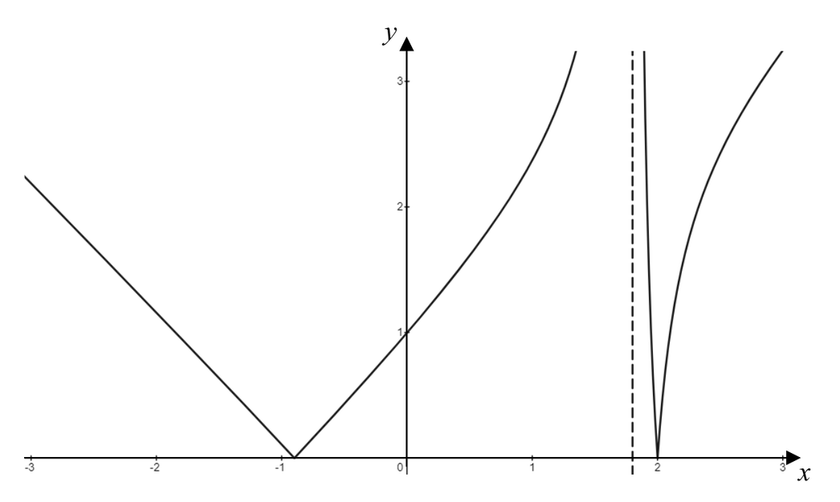
反射函数值为负的两段,两个横轴交点都变成尖点,竖直渐近线仍要保留。
答题过程
展开
Reflect the parts with and in the -axis; keep the positive parts unchanged.
The graph lies on or above the -axis and has sharp minima at and . It passes through , tends to on both sides of and retains that vertical asymptote.
(e)
解法一
思路
展开
题目已给对应y=−4的两个边界,另外两个边界由y=4求出。用两支严格递增确认p、q的顺序。
答题过程
展开
The two stated lower endpoints come from . The upper endpoints satisfy :
Thus or . Each branch of is strictly increasing. The root lies to the left of the vertical asymptote and is the upper endpoint of the first interval; lies to its right and is the upper endpoint of the second interval.
Therefore .