Skip to content
CalcGospel 國際數學圖譜
返回

CIE 9231 2023 June Paper 21 Q7

A Level / CIE / FP2

CIE 9231 2023 June Paper 21 Paper · Question 7

题目

Problem

(a) Use the substitution u=x2−1u=x^2-1 to find ∫xx2−1 dx\displaystyle\int\frac{x}{\sqrt{x^2-1}}\,\mathrm{d}x.

(3)

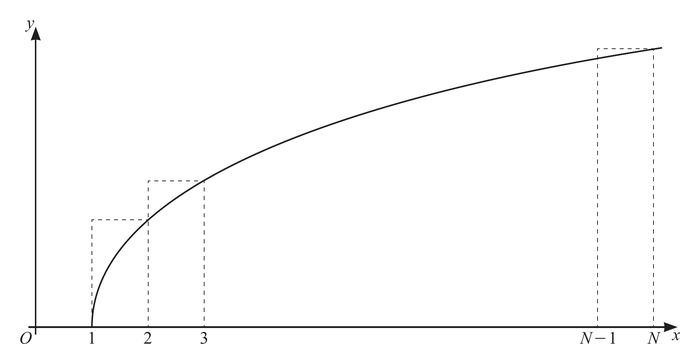
The diagram shows the curve with equation y=cosh⁡−1xy=\cosh^{-1}x together with a set of (N−1)(N-1) rectangles of unit width.

(b) By considering the sum of the areas of these rectangles, show that

∑r=2Nln⁡(r+r2−1)>Nln⁡(N+N2−1)−N2−1.\sum_{r=2}^{N}\ln\big(r+\sqrt{r^2-1}\big) \gt N\ln\big(N+\sqrt{N^2-1}\big)-\sqrt{N^2-1}.
(5)

(c) Use a similar method to find, in terms of NN, an upper bound for ∑r=2Nln⁡(r+r2−1)\displaystyle\sum_{r=2}^{N}\ln\big(r+\sqrt{r^2-1}\big).

(3)
题目中文翻译

(a) 用代换 u=x2−1u=x^2-1,求 ∫xx2−1 dx\displaystyle\int\frac{x}{\sqrt{x^2-1}}\,\mathrm{d}x。

(3)

图中显示了方程为 y=cosh⁡−1xy=\cosh^{-1}x 的曲线,以及一组由 (N−1)(N-1) 个宽为 11 的矩形组成的图形。

(b) 通过考虑这些矩形的面积之和,证明

∑r=2Nln⁡(r+r2−1)>Nln⁡(N+N2−1)−N2−1.\sum_{r=2}^{N}\ln\big(r+\sqrt{r^2-1}\big) \gt N\ln\big(N+\sqrt{N^2-1}\big)-\sqrt{N^2-1}.
(5)

(c) 用类似的方法求 ∑r=2Nln⁡(r+r2−1)\displaystyle\sum_{r=2}^{N}\ln\big(r+\sqrt{r^2-1}\big) 的一个上界,用 NN 表示。

(3)
原卷通用作答要求

Answer all questions. You should use a calculator where appropriate.

You must show all necessary working clearly; no marks will be given for unsupported answers from a calculator.

Give non-exact numerical answers correct to 3 significant figures, or 1 decimal place for angles in degrees, unless a different level of accuracy is specified in the question.

请回答所有题目。适当时应使用计算器。必须清楚展示所有必要的计算过程;仅给出计算器答案而没有过程,不予评分。除非题目另有精度要求,非精确数值答案保留 3 位有效数字,以度为单位的角度保留 1 位小数。

解答

(a)

解法一

思路

展开

令 u=x2−1u=x^2-1 后,分子 x dxx\,\mathrm{d}x 变成 12du\frac12\mathrm{d}u。

答题过程

展开

With u=x2−1u=x^2-1, du=2x dx\mathrm{d}u=2x\,\mathrm{d}x, so

∫xx2−1 dx= 12∫u−1/2 du= x2−1+C.\begin{align*} \int\frac{x}{\sqrt{x^2-1}}\,\mathrm{d}x =&\,\frac12\int u^{-1/2}\,\mathrm{d}u\\ =&\,\boxed{\sqrt{x^2-1}+C}. \end{align*}

(b)

解法一

思路

展开

题图取右端点,递增曲线下的面积小于矩形总面积。对反双曲余弦做分部积分,余项正好使用 (a)。

答题过程

展开

Let f(x)=arcosh⁡x=ln⁡(x+x2−1)f(x)=\operatorname{arcosh}x=\ln(x+\sqrt{x^2-1}). It is strictly increasing for x≥1x\ge1. The right-endpoint rectangles of width one on [1,N][1,N] have total area f(2)+f(3)+f(4)+⋯+f(N−1)+f(N)f(2)+f(3)+f(4)+\cdots+f(N-1)+f(N). Hence

∑r=2Nf(r)>∫1Nf(x) dx.\sum_{r=2}^N f(r)>\int_1^N f(x)\,\mathrm{d}x.

For integration by parts, take u=f(x)u=f(x) and dv=dx\mathrm{d}v=\mathrm{d}x. Then du=dx/x2−1\mathrm{d}u=\mathrm{d}x/\sqrt{x^2-1} and v=xv=x. Using (a),

∫f(x) dx= xf(x)−∫xx2−1 dx= xf(x)−x2−1+C.\begin{align*} \int f(x)\,\mathrm{d}x =&\,xf(x)-\int\frac{x}{\sqrt{x^2-1}}\,\mathrm{d}x\\ =&\,xf(x)-\sqrt{x^2-1}+C. \end{align*}

Thus an antiderivative is xf(x)−x2−1xf(x)-\sqrt{x^2-1} for x>1x>1. It tends to zero as x→1+x\to1^+, so

∫1Nf(x) dx=Nln⁡(N+N2−1)−N2−1.\int_1^N f(x)\,\mathrm{d}x =N\ln(N+\sqrt{N^2-1})-\sqrt{N^2-1}.

Substitution into the comparison proves the stated inequality.

(c)

解法一

思路

展开

在同一区间改用左端点。由于 f(1)=0f(1)=0,左端点和与所求的和只差最后一个 f(N)f(N)。

答题过程

展开

On [1,N][1,N] the left-endpoint rectangle sum is f(1)+f(2)+f(3)+⋯+f(N−2)+f(N−1)f(1)+f(2)+f(3)+\cdots+f(N-2)+f(N-1). It satisfies

∑r=1N−1f(r)<∫1Nf(x) dx.\sum_{r=1}^{N-1}f(r)<\int_1^N f(x)\,\mathrm{d}x.

Adding f(N)f(N) and using f(1)=0f(1)=0 gives the upper bound

(N+1)ln⁡(N+N2−1)−N2−1.\boxed{(N+1)\ln(N+\sqrt{N^2-1})-\sqrt{N^2-1}}.

For N>2N>2, comparing f(2)+⋯+f(N−1)f(2)+\cdots+f(N-1) with ∫2Nf(x) dx\int_2^N f(x)\,\mathrm{d}x also gives the slightly smaller upper bound

 (N+1)ln⁡(N+N2−1)−N2−1 −2ln⁡(2+3)+3.\begin{align*} &\,(N+1)\ln(N+\sqrt{N^2-1})-\sqrt{N^2-1}\\ &\,\hspace{2pt}-2\ln(2+\sqrt3)+\sqrt3. \end{align*}

解法二

思路

展开

也可把第 rr 项作为区间 [r,r+1][r,r+1] 的左端点矩形。这样恰好覆盖所求的全部项,比较的积分改为从 22 到 N+1N+1。

答题过程

展开

For r=2,…,Nr=2,\ldots,N, f(r)<∫rr+1f(x) dxf(r)<\int_r^{r+1}f(x)\,\mathrm{d}x because ff is strictly increasing. Thus the sum is less than ∫2N+1f(x) dx\int_2^{N+1}f(x)\,\mathrm{d}x. Using the antiderivative from (b), this upper bound is

 (N+1)ln⁡(N+1+N2+2N)−N2+2N −2ln⁡(2+3)+3.\begin{align*} &\,(N+1)\ln(N+1+\sqrt{N^2+2N})-\sqrt{N^2+2N}\\ &\,\hspace{2pt}-2\ln(2+\sqrt3)+\sqrt3. \end{align*}