Skip to content
CalcGospel 國際數學圖譜
返回

CIE 9231 2025 June Paper 24 Q8

A Level / CIE / FP2

CIE 9231 2025 June Paper 24 Paper · Question 8

题目

Problem

The curve CC has equation y=tanh⁡xy = \tanh x for x≥0x \ge 0.

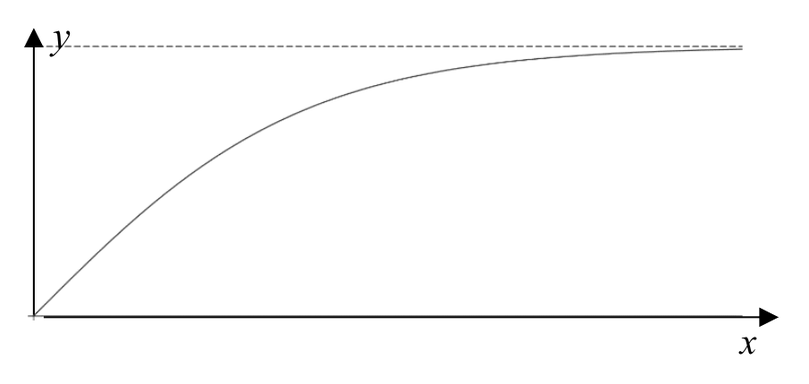
(a) Sketch CC and state the equation of the asymptote.

[2]

(b) By considering a suitable set of NN rectangles of unit width, use your sketch to show that

∑r=1Ntanh⁡r>ln⁡(cosh⁡N).\sum_{r = 1}^{N} \tanh r > \ln(\cosh N).
[3]

(c) The arc of CC joining the point where x=0x = 0 to the point where x=12ln⁡3x = \frac{1}{2}\ln 3 is rotated through one complete revolution about the xx-axis. The area of the surface generated is denoted by SS.

(i) Use the substitution u=1+sech⁡4xu = \sqrt{1 + \operatorname{sech}^4 x} to show that

S=π∫542u2u2−1 du.S = \pi\int_{\frac{5}{4}}^{\sqrt{2}} \frac{u^2}{u^2 - 1}\,\mathrm{d}u.
[7]

(ii) Find the exact value of

π∫542u2u2−1 du.\pi\int_{\frac{5}{4}}^{\sqrt{2}} \frac{u^2}{u^2 - 1}\,\mathrm{d}u.

You need not simplify your answer.

[3]
题目中文翻译

曲线 CC 的方程为 y=tanh⁡xy = \tanh x,其中 x≥0x \ge 0。

(a) 绘制 CC 的草图,并写出渐近线的方程。

(2)

(b) 考虑一组合适的、宽度为 1 的 NN 个矩形,利用你的草图证明

∑r=1Ntanh⁡r>ln⁡(cosh⁡N)\sum_{r = 1}^{N} \tanh r > \ln(\cosh N)
(3)

(c) 将 CC 上从 x=0x = 0 的点到 x=12ln⁡3x = \frac{1}{2}\ln 3 的点之间的弧段绕 xx 轴旋转一周。所得旋转曲面的面积记为 SS。

(i) 使用代换 u=1+sech⁡4xu = \sqrt{1 + \operatorname{sech}^4 x} 证明

S=π∫542u2u2−1 duS = \pi\int_{\frac{5}{4}}^{\sqrt{2}} \frac{u^2}{u^2 - 1}\,\mathrm{d}u
(7)

(ii) 求

π∫542u2u2−1 du\pi\int_{\frac{5}{4}}^{\sqrt{2}} \frac{u^2}{u^2 - 1}\,\mathrm{d}u

的精确值。答案不必化简。

(3)
原卷通用作答要求

Answer all questions. You should use a calculator where appropriate.

You must show all necessary working clearly; no marks will be given for unsupported answers from a calculator.

Give non-exact numerical answers correct to 3 significant figures, or 1 decimal place for angles in degrees, unless a different level of accuracy is specified in the question.

请回答所有题目。适当时应使用计算器。必须清楚展示所有必要的计算过程;仅给出计算器答案而没有过程,不予评分。除非题目另有精度要求,非精确数值答案保留 3 位有效数字,以度为单位的角度保留 1 位小数。

解答

(a)

解法一

思路

展开

从原点起画。曲线始终递增,但斜率逐渐减小,并从下方趋向水平渐近线。

答题过程

展开

The curve starts at (0,0)(0,0) and increases, since y′=sech⁡2x>0y'=\operatorname{sech}^2x>0. For x>0x>0, y′′=−2sech⁡2xtanh⁡x<0y''=-2\operatorname{sech}^2x\tanh x<0. Also tanh⁡x→1\tanh x\to1 as x→∞x\to\infty, so the horizontal asymptote is y=1\boxed{y=1}.

(b)

解法一

思路

展开

在草图上,从 00 到 NN 每隔 11 划一个区间。曲线递增,右端点高度给出的矩形在曲线上方。

答题过程

展开

On each [r−1,r][r-1,r], the width-one rectangle of height tanh⁡r\tanh r lies above the curve except at the right endpoint. The total area is

1tanh⁡1+1tanh⁡2+1tanh⁡3+⋯+1tanh⁡(N−1)+1tanh⁡N,1\tanh1+1\tanh2+1\tanh3+\cdots+1\tanh(N-1)+1\tanh N,

where the terms show the pattern of NN rectangles. Thus

∑r=1Ntanh⁡r>∫0Ntanh⁡x dx=[ln⁡(cosh⁡x)]0N=ln⁡(cosh⁡N).\sum_{r=1}^N\tanh r>\int_0^N\tanh x\,\mathrm{d}x =[\ln(\cosh x)]_0^N=\ln(\cosh N).

(c)(i)

解法一

思路

展开

先写绕 xx 轴旋转的曲面面积公式。按题意求 dudx\frac{\mathrm{d}u}{\mathrm{d}x},用 u2−1=sech⁡4xu^2-1=\operatorname{sech}^4x 整理,并换掉两个积分端点。

答题过程

展开

The surface area about the xx-axis is

S=2π∫aby1+(dydx)2 dx.S=2\pi\int_a^b y\sqrt{1+\bigg(\frac{\mathrm{d}y}{\mathrm{d}x}\bigg)^2}\,\mathrm{d}x.

Since y=tanh⁡xy=\tanh x and y′=sech⁡2xy'=\operatorname{sech}^2x,

S=2π∫0(ln⁡3)/2tanh⁡x1+sech⁡4x dx.S=2\pi\int_0^{(\ln3)/2}\tanh x\sqrt{1+\operatorname{sech}^4x}\,\mathrm{d}x.

With u=1+sech⁡4xu=\sqrt{1+\operatorname{sech}^4x}, we have

dudx=−2sech⁡4xtanh⁡xu,\frac{\mathrm{d}u}{\mathrm{d}x} =-\frac{2\operatorname{sech}^4x\tanh x}{u},

Since u2−1=sech⁡4xu^2-1=\operatorname{sech}^4x, this gives

2utanh⁡x dx=−u2u2−1 du.2u\tanh x\,\mathrm{d}x=-\frac{u^2}{u^2-1}\,\mathrm{d}u.

At x=0x=0, u=2u=\sqrt2. At x=12ln⁡3x=\frac12\ln3, tanh⁡x=(3−1)/(3+1)=12\tanh x=(3-1)/(3+1)=\frac12, so sech⁡2x=1−14=34\operatorname{sech}^2x=1-\frac14=\frac34 and u=1+916=54u=\sqrt{1+\frac9{16}}=\frac54. Reversing the transformed limits cancels the minus sign, giving

S=π∫5/42u2u2−1 du.S=\pi\int_{5/4}^{\sqrt2}\frac{u^2}{u^2-1}\,\mathrm{d}u.

(c)(ii)

解法一

思路

展开

先把分子除以分母,余下的真分式拆成 1/(u−1)1/(u-1) 和 1/(u+1)1/(u+1) 两项。

答题过程

展开

For u>1u>1,

u2u2−1=1+12(1u−1−1u+1).\frac{u^2}{u^2-1}=1+\frac12\bigg(\frac1{u-1}-\frac1{u+1}\bigg).

Thus

S= π[u+12ln⁡(u−1u+1)]5/42= π[2−54+ln⁡3 +12ln⁡(2−12+1)].\begin{align*} S=&\,\pi\bigg[u+\frac12\ln\bigg(\frac{u-1}{u+1}\bigg)\bigg]_{5/4}^{\sqrt2}\\ =&\,\pi\bigg[\sqrt2-\frac54+\ln3\\[4mm] &\,\hspace{2pt}+\frac12\ln\bigg(\frac{\sqrt2-1}{\sqrt2+1}\bigg)\bigg]. \end{align*}