Skip to content
CalcGospel 國際數學圖譜
返回

CIE 9231 2022 November Paper 22 Q6

A Level / CIE / FP2

CIE 9231 2022 Nov Paper 22 Paper · Question 6

题目

Problem

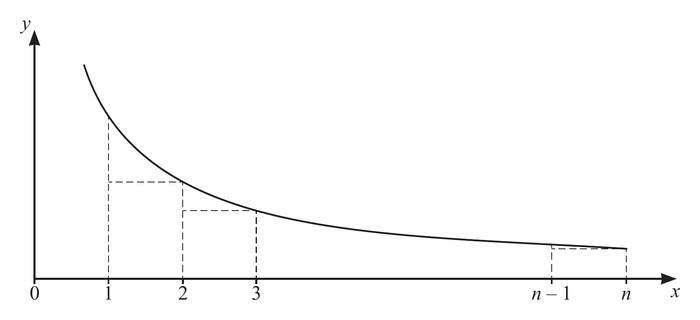
The diagram shows the curve y=1x2+2xy=\dfrac{1}{\sqrt{x^2+2x}} for x>0x\gt0, together with a set of (n−1)(n-1) rectangles of unit width.

By considering the sum of the areas of these rectangles, show that

∑r=1n1r2+2r< ln⁡(n+1+n2+2n) +133−ln⁡(2+3).\begin{align*} \sum_{r=1}^{n}\frac{1}{\sqrt{r^2+2r}}<&\,\ln\big(n+1+\sqrt{n^2+2n}\big)\\ &\,\hspace{2pt}+\frac{1}{3}\sqrt{3}-\ln\big(2+\sqrt{3}\big). \end{align*}
(10)
题目中文翻译

图中显示了曲线 y=1x2+2xy=\dfrac{1}{\sqrt{x^2+2x}}(x>0x\gt0),以及一组宽均为一个单位的 (n−1)(n-1) 个矩形。

通过考虑这些矩形的面积之和,证明

∑r=1n1r2+2r< ln⁡(n+1+n2+2n) +133−ln⁡(2+3).\begin{align*} \sum_{r=1}^{n}\frac{1}{\sqrt{r^2+2r}}<&\,\ln\big(n+1+\sqrt{n^2+2n}\big)\\ &\,\hspace{2pt}+\frac{1}{3}\sqrt{3}-\ln\big(2+\sqrt{3}\big). \end{align*}
(10)
原卷通用作答要求

Answer all questions. You should use a calculator where appropriate.

You must show all necessary working clearly; no marks will be given for unsupported answers from a calculator.

Give non-exact numerical answers correct to 3 significant figures, or 1 decimal place for angles in degrees, unless a different level of accuracy is specified in the question.

请回答所有题目。适当时应使用计算器。必须清楚展示所有必要的计算过程;仅给出计算器答案而没有过程,不予评分。除非题目另有精度要求,非精确数值答案保留 3 位有效数字,以度为单位的角度保留 1 位小数。

解答

解法一

思路

展开

曲线递减,题图取右端点,面积和从 r=2r=2 开始。先与 [1,n][1,n] 上的积分比较,配方后用反双曲余弦求积分,最后补回 r=1r=1 项。

答题过程

展开

Let f(x)=(x2+2x)−1/2f(x)=(x^2+2x)^{-1/2} for x>0x>0. It is strictly decreasing because x2+2xx^2+2x is strictly increasing. The right-endpoint rectangles of width one on [1,n][1,n], with n>1n>1, give

 f(2)+f(3)+f(4)+⋯+f(n−1)+f(n)= 18+115+124+⋯ +1(n−1)2+2(n−1)+1n2+2n= ∑r=2nf(r)<∫1nf(x) dx.\begin{align*} &\,f(2)+f(3)+f(4)+\cdots+f(n-1)+f(n)\\ =&\,\frac1{\sqrt8}+\frac1{\sqrt{15}}+\frac1{\sqrt{24}}+\cdots\\ &\,\hspace{2pt}+\frac1{\sqrt{(n-1)^2+2(n-1)}}+\frac1{\sqrt{n^2+2n}}\\ =&\,\sum_{r=2}^{n}f(r)<\int_1^n f(x)\,\mathrm{d}x. \end{align*}

The first and last terms in the sum are f(2)f(2) and f(n)f(n). Since x2+2x=(x+1)2−1x^2+2x=(x+1)^2-1, put u=x+1u=x+1, so du=dx\mathrm{d}u=\mathrm{d}x and uu runs from 22 to n+1n+1. The standard antiderivative is arcosh⁡u=ln⁡(u+u2−1)\operatorname{arcosh}u=\ln(u+\sqrt{u^2-1}). Thus

∫1nf(x) dx= [arcosh⁡(x+1)]1n= [ln⁡(x+1+x2+2x)]1n= ln⁡(n+1+n2+2n)−ln⁡(2+3).\begin{align*} \int_1^n f(x)\,\mathrm{d}x =&\,[\operatorname{arcosh}(x+1)]_1^n\\ =&\,\big[\ln(x+1+\sqrt{x^2+2x})\big]_1^n\\ =&\,\ln(n+1+\sqrt{n^2+2n})-\ln(2+\sqrt3). \end{align*}

Adding f(1)=1/3=3/3f(1)=1/\sqrt3=\sqrt3/3 gives the required strict bound.