题目
Problem
(a) State the sum of the series 1+z+z2+⋯+zn−1, for z=1.
[1]
(b) By letting z=cosθ+isinθ, where cosθ=1, show that
1+cosθ+cos2θ+⋯+cos(n−1)θ=21(1−cosnθ+1−cosθsinnθsinθ).
[7]
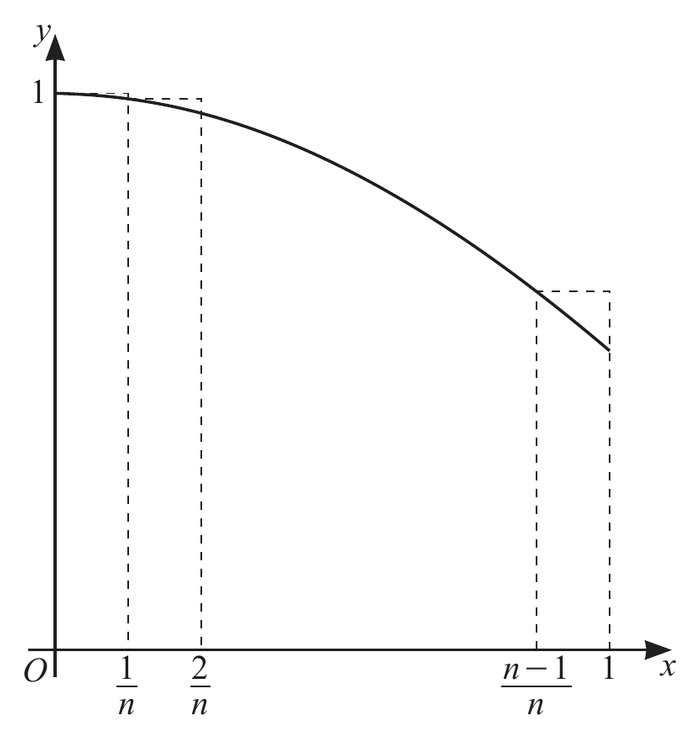
The diagram shows the curve with equation y=cosx for 0≤x≤1, together with a set of n rectangles of width n1.
(c) By considering the sum of the areas of these rectangles, show that
∫01cosxdx<2n1(1−cos1+1−cosn1sinn1sin1).
[4]
(d) Use a similar method to find, in terms of n, a lower bound for
∫01cosxdx.
[3]
题目中文翻译
(a) 写出级数 1+z+z2+⋯+zn−1 的和,其中 z=1。
(1)
(b) 令 z=cosθ+isinθ,其中 cosθ=1,证明
1+cosθ+cos2θ+⋯+cos(n−1)θ=21(1−cosnθ+1−cosθsinnθsinθ)
(7)
图中显示曲线 y=cosx,其中 0≤x≤1,以及一组宽度均为 n1 的 n 个矩形。
(c) 通过考虑这些矩形的面积之和,证明
∫01cosxdx<2n1(1−cos1+1−cosn1sinn1sin1)
(4)
(d) 使用类似方法,求关于 n 的积分
∫01cosxdx
的下界。
(3)
原卷通用作答要求
Answer all questions. You should use a calculator where appropriate.
You must show all necessary working clearly; no marks will be given for unsupported answers from a calculator.
Give non-exact numerical answers correct to 3 significant figures, or 1 decimal place for angles in degrees, unless a different level of accuracy is specified in the question.
请回答所有题目。适当时应使用计算器。必须清楚展示所有必要的计算过程;仅给出计算器答案而没有过程,不予评分。除非题目另有精度要求,非精确数值答案保留 3 位有效数字,以度为单位的角度保留 1 位小数。
解答
(a)
解法一
思路
展开
用首项为 1、公比为 z 的有限等比数列求和公式。
答题过程
展开
For z=1,
1+z+⋯+zn−1=1−z1−zn.
(b)
解法一
思路
展开
余弦和是等比和的实部。将分子分母同乘 1−zˉ,分母可化成 2(1−cosθ)。
答题过程
展开
Let z=cosθ+isinθ. By de Moivre’s theorem, the required cosine sum is the real part of (1−zn)/(1−z). Multiplying by 1−zˉ makes the denominator
(1−cosθ)2+sin2θ=2(1−cosθ).
Let a=1−cosnθ, b=sinnθ, c=1−cosθ, and d=sinθ. Then
(a−ib)(c+id)=ac+bd+i(ad−bc).
Thus
Re(1−z1−zn)===2cac+bd21(a+cbd)21(1−cosnθ+1−cosθsinnθsinθ).
解法二
思路
展开
也可在指数形式的分子和分母同时乘 e−iθ/2,把分母化成纯虚数。取实部后,再用半角恒等式。
答题过程
展开
With z=eiθ,
z−1zn−1=2isin(θ/2)ei(n−1/2)θ−e−iθ/2.
Its real part is
==2sin(θ/2)sin((n−21)θ)+sin(θ/2)21+2sin(θ/2)sinnθcos(θ/2)−21cosnθ21(1−cosnθ+sinnθsin(θ/2)cos(θ/2)).
Using cos(θ/2)/sin(θ/2)=sinθ/(1−cosθ) gives the required identity.
(c)
解法一
思路
展开
余弦在 [0,1] 上递减,题图的左端点矩形给出上界。面积和中的角度以 1/n 为步长,直接用 (b)。
答题过程
展开
The left-endpoint rectangles have total area
Un==n1[1+cosn1+cosn2+⋯+cosnn−2+cosnn−1]n1r=0∑n−1cosnr.
Since cosine is strictly decreasing on [0,1], the integral is strictly less than Un. Applying (b) with θ=1/n gives
∫01cosxdx<2n1(1−cos1+1−cos(1/n)sin1sin(1/n)).
(d)
解法一
思路
展开
右端点矩形给出下界。与上界相比,只需删去高度 cos0 对应的面积,再加上高度 cos1 对应的面积。
答题过程
展开
The area sum of the right-endpoint rectangles lies strictly below the integral. It differs from Un by replacing the term 1/n with (cos1)/n. Therefore the lower bound is
Ln==Un+ncos1−12n1(cos1−1+1−cos(1/n)sin1sin(1/n)).
