题目
Problem
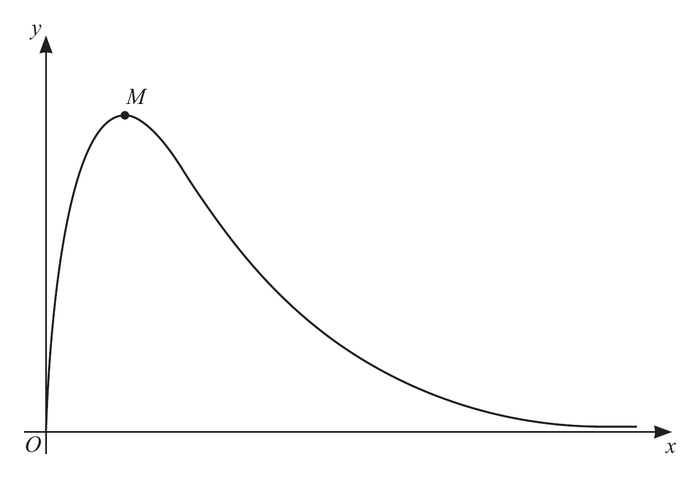
The diagram shows part of the curve y=xsech2x and its maximum point M.
(a) Show that, at M,
2xtanhx−1=0
and verify that this equation has a root between 0.7 and 0.8.
[4]
(b) By considering a suitable set of rectangles, use the diagram to show that
r=2∑nrsech2r<ntanhn+ln(sechn)−tanh1−ln(sech1).
[6]
题目中文翻译
图中显示了曲线 y=xsech2x 的一部分及其最高点 M。
(a) 证明在 M 点,
2xtanhx−1=0
并验证此方程在 0.7 与 0.8 之间有一个根。
(4)
(b) 考虑一组合适的矩形,利用图示证明
r=2∑nrsech2r<ntanhn+ln(sechn)−tanh1−ln(sech1)
(6)
原卷通用作答要求
Answer all questions. You should use a calculator where appropriate.
You must show all necessary working clearly; no marks will be given for unsupported answers from a calculator.
Give non-exact numerical answers correct to 3 significant figures, or 1 decimal place for angles in degrees, unless a different level of accuracy is specified in the question.
请回答所有题目。适当时应使用计算器。必须清楚展示所有必要的计算过程;仅给出计算器答案而没有过程,不予评分。除非题目另有精度要求,非精确数值答案保留 3 位有效数字,以度为单位的角度保留 1 位小数。
解答
(a)
解法一
思路
展开
用乘积法则求导,提出始终为正的 sech2x。再对剩下的方程检查两端的符号。
答题过程
展开
For f(x)=xsech2x,
f′(x)==sech2x−2xsech2xtanhxsech2x(1−2xtanhx).
At M the derivative vanishes. Since sech2x>0, we obtain 2xtanhx−1=0. The continuous function h(x)=2xtanhx−1 satisfies
h(0.7)≈−0.154<0,h(0.8)≈0.062>0.
So it has a root in (0.7,0.8).
(b)
解法一
思路
展开
在 x≥1 的下降段用宽为 1 的右端点矩形。它们给出积分的下界。积分时把 x 保留作因子,对 sech2x 积分。
答题过程
展开
For x>0, h′(x)=2tanhx+2xsech2x>0. Since h(0.8)>0, it follows that f′(x)<0 for x≥1. For r=2,…,n, the rectangle on [r−1,r] with height f(r) lies below the curve on the interval interior. The areas are 2sech22, 3sech23, 4sech24, …, (n−1)sech2(n−1), nsech2n. Thus
r=2∑nrsech2r<∫1nxsech2xdx.
Take u=x and dv=sech2xdx, so du=dx and v=tanhx. Integration by parts gives
∫1nxsech2xdx===[xtanhx]1n−∫1ntanhxdx[xtanhx+ln(sechx)]1nntanhn+ln(sechn)−tanh1−ln(sech1).
This proves the claimed bound.
