题目
Problem
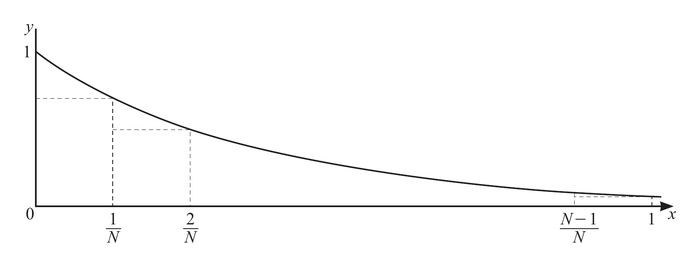
The diagram shows the curve with equation y=(21)x for 0≤x≤1, together with a set of N rectangles each of width N1.
(a) By considering the sum of the areas of these rectangles, show that
∫01(21)xdx>LN,
where
LN=2N(2N1−1)1.
[4]
(b) Use a similar method to find, in terms of N, an upper bound UN for
∫01(21)xdx.
[4]
(c) Find the least value of N such that UN−LN≤10−3.
[2]
(d) Given that
∫01(21)xdx=2ln21,
use the value of N found in part (c) to find upper and lower bounds for ln2.
[4]
题目中文翻译
图中显示曲线 y=(21)x,其中 0≤x≤1,以及一组宽度均为 N1 的 N 个矩形。
(a) 通过考虑这些矩形的面积之和,证明
∫01(21)xdx>LN
其中
LN=2N(2N1−1)1
(4)
(b) 使用类似方法,求
∫01(21)xdx
的一个关于 N 的上界 UN。
(4)
(c) 求使 UN−LN≤10−3 的最小 N 值。
(2)
(d) 已知
∫01(21)xdx=2ln21
使用 (c) 部分求得的 N 值,求 ln2 的上下界。
(4)
原卷通用作答要求
Answer all questions. You should use a calculator where appropriate.
You must show all necessary working clearly; no marks will be given for unsupported answers from a calculator.
Give non-exact numerical answers correct to 3 significant figures, or 1 decimal place for angles in degrees, unless a different level of accuracy is specified in the question.
请回答所有题目。适当时应使用计算器。必须清楚展示所有必要的计算过程;仅给出计算器答案而没有过程,不予评分。除非题目另有精度要求,非精确数值答案保留 3 位有效数字,以度为单位的角度保留 1 位小数。
解答
(a)
解法一
思路
展开
题图取右端点的高度。曲线递减,所以这些矩形的面积和严格小于积分。面积构成等比数列,可用求和公式。
答题过程
展开
Let r=2−1/N. The right-endpoint rectangles lie below the decreasing curve on the interior of each interval. Hence their area sum satisfies
LN====<N1(r+r2+r3+⋯+rN−1+rN)N(1−r)r(1−rN)2N(r−1−1)12N(21/N−1)1∫01(1/2)xdx,
where rN=21. The displayed terms indicate the pattern of N rectangles; for small N, the sum contains each of its N terms once.
(b)
解法一
思路
展开
改用左端点的高度。与 (a) 的等比和相比,每一项都除以公比 r。
答题过程
展开
The left-endpoint rectangles lie above the decreasing curve, so their area sum gives the upper bound
UN===N1(1+r+r2+⋯+rN−2+rN−1)N(1−r)1−rN2N(21/N−1)21/N.
(c)
解法一
思路
展开
上下界相减后,分子消去同一个指数差。再解不等式并取最小正整数。
答题过程
展开
We have
UN−LN=2N(21/N−1)21/N−1=2N1.
The condition 2N1≤10−3 gives N≥500, so the least value is 500.
(d)
解法一
思路
展开
将给定积分夹在 LN 和 UN 之间。三项都为正,取倒数时不等号反向。
答题过程
展开
From LN<1/(2ln2)<UN we obtain
2UN1<ln2<2LN1.
Putting N=500 gives the exact bounds
500(1−2−1/500)<ln2<500(21/500−1).
The bounds are approximately 0.6926669495 and 0.6936278557, respectively. Rounding outward gives 0.69266<ln2<0.69363.
