(a) Use the substitution x=212sinhu to find ∫2x2+11dx.
[3]
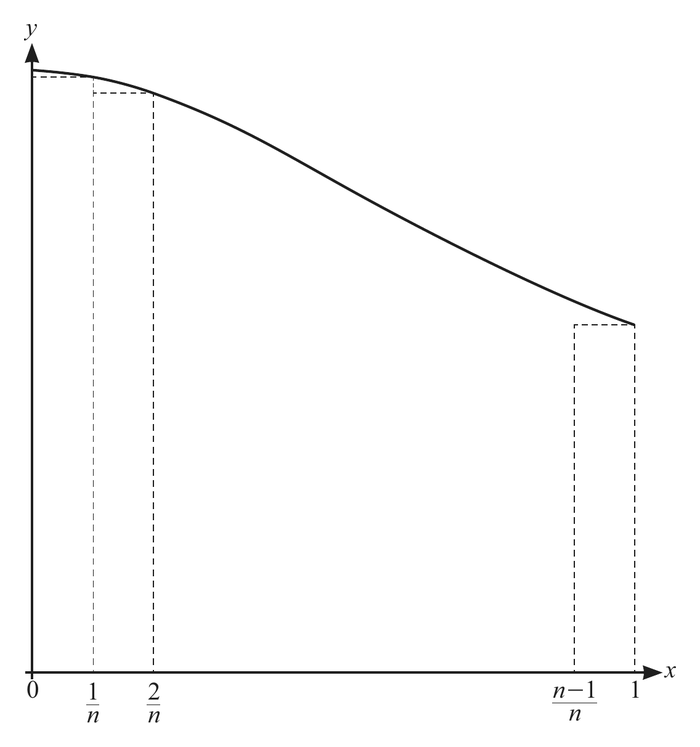
The diagram shows the curve with equation y=2x2+11 for 0≤x≤1, together with a set of n rectangles of width n1.
(b) By considering the sum of the areas of these rectangles, show that
r=1∑n2r2+n21<212ln(2+3).
[5]
(c) Use a similar method to find, in terms of n, a lower bound for ∑r=1n2r2+n21.
[4]
(d) Deduce the exact value of
n→∞limr=1∑n2r2+n21.
[1]
题目中文翻译
(a) 使用代换 x=212sinhu,求 ∫2x2+11dx。
(3)
题图显示曲线 y=2x2+11,其中 0≤x≤1,以及一组宽为 n1 的 n 个矩形。
(b) 通过考虑这些矩形面积之和,证明
r=1∑n2r2+n21<212ln(2+3).
(5)
(c) 用类似方法,求出关于 n 的 ∑r=1n2r2+n21 的下界。
(4)
(d) 推得
n→∞limr=1∑n2r2+n21
的精确值。
(1)
原卷通用作答要求
Answer all questions. You should use a calculator where appropriate.
You must show all necessary working clearly; no marks will be given for unsupported answers from a calculator.
Give non-exact numerical answers correct to 3 significant figures, or 1 decimal place for angles in degrees, unless a different level of accuracy is specified in the question.
Let f(x)=(2x2+1)−1/2, which is strictly decreasing on [0,1]. The rectangles in the diagram use the right endpoints. For example, writing the first terms and the final term, the area sum is
Write I=21ln(2+3). By (a), I=[arsinh(2x)/2]01, since arsinh(2)=ln(2+3) and arsinh(0)=0. The left-endpoint area sum is greater than I. It exceeds Sn by