(a) Find the exact values of x for which cosh2x=6sinh2x, giving your answers in logarithmic form.
[4]
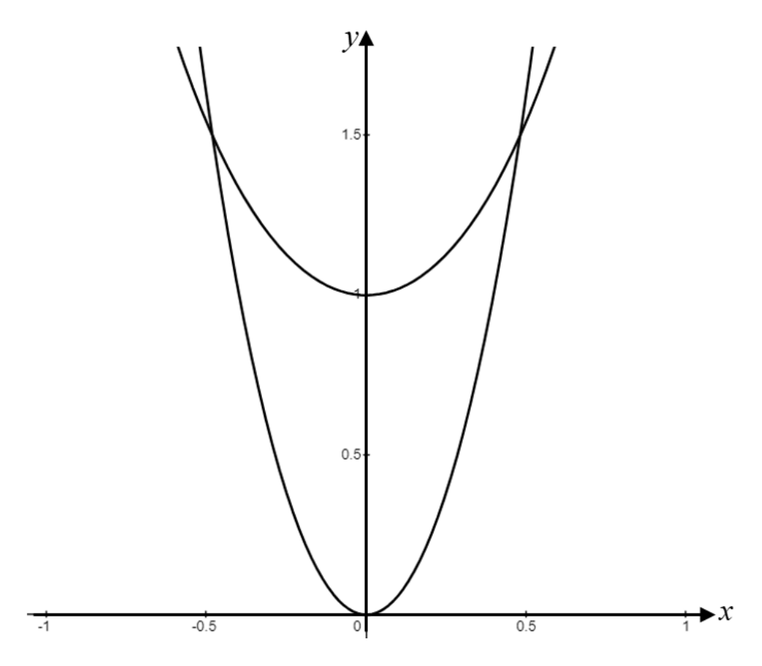
(b) Sketch the curves C1:y=cosh2x and C2:y=6sinh2x on the same diagram.
[2]
题目中文翻译
(a) 求满足 cosh2x=6sinh2x 的 x 的精确值,并用对数形式给出答案。
(4)
(b) 在同一图中画出曲线 C1:y=cosh2x 和 C2:y=6sinh2x。
(2)
原卷通用作答要求
Answer all questions. You should use a calculator where appropriate.
You must show all necessary working clearly; no marks will be given for unsupported answers from a calculator.
Give non-exact numerical answers correct to 3 significant figures, or 1 decimal place for angles in degrees, unless a different level of accuracy is specified in the question.
Using cosh2x=1+2sinh2x gives 4sinh2x=1. Thus sinhx=±21 and
x===arsinh(±21)ln(±21+1+41)ln(25±1).
解法二
思路
展开
也可把双曲函数全写成指数式。令 u=e2x,所得方程是一个二次方程。
答题过程
展开
The equation becomes
2e2x+e−2x=23(e2x−2+e−2x).
Hence e2x+e−2x=3. With u=e2x>0, we obtain u2−3u+1=0, so
e2x=23±5=(25±1)2.
Taking logarithms gives x=ln(25±1).
(b)
解法一
思路
展开
两条曲线都是偶函数,先标出各自在 y 轴上的最低点。再用 (a) 标出两个交点,并检查两条曲线在交点内外的高低关系。
答题过程
展开
Both curves are symmetric about the y-axis. The minimum of C1 is (0,1) and the minimum of C2 is (0,0). Let h=ln(25+1). The curves meet at (−h,23) and (h,23). Since C2−C1 in height is 4sinh2x−1, C2 is lower for ∣x∣<h and higher for ∣x∣>h.