题目
Problem
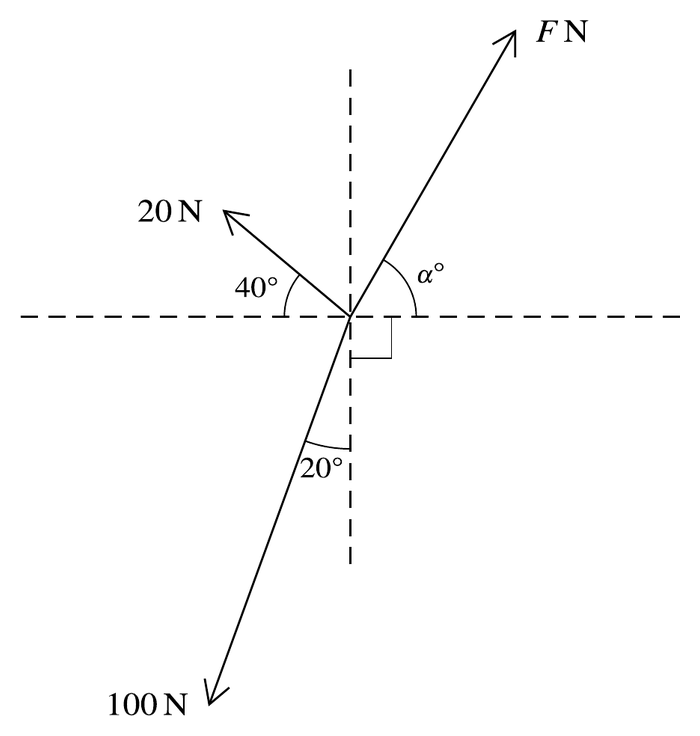
Three coplanar forces of magnitudes 20 N 20\,\mathrm{N} 20 N 100 N 100\,\mathrm{N} 100 N F N F\,\mathrm{N} F N
Given that the three forces are in equilibrium, find F F F α \alpha α
(6)
题目中文翻译
大小分别为 20 N 20\,\mathrm{N} 20 N 100 N 100\,\mathrm{N} 100 N F N F\,\mathrm{N} F N
已知这三个力处于平衡状态,求 F F F α \alpha α
(6)
原卷通用作答要求
Answer all questions. You should use a calculator where appropriate.
You must show all necessary working clearly; no marks will be given for unsupported answers from a calculator.
Give non-exact numerical answers correct to 3 significant figures, or 1 decimal place for angles in degrees, unless a different level of accuracy is specified in the question.
请回答所有题目。适当时应使用计算器。必须清楚展示所有必要的计算过程;仅给出计算器答案而没有过程,不予评分。除非题目另有精度要求,非精确数值答案保留 3 位有效数字,以度为单位的角度保留 1 位小数。
Where a numerical value for the acceleration due to gravity (g g g 10 m s − 2 10\,\mathrm{m\,s^{-2}} 10 m s − 2
需要使用重力加速度 g g g 10 m s − 2 10\,\mathrm{m\,s^{-2}} 10 m s − 2
解答
解法一
思路
展开
分别沿水平和竖直平衡,计算F的两个分量;按原图选择第一象限方向。
答题过程
展开
Horizontal and vertical equilibrium give
F cos α = 20 cos 40 ∘ + 100 sin 20 ∘ , F\cos\alpha=20\cos40^\circ+100\sin20^\circ, F cos α = 20 cos 4 0 ∘ + 100 sin 2 0 ∘ , F sin α = 100 cos 20 ∘ − 20 sin 40 ∘ . F\sin\alpha=100\cos20^\circ-20\sin40^\circ. F sin α = 100 cos 2 0 ∘ − 20 sin 4 0 ∘ . Denote these positive right-hand sides by H H H V V V
H = 49.522903 … , V = 81.113509 … . \begin{align*}
H=&\,49.522903\ldots,\\[4mm]
V=&\,81.113509\ldots.
\end{align*} H = V = 49.522903 … , 81.113509 … . Therefore
F = H 2 + V 2 ≈ 95.0 , F=\sqrt{H^2+V^2}\approx\boxed{95.0}, F = H 2 + V 2 ≈ 95.0 , α = tan − 1 ( V / H ) ≈ 58.6 ∘ . \alpha=\tan^{-1}(V/H)\approx\boxed{58.6^\circ}. α = tan − 1 ( V / H ) ≈ 58. 6 ∘ .
解法二
思路
展开
三个平衡力组成闭合三角形,已知两边100和20及夹角70度,用余弦定理及正弦定理。
答题过程
展开
In the closed triangle of forces, the sides 100 100 100 20 20 20 70 ∘ 70^\circ 7 0 ∘
F 2 = 100 2 + 20 2 − 2 ( 100 ) ( 20 ) cos 70 ∘ , F^2=100^2+20^2-2(100)(20)\cos70^\circ, F 2 = 10 0 2 + 2 0 2 − 2 ( 100 ) ( 20 ) cos 7 0 ∘ , so F = 95.036411 … F=95.036411\ldots F = 95.036411 … 20 20 20 β \beta β β = 70 ∘ − α \beta=70^\circ-\alpha β = 7 0 ∘ − α
F sin 70 ∘ = 20 sin β . \frac{F}{\sin70^\circ}=\frac{20}{\sin\beta}. sin 7 0 ∘ F = sin β 20 . Thus β = 11.405663 … ∘ \beta=11.405663\ldots^\circ β = 11.405663 … ∘
F ≈ 95.0 , \boxed{F\approx95.0}, F ≈ 95.0 , α = 70 ∘ − β ≈ 58.6 ∘ . \alpha=70^\circ-\beta\approx\boxed{58.6^\circ}. α = 7 0 ∘ − β ≈ 58. 6 ∘ .
解法三
思路
展开
也可沿100牛力的反方向及其垂直方向分解,以消去一个力的分量,再由两个分量求F及角。
答题过程
展开
Resolving parallel and perpendicular to the line of action of the 100 N 100\,\mathrm{N} 100 N
F sin ( α + 20 ∘ ) = 100 − 20 sin 20 ∘ , F\sin(\alpha+20^\circ)=100-20\sin20^\circ, F sin ( α + 2 0 ∘ ) = 100 − 20 sin 2 0 ∘ , F cos ( α + 20 ∘ ) = 20 cos 20 ∘ . F\cos(\alpha+20^\circ)=20\cos20^\circ. F cos ( α + 2 0 ∘ ) = 20 cos 2 0 ∘ . Hence
F 2 = ( 100 − 20 sin 20 ∘ ) 2 + ( 20 cos 20 ∘ ) 2 . \begin{align*}
F^2=&\,(100-20\sin20^\circ)^2\\[4mm]
&\,+(20\cos20^\circ)^2.
\end{align*} F 2 = ( 100 − 20 sin 2 0 ∘ ) 2 + ( 20 cos 2 0 ∘ ) 2 . Taking the positive square root,
F ≈ 95.0 . F\approx\boxed{95.0}. F ≈ 95.0 . Both components are positive. Thus
α + 20 ∘ = tan − 1 ( 100 − 20 sin 20 ∘ 20 cos 20 ∘ ) , \alpha+20^\circ
=\tan^{-1}\bigg(\frac{100-20\sin20^\circ}{20\cos20^\circ}\bigg), α + 2 0 ∘ = tan − 1 ( 20 cos 2 0 ∘ 100 − 20 sin 2 0 ∘ ) , giving α ≈ 58.6 ∘ \boxed{\alpha\approx58.6^\circ} α ≈ 58. 6 ∘