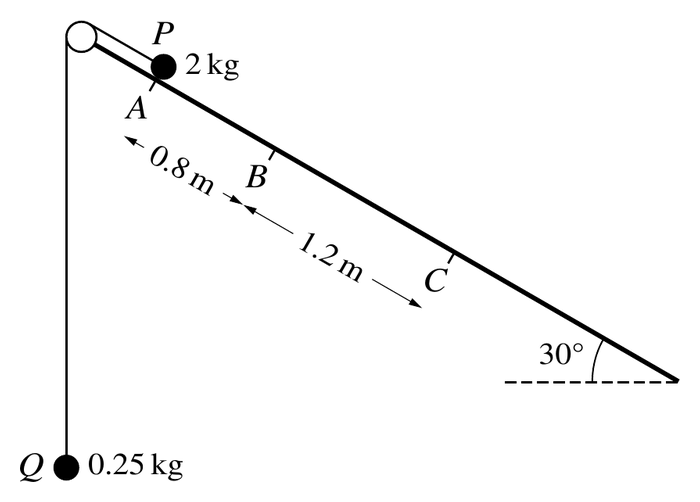
Two particles P and Q, of masses 2kg and 0.25kg respectively, are connected by a light inextensible string that passes over a fixed smooth pulley. Particle P is on an inclined plane at an angle of 30∘ to the horizontal. Particle Q hangs below the pulley. Three points A, B and C lie on a line of greatest slope of the plane with AB=0.8m and BC=1.2m (see diagram).
Particle P is released from rest at A with the string taut and slides down the plane. During the motion of P from A to C, Q does not reach the pulley. The part of the plane from A to B is rough, with coefficient of friction 0.3 between the plane and P. The part of the plane from B to C is smooth.
(a) (i) Find the acceleration of P between A and B.
(4)
(ii) Hence, find the speed of P at C.
(5)
(b) Find the time taken for P to travel from A to C.
(4)
题目中文翻译
两个质点 P 和 Q 的质量分别为 2kg 和 0.25kg,由一根绕过固定光滑滑轮的不可伸长轻绳连接。质点 P 位于与水平面成 30∘ 角的斜面上。质点 Q 悬挂在滑轮下方。三个点 A、B 和 C 位于斜面的一条最大坡度线上,其中 AB=0.8m,BC=1.2m(见图)。
质点 P 在绳绷紧的情况下从 A 点由静止释放,沿斜面向下滑动。在 P 从 A 运动到 C 的过程中,Q 不会到达滑轮。斜面从 A 到 B 的部分粗糙,斜面与 P 之间的摩擦系数为 0.3。斜面从 B 到 C 的部分光滑。
(a) (i) 求 P 在 A 与 B 之间运动时的加速度。
(4)
(ii) 由此求 P 在 C 点的速率。
(5)
(b) 求 P 从 A 运动到 C 所用的时间。
(4)
原卷通用作答要求
Answer all questions. You should use a calculator where appropriate.
You must show all necessary working clearly; no marks will be given for unsupported answers from a calculator.
Give non-exact numerical answers correct to 3 significant figures, or 1 decimal place for angles in degrees, unless a different level of accuracy is specified in the question.
Where a numerical value for the acceleration due to gravity (g) is needed, use 10ms−2.
需要使用重力加速度 g 的数值时,取 10ms−2。
解答
(a)(i)
解法一
思路
展开
P下坡、Q上升。粗糙段支持力决定摩擦,对整体列牛顿第二定律消去张力。
答题过程
展开
On AB, the friction on P is
F=0.3(2)(10)cos30∘=33N.
Resolving for the whole system in the direction of motion,
2(10)sin30∘−F−0.25(10)=2.25a1.
Therefore
a1=310−43ms−2≈1.02ms−2.
(a)(ii)
解法一
思路
展开
承接(a)(i)先求B处速率,进入光滑段后重新求加速度,再求C处速率。
答题过程
展开
Using the acceleration from (a)(i), the speed u at B satisfies
u2=2a1(0.8)=1580−323.u=1.279957…ms−1.
On smooth BC, the system equation gives
10−2.5=2.25a2,a2=310.
Thus the speed v at C satisfies
v2=u2+2(310)(1.2)=u2+8.
Hence
v≈3.10ms−1.
解法二
思路
展开
承接粗糙段加速度求B速率,光滑段则对系统写机械能变化,不需重新算张力。
答题过程
展开
From (a)(i),
u2=2a1(0.8)=1580−323.
Over BC, the decrease in the system’s potential energy is
2(10)(1.2)sin30∘−0.25(10)(1.2)=9J.
There is no friction on this section, so
21(2.25)(v2−u2)=9,v2=u2+8.
Therefore
v≈3.10ms−1.
解法三
思路
展开
用(a)(i)的系统受力结果识别粗糙段摩擦,再对整个A到C过程作能量平衡,摩擦只作用于前0.8米。
答题过程
展开
From the system equation in (a)(i), the friction on AB is F=7.5−2.25a1=33N. Over the complete 2m journey, P descends vertically by 1m and Q rises by 2m.
The total loss in potential energy is
2(10)(2sin30∘)−0.25(10)(2)=15J.
The work-energy equation is
21(2.25)v2+33(0.8)=15.
Hence
v=1.12515−2.43≈3.10ms−1.
解法四
思路
展开
两阶段分别用能量,也能清楚保留B处的速度衔接。第一段摩擦取自(a)(i),第二段没有摩擦。
答题过程
展开
Using F=7.5−2.25a1=33 from (a)(i), the work-energy equation on AB is