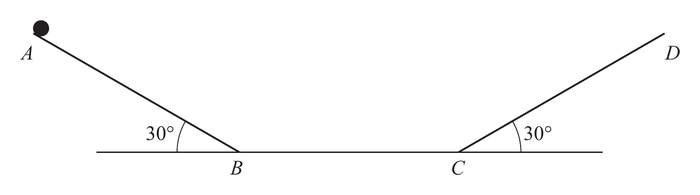
The diagram shows a track ABCD which lies in a vertical plane. The section AB is a straight line inclined at an angle of 30∘ to the horizontal and is smooth. The section BC is a horizontal straight line and is rough. The section CD is a straight line inclined at an angle of 30∘ to the horizontal and is rough. The lengths AB, BC and CD are each 2m.
A particle is released from rest at A. The coefficient of friction between the particle and both BC and CD is μ. There is no change in the speed of the particle when it passes through either of the points B or C.
(a) It is given that μ=0.1.
Find the distance which the particle has moved up the section CD when its speed is 1ms−1.
(5)
(b) It is given instead that with a different value of μ the particle travels 1m up the track from C before it comes instantaneously to rest.
Find the value of μ and the speed of the particle at the instant that it passes C for the second time.
一个质点从 A 处由静止释放。质点与 BC、CD 两段之间的摩擦系数均为 μ。质点经过点 B 或点 C 时,速率不发生变化。
(a) 已知 μ=0.1。
求质点速率为 1ms−1 时沿 CD 段向上运动的距离。
(5)
(b) 改为已知在另一个 μ 值下,质点从 C 沿轨道向上运动 1m 后瞬时静止。
求 μ 的值以及质点第二次经过 C 的瞬间的速率。
(4)
原卷通用作答要求
Answer all questions. You should use a calculator where appropriate.
You must show all necessary working clearly; no marks will be given for unsupported answers from a calculator.
Give non-exact numerical answers correct to 3 significant figures, or 1 decimal place for angles in degrees, unless a different level of accuracy is specified in the question.
For AB, vB2=20. On BC, the acceleration is −10μ, so
vC2=20−40μ.
The acceleration during ascent on CD is −5−53μ. Since the particle stops after 1m,
0=20−40μ−2(5+53μ)(1).
Thus
μ=4+31≈0.174.
On descending, the acceleration down the plane is
a=5−53μ>0.
Starting from rest and travelling 1m,
v2=2(5−53μ)(1).v≈2.64ms−1.
解法三
思路
展开
还可以从A到第二次经过C整体算能量。BC只走一次,而CD上、下各走1米,总摩擦路程是2米。
答题过程
展开
From A to the turning point, the energy equation gives
10m=20mμ+53mμ+5m,
hence
μ=4+31≈0.174.
Between A and the second crossing of C, the total friction work is 2μmg on BC and 2μmgcos30∘ on CD. The initial potential energy above C is mg. Therefore