
题目
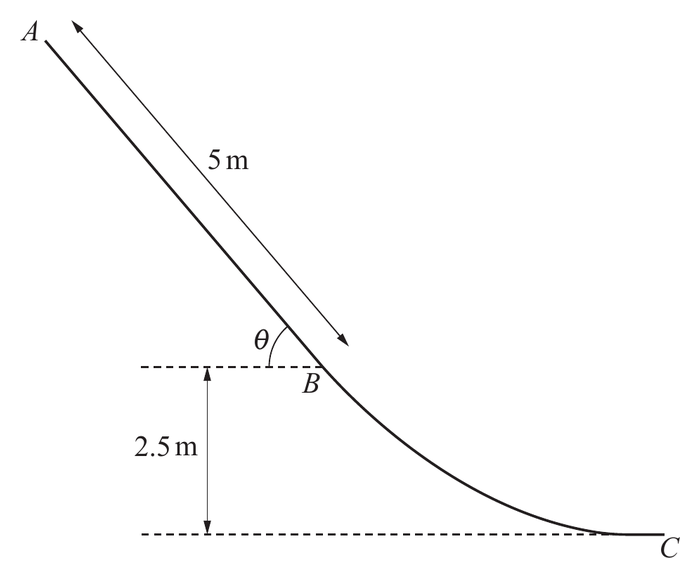
The diagram shows the vertical cross-section of a rough waterslide. The section is a straight line of length inclined at an angle of to the horizontal, where . The point is above the level of . A man of mass , modelled as a particle, slides down the waterslide, starting from rest at . The coefficient of friction between the man and the straight section of the waterslide is .
(a) Find the speed of the man at .
It is given that there is no change in the speed of the man when passing through and that his speed at is .
(b) Find the work done against the resistance force as the man moves from to .
题目中文翻译
图中显示一个粗糙水滑梯的竖直截面 。 段是一条长 的直线,与水平面成 角,其中 。点 比 所在的水平面高 。一名质量为 、被视为质点的男子,从 由静止开始沿水滑梯下滑。男子与水滑梯直线段之间的摩擦系数为 。
(a) 求男子在 处的速率。
已知男子经过 时速率没有变化,且他在 处的速率为 。
(b) 求男子从 移动到 时克服阻力所做的功。
原卷通用作答要求
Answer all questions. You should use a calculator where appropriate.
You must show all necessary working clearly; no marks will be given for unsupported answers from a calculator.
Give non-exact numerical answers correct to 3 significant figures, or 1 decimal place for angles in degrees, unless a different level of accuracy is specified in the question.
请回答所有题目。适当时应使用计算器。必须清楚展示所有必要的计算过程;仅给出计算器答案而没有过程,不予评分。除非题目另有精度要求,非精确数值答案保留 3 位有效数字,以度为单位的角度保留 1 位小数。
Where a numerical value for the acceleration due to gravity () is needed, use .
需要使用重力加速度 的数值时,取 。
解答
(a)
解法一
思路
展开
直滑道正压力等于重力垂直分量;先求摩擦,再求下滑加速度与B处速度。
答题过程
展开
Since , . The normal contact force and friction are
Taking down the slide as positive,
Starting from rest and travelling 5 metres,
Thus
解法二
思路
展开
也可由下降高度4m的势能损失减摩擦功,求末动能。
答题过程
展开
The normal force is , so the friction is .
On descending the straight 5-metre section, the loss of potential energy is and the work against friction is . Hence
Therefore
(b)
解法一
思路
展开
只算B到C一段,势能下降2000J,其中一部分变动能,余下才是阻力耗散。
答题过程
展开
From to , the potential energy decreases by
The increase in kinetic energy is
Thus the work done against resistance is