
题目
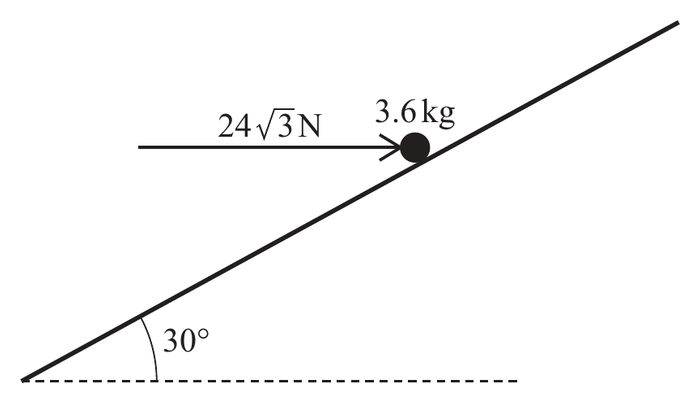
A particle of mass is placed on a rough plane inclined at an angle of to the horizontal. The particle is held at rest on the plane by a horizontal force of magnitude . The force acts in a vertical plane containing a line of greatest slope of the inclined plane (see diagram). The particle is on the point of moving up the plane.
(a) Show that the coefficient of friction between the particle and the plane is .
The force of magnitude is now removed, and the particle moves from rest down the plane.
(b) Find the speed of the particle after it has travelled down the plane.
题目中文翻译
将一个质量为 的质点放在与水平面成 角的粗糙斜面上。一个大小为 的水平力使质点在斜面上保持静止。该力作用于包含斜面最大坡度线的竖直平面内(见图)。质点处于即将沿斜面向上运动的状态。
(a) 证明质点与斜面之间的摩擦系数为 。
现在撤去大小为 的力,质点从静止开始沿斜面向下运动。
(b) 求质点沿斜面向下运动 后的速率。
原卷通用作答要求
Answer all questions. You should use a calculator where appropriate.
You must show all necessary working clearly; no marks will be given for unsupported answers from a calculator.
Give non-exact numerical answers correct to 3 significant figures, or 1 decimal place for angles in degrees, unless a different level of accuracy is specified in the question.
请回答所有题目。适当时应使用计算器。必须清楚展示所有必要的计算过程;仅给出计算器答案而没有过程,不予评分。除非题目另有精度要求,非精确数值答案保留 3 位有效数字,以度为单位的角度保留 1 位小数。
Where a numerical value for the acceleration due to gravity () is needed, use .
需要使用重力加速度 的数值时,取 。
解答
(a)
解法一
思路
展开
即将上滑时摩擦力沿斜面向下;水平外力有压向斜面的分量,必须计入正压力。
答题过程
展开
Let be the normal contact force and the friction. Since the particle is on the point of moving up the plane, friction acts down the plane and .
Resolving perpendicular to the plane,
Resolving parallel to the plane,
so and . Thus
(b)
解法一
思路
展开
撤去水平力后重算正压力;下滑时摩擦力改为沿斜面向上,求加速度后用运动学公式。
答题过程
展开
With the horizontal force removed, the normal contact force is
The particle moves down the plane, so friction acts up the plane and has magnitude
Resolving down the plane,
After travelling from rest,
Therefore
解法二
思路
展开
也可用重力势能减少减去克服摩擦的功,等于动能增加。
答题过程
展开
After removal of the horizontal force,
Over down the plane, the decrease in gravitational potential energy is
and the work done against friction is . Thus