
题目
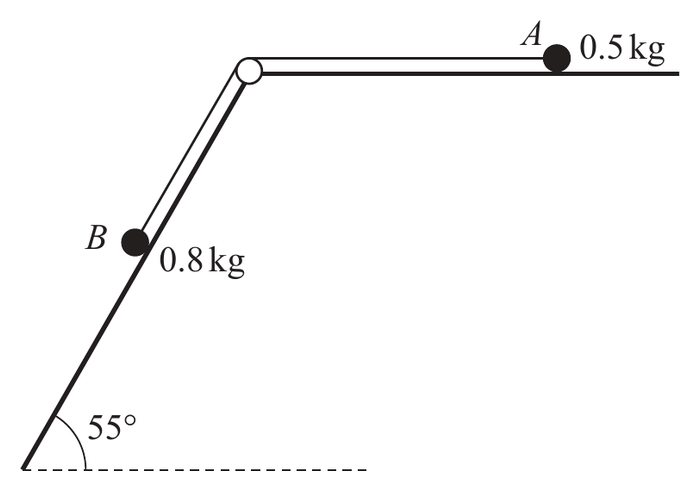
Two particles, and , of masses and respectively are attached to the ends of a light inextensible string. The string passes over a small smooth pulley fixed at the end of a rough horizontal plane and to the top of a smooth inclined plane. Particle is held on the horizontal plane, while lies on the inclined plane, which makes an angle of with the horizontal. The string is in the same vertical plane as a line of greatest slope of the inclined plane (see diagram).
Particle is released from rest with the string taut. Particle moves down the inclined plane in .
(a) Find the tension in the string.
(b) Find the coefficient of friction between and the horizontal plane.
(c) After has been moving for , the string suddenly breaks. Given that subsequently comes to rest on the horizontal plane, find the work done by the frictional force in bringing to rest. You may assume that does not reach the pulley.
题目中文翻译
质量分别为 和 的两个质点 和 连接在一根轻质不可伸长细绳的两端。细绳跨过一个固定在粗糙水平面边缘及光滑斜面顶端的小型光滑滑轮。质点 被保持在水平面上, 位于与水平面成 角的斜面上。细绳与斜面的一条最大坡度线位于同一竖直平面内(见图)。
在细绳绷紧的情况下,质点 从静止释放。质点 在 内沿斜面向下运动了 。
(a) 求细绳中的张力。
(b) 求 与水平面之间的摩擦系数。
(c) 在 运动了 后,细绳突然断裂。已知 随后在水平面上停止,求摩擦力在使 停止的过程中所做的功。可假设 不会到达滑轮。
原卷通用作答要求
Answer all questions. You should use a calculator where appropriate.
You must show all necessary working clearly; no marks will be given for unsupported answers from a calculator.
Give non-exact numerical answers correct to 3 significant figures, or 1 decimal place for angles in degrees, unless a different level of accuracy is specified in the question.
请回答所有题目。适当时应使用计算器。必须清楚展示所有必要的计算过程;仅给出计算器答案而没有过程,不予评分。除非题目另有精度要求,非精确数值答案保留 3 位有效数字,以度为单位的角度保留 1 位小数。
Where a numerical value for the acceleration due to gravity () is needed, use .
需要使用重力加速度 的数值时,取 。
解答
(a)
解法一
思路
展开
先由静止位移求共同加速度,再对光滑斜面上的B列沿坡方向牛顿第二定律。
答题过程
展开
The acceleration is constant. From rest,
Resolving down the smooth inclined plane for ,
Hence
解法二
思路
展开
也可先由平均速度求末速度,再对B用重力功减张力功等于动能增加。
答题过程
展开
For uniformly accelerated motion from rest,
For , the work done by gravity minus the work done against tension equals its increase in kinetic energy:
Thus
(b)
解法一
思路
展开
A在水平面上的正压力等于其重量,张力减摩擦力提供加速度。
答题过程
展开
For , the normal contact force is . Resolving towards the pulley,
Using the unrounded values from (a),
(c)
解法一
思路
展开
只算断绳后停止这段。速度1.5,摩擦力所做的功等于动能变化,带负号。
答题过程
展开
When the string breaks, ‘s speed is
Afterwards, friction is the only force doing work. By the work-energy principle,
Thus the energy dissipated by friction is .
解法二
思路
展开
也可用摩擦减速度求断绳后的停止距离,再计算负的摩擦功。
答题过程
展开
The speed when the string breaks is . Taking ‘s motion as positive, its subsequent acceleration is
If is the stopping distance after the break, then
Friction acts against the displacement, so its work is