
题目
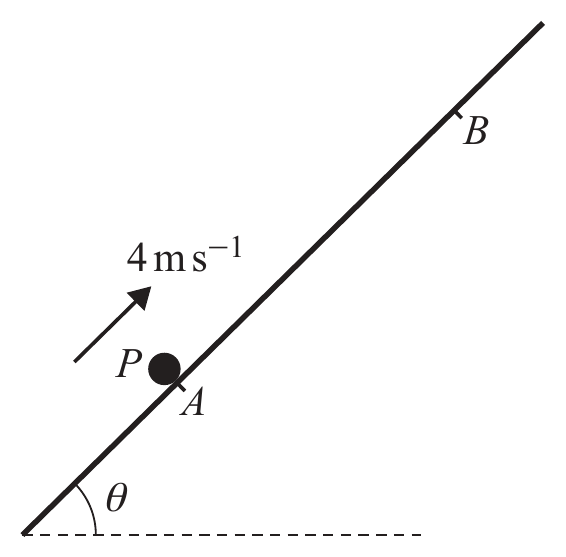
A particle is projected from a point with a speed of up a line of greatest slope of a rough plane inclined at an angle to the horizontal, where .
comes to instantaneous rest at a point on the plane (see diagram).
The coefficient of friction between and the plane is .
(a) Using an energy method, show that the distance is .
(b) After coming to instantaneous rest at , the particle slides down the plane.
Find the total time from the instant at which is projected from until it returns to .
题目中文翻译
质点 从点 以 的速率沿粗糙斜面的一条最大坡度线向上发射。斜面与水平面的夹角为 ,其中 。
质点在斜面上的点 瞬时静止(见图)。
与斜面之间的摩擦系数为 。
(a) 使用能量方法,证明距离 为 。
(b) 在 处瞬时静止后,质点沿斜面向下滑动。
求从 自 发射起至返回 所经历的总时间。
原卷通用作答要求
Answer all questions. You should use a calculator where appropriate.
You must show all necessary working clearly; no marks will be given for unsupported answers from a calculator.
Give non-exact numerical answers correct to 3 significant figures, or 1 decimal place for angles in degrees, unless a different level of accuracy is specified in the question.
请回答所有题目。适当时应使用计算器。必须清楚展示所有必要的计算过程;仅给出计算器答案而没有过程,不予评分。除非题目另有精度要求,非精确数值答案保留 3 位有效数字,以度为单位的角度保留 1 位小数。
Where a numerical value for the acceleration due to gravity () is needed, use .
需要使用重力加速度 的数值时,取 。
解答
(a)
解法一
思路
展开
题目指定能量法。设质量m,不擅自令m=1;先求正压力与摩擦,再写能量平衡。
答题过程
展开
Let the mass be and metres. From ,
The normal contact force and friction are
On the upward journey, the initial kinetic energy is used to increase potential energy and do work against friction:
Since , cancellation gives
as required.
(b)
解法一
思路
展开
上行由平均速度求时间,下行摩擦方向反向,重算下行加速度再求时间。
答题过程
展开
The upward journey has initial speed 4 and final speed 0, so
On the downward journey, friction acts up the plane. Resolving downwards,
so . Starting from rest at ,
Thus the total time is
解法二
思路
展开
下行也可用能量法求返回A的速率,再由平均速度求下行时间。
答题过程
展开
The upward time is
On descending from to , the loss of potential energy minus the work against friction gives
Thus , so . Since the downward acceleration is constant,
Hence the total time is