Skip to content
CalcGospel 國際數學圖譜
返回

CIE 9709 2026 June Paper 45 Q6

A Level / CIE / M1

CIE 9709 2026 June Paper 45 Paper · Question 6

题目

Problem

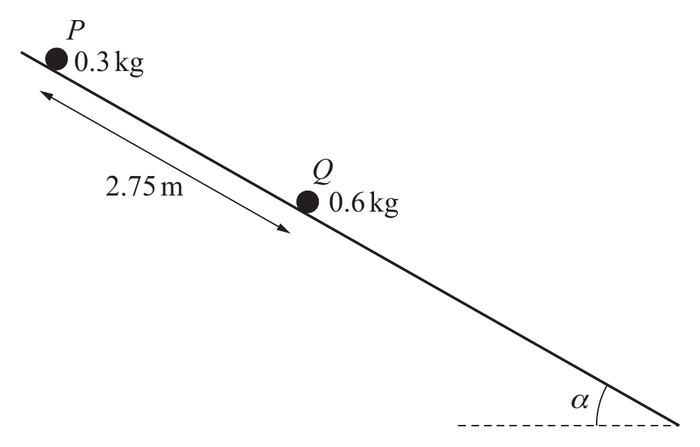
Particles PP and QQ have masses 0.3 kg0.3\,\mathrm{kg} and 0.6 kg0.6\,\mathrm{kg} respectively. The particles are held at rest at a distance of 2.75 m2.75\,\mathrm{m} apart on a line of greatest slope of a rough plane inclined at angle α\alpha to the horizontal, where sin⁡α=0.28\sin\alpha=0.28 (see diagram). The coefficient of friction between each particle and the plane is 0.50.5.

Particles PP and QQ are then released.

(a) Show that neither particle moves.

(3)

Particle PP is now projected directly towards QQ with speed 6 m s−16\,\mathrm{m\,s^{-1}}.

(b) Find the speed of PP immediately before it collides with QQ.

(4)

(c) Immediately after the collision, PP begins to move with speed 1 m s−11\,\mathrm{m\,s^{-1}} up the plane.

Find the distance between the two particles when they both come to rest after the collision.

(5)
题目中文翻译

质点 PP 和 QQ 的质量分别为 0.3 kg0.3\,\mathrm{kg} 和 0.6 kg0.6\,\mathrm{kg}。两质点被保持静止在粗糙斜面的一条最大坡度线上,相距 2.75 m2.75\,\mathrm{m}。斜面与水平面的夹角为 α\alpha,其中 sin⁡α=0.28\sin\alpha=0.28(见图)。每个质点与斜面之间的摩擦系数均为 0.50.5。

随后释放质点 PP 和 QQ。

(a) 证明两个质点都不移动。

(3)

现在将质点 PP 以 6 m s−16\,\mathrm{m\,s^{-1}} 的速率直接朝 QQ 发射。

(b) 求 PP 在与 QQ 碰撞前一瞬间的速率。

(4)

(c) 碰撞后一瞬间,PP 开始以 1 m s−11\,\mathrm{m\,s^{-1}} 的速率沿斜面向上运动。

求碰撞后两质点都停止时它们之间的距离。

(5)
原卷通用作答要求

Answer all questions. You should use a calculator where appropriate.

You must show all necessary working clearly; no marks will be given for unsupported answers from a calculator.

Give non-exact numerical answers correct to 3 significant figures, or 1 decimal place for angles in degrees, unless a different level of accuracy is specified in the question.

请回答所有题目。适当时应使用计算器。必须清楚展示所有必要的计算过程;仅给出计算器答案而没有过程,不予评分。除非题目另有精度要求,非精确数值答案保留 3 位有效数字,以度为单位的角度保留 1 位小数。

Where a numerical value for the acceleration due to gravity (gg) is needed, use 10 m s−210\,\mathrm{m\,s^{-2}}.

需要使用重力加速度 gg 的数值时,取 10 m s−210\,\mathrm{m\,s^{-2}}。

解答

(a)

解法一

思路

展开

静止摩擦力不是自动取最大值;比较维持静止所需的重力沿坡分量与最大静摩擦力。

答题过程

展开

Since cos⁡α=1−0.282=0.96\cos\alpha=\sqrt{1-0.28^2}=0.96, for either particle of mass mm kilograms,

R=mgcos⁡α=0.96mg.R=mg\cos\alpha=0.96mg.

The maximum available friction is

μR=0.5(0.96mg)=0.48mg,\mu R=0.5(0.96mg)=0.48mg,

whereas the force required to prevent sliding is mgsin⁡α=0.28mgmg\sin\alpha=0.28mg. Since 0.28mg<0.48mg0.28mg<0.48mg, static friction can balance the downslope weight component for both particles. Neither particle moves.

解法二

思路

展开

也可把静止条件化为斜面角正切小于摩擦系数。

答题过程

展开

For equilibrium, friction must balance mgsin⁡αmg\sin\alpha and must not exceed μmgcos⁡α\mu mg\cos\alpha. Thus the condition is

tan⁡α≤μ.\tan\alpha\leq\mu.

Here

tan⁡α=0.280.96=724<12=μ.\tan\alpha=\frac{0.28}{0.96}=\frac7{24}<\frac12=\mu.

This condition is independent of mass, so both particles remain at rest.

(b)

解法一

思路

展开

P投射后下滑,摩擦取0.5R且向上,得到下坡加速度−2,再用路程2.75求碰前速度。

答题过程

展开

Taking down the plane as positive, for PP,

0.3a=0.3(10)(0.28)−0.5[0.3(10)(0.96)].0.3a=0.3(10)(0.28)-0.5\bigl[0.3(10)(0.96)\bigr].

Thus a=2.8−4.8=−2 m s−2a=2.8-4.8=-2\,\mathrm{m\,s^{-2}}. Over 2.75 m2.75\,\mathrm{m},

v2=62+2(−2)(2.75)=25.v^2=6^2+2(-2)(2.75)=25.

Hence the speed immediately before collision is 5 m s−1\boxed{5\text{ m s}^{-1}}.

解法二

思路

展开

也可用初动能加下滑损失的势能,减去摩擦耗散求末动能。

答题过程

展开

For PP, over 2.75 m2.75\,\mathrm{m} down the plane,

12(0.3)v2= 12(0.3)(6)2+0.3(10)(2.75)(0.28) −0.5[0.3(10)(0.96)](2.75).\begin{align*} \frac12(0.3)v^2=&\,\frac12(0.3)(6)^2+0.3(10)(2.75)(0.28)\\[4mm] &\,\hspace{2pt}-0.5\bigl[0.3(10)(0.96)\bigr](2.75). \end{align*}

Thus

5.4+2.31−3.96=0.15v2,v2=25.5.4+2.31-3.96=0.15v^2, \qquad v^2=25.

The required speed is 5 m s−1\boxed{5\text{ m s}^{-1}}.

(c)

解法一

思路

展开

碰撞先守恒动量,P反弹速度取负;之后P上行与Q下行的减速度不同,分别求路程再加。

答题过程

展开

Take down the plane as positive. Let ww be QQ‘s velocity immediately after impact. Conservation of momentum gives

0.3(5)=0.3(−1)+0.6w,w=3 m s−1.0.3(5)=0.3(-1)+0.6w, \qquad w=3\text{ m s}^{-1}.

For QQ moving down the plane, aQ=−2 m s−2a_Q=-2\,\mathrm{m\,s^{-2}}, as in (b). Thus its stopping distance is

0=32+2(−2)dQ,dQ=94 m.0=3^2+2(-2)d_Q, \qquad d_Q=\frac94\text{ m}.

For PP moving up the plane, gravity and friction both act down the plane. Taking upwards as positive,

0.3aP=−0.3(10)(0.28)−0.5[0.3(10)(0.96)],0.3a_P=-0.3(10)(0.28)-0.5\bigl[0.3(10)(0.96)\bigr],

so aP=−7.6 m s−2a_P=-7.6\,\mathrm{m\,s^{-2}}. Hence

0=12+2(−7.6)dP,dP=576 m.0=1^2+2(-7.6)d_P, \qquad d_P=\frac5{76}\text{ m}.

The particles move in opposite directions from the collision point and remain at rest once stopped, by (a). Their final separation is

dP+dQ=576+94=4419≈2.32 m (3 s.f.).d_P+d_Q=\frac5{76}+\frac94=\frac{44}{19} \approx\boxed{2.32\text{ m}}\text{ (3 s.f.)}.

解法二

思路

展开

碰后各段也可独立用能量方程求停止距离,再相加。

答题过程

展开

Taking down the plane as positive, conservation of momentum gives

0.3(5)=0.3(−1)+0.6w,w=3 m s−1.0.3(5)=0.3(-1)+0.6w, \qquad w=3\text{ m s}^{-1}.

For QQ descending distance dQd_Q, the initial kinetic energy plus the loss of potential energy equals work against friction:

 12(0.6)(3)2+0.6(10)(0.28)dQ= 0.5[0.6(10)(0.96)]dQ.\begin{align*} &\,\frac12(0.6)(3)^2+0.6(10)(0.28)d_Q\\[4mm] =&\,0.5\bigl[0.6(10)(0.96)\bigr]d_Q. \end{align*}

Thus 2.7+1.68dQ=2.88dQ2.7+1.68d_Q=2.88d_Q, giving dQ=9/4d_Q=9/4 metres.

For PP ascending distance dPd_P, its initial kinetic energy is used to gain potential energy and overcome friction:

12(0.3)(1)2= 0.3(10)(0.28)dP +0.5[0.3(10)(0.96)]dP.\begin{align*} \frac12(0.3)(1)^2=&\,0.3(10)(0.28)d_P\\[4mm] &\,\hspace{2pt}+0.5\bigl[0.3(10)(0.96)\bigr]d_P. \end{align*}

Thus 0.15=(0.84+1.44)dP0.15=(0.84+1.44)d_P, giving dP=5/76d_P=5/76 metres. By (a), each remains at rest once stopped. Their separation is

dP+dQ=576+94=4419≈2.32 m (3 s.f.).d_P+d_Q=\frac5{76}+\frac94=\frac{44}{19} \approx\boxed{2.32\text{ m}}\text{ (3 s.f.)}.