题目
Problem
A particle X travels in a straight line. The velocity of X at time ts after leaving a fixed point O is denoted by vms−1, where
v=−0.1t3+1.8t2−6t+5.6.
The acceleration of X is zero at t=p and t=q, where p<q.
(a) Find the value of p and the value of q.
(4)
It is given that the velocity of X is zero at t=14.
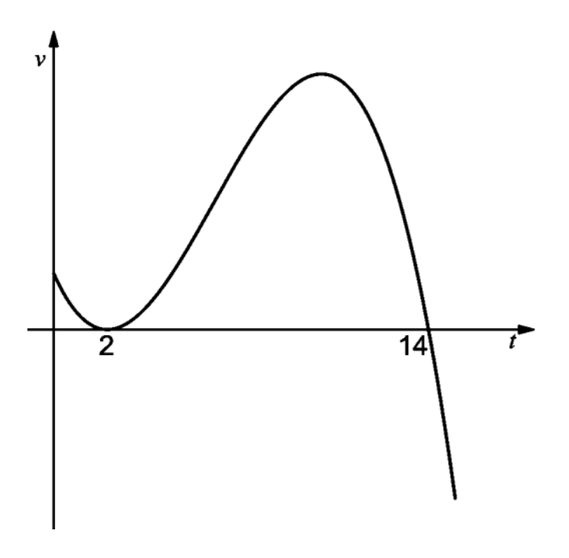
(b) Find the velocities of X at t=p and at t=q, and hence sketch the velocity-time graph for the motion of X for 0⩽t⩽15.
(3)
(c) Find the total distance travelled by X between t=0 and t=15.
(5)
题目中文翻译
一个质点 X 沿直线运动。离开固定点 O 后 ts 时,X 的速度记为 vms−1,其中
v=−0.1t3+1.8t2−6t+5.6.
X 在 t=p 和 t=q 时的加速度为零,其中 p<q。
(a) 求 p 和 q 的值。
(4)
已知 X 在 t=14 时的速度为零。
(b) 求 X 在 t=p 和 t=q 时的速度,并由此画出 X 在 0⩽t⩽15 内运动的速度—时间图像的草图。
(3)
(c) 求 X 在 t=0 至 t=15 之间经过的总路程。
(5)
原卷通用作答要求
Answer all questions. You should use a calculator where appropriate.
You must show all necessary working clearly; no marks will be given for unsupported answers from a calculator.
Give non-exact numerical answers correct to 3 significant figures, or 1 decimal place for angles in degrees, unless a different level of accuracy is specified in the question.
请回答所有题目。适当时应使用计算器。必须清楚展示所有必要的计算过程;仅给出计算器答案而没有过程,不予评分。除非题目另有精度要求,非精确数值答案保留 3 位有效数字,以度为单位的角度保留 1 位小数。
Where a numerical value for the acceleration due to gravity (g) is needed, use 10ms−2.
需要使用重力加速度 g 的数值时,取 10ms−2。
解答
(a)
解法一
思路
展开
求速度导数,因式分解加速度二次式,按p小于q排序。
答题过程
展开
Differentiating,
a=−0.3t2+3.6t−6=−0.3(t2−12t+20).
Thus a=0 gives
(t−2)(t−10)=0.
Since p<q,
p=2,q=10.
(b)
解法一
思路
展开
代入两个驻点求速度,结合加速度符号画平滑三次曲线。在t等于2处只是切触时间轴,不穿过。
答题过程
展开
At the stationary points,
v(2)==−0.1(8)+1.8(4)−12+5.60ms−1.
v(10)==−100+180−60+5.625.6ms−1.
The acceleration is negative for 0<t<2, positive for 2<t<10, and negative for t>10. Sketch a smooth curve starting at (0,5.6), touching the t-axis at the minimum (2,0), rising to the maximum (10,25.6), then crossing the axis at (14,0) and reaching (15,−16.9). The change of curvature occurs at t=6.
(c)
解法一
思路
展开
速度在2处不变号,14之后才为负。先积分0到14,再把14到15的负位移改成正路程。
答题过程
展开
The velocity factorises as
v=−0.1(t−2)2(t−14).
Thus v≥0 for 0≤t≤14 and v<0 for 14<t≤15. An antiderivative is
S(t)=−0.025t4+0.6t3−3t2+5.6t.
Its required values are
S(0)=S(14)=S(15)=0,176.4,168.375.
Hence the total distance is
D===[S(14)−S(0)]−[S(15)−S(14)]176.4+8.025184.425m.
