
题目
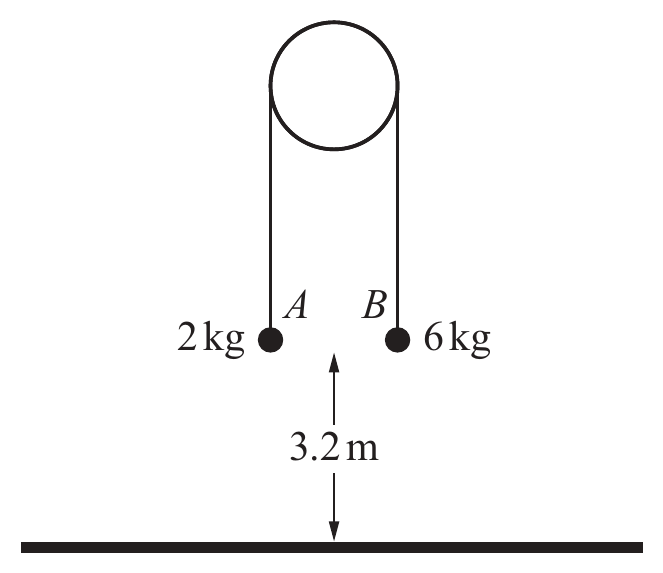
Particles and , of masses and respectively, are attached to the ends of a light inextensible string. The string passes over a smooth fixed pulley and the particles hang vertically below the pulley. Both particles are initially held at rest at a height of above horizontal ground (see diagram). Particle is projected vertically downwards with a speed of .
(a) Find the tension in the string and the magnitude of the acceleration of the particles.
In the subsequent motion, does not hit the ground and neither particle reaches the pulley. When hits the ground, it does not rebound.
(b) Find the time that is in motion.
(c) Find the distance between the lowest and highest points that reaches.
题目中文翻译
质量分别为 和 的质点 和 连接在一根轻质不可伸长细绳的两端。细绳跨过一个光滑定滑轮,两个质点竖直悬挂在滑轮下方。两个质点最初均被保持静止,距水平地面的高度为 (见图)。质点 以 的速率竖直向下发射。
(a) 求细绳中的张力及质点的加速度大小。
在随后的运动中, 不会碰到地面,且两个质点均不会到达滑轮。当 碰到地面时,它不会反弹。
(b) 求 运动的时间。
(c) 求 所到达的最低点与最高点之间的距离。
原卷通用作答要求
Answer all questions. You should use a calculator where appropriate.
You must show all necessary working clearly; no marks will be given for unsupported answers from a calculator.
Give non-exact numerical answers correct to 3 significant figures, or 1 decimal place for angles in degrees, unless a different level of accuracy is specified in the question.
请回答所有题目。适当时应使用计算器。必须清楚展示所有必要的计算过程;仅给出计算器答案而没有过程,不予评分。除非题目另有精度要求,非精确数值答案保留 3 位有效数字,以度为单位的角度保留 1 位小数。
Where a numerical value for the acceleration due to gravity () is needed, use .
需要使用重力加速度 的数值时,取 。
解答
(a)
解法一
思路
展开
A初向下运动但加速度向上;以A向上、B向下为共同正方向列两式。
答题过程
展开
Let be ‘s upward acceleration, equal in magnitude to ‘s downward acceleration, and let be the tension. Newton’s second law gives
Adding,
Then
(b)
解法一
思路
展开
B最初向上1.2,之后加速度向下5。以下为正,落地位移3.2,解正时间。
答题过程
展开
Take downwards as positive for . Its initial velocity is , so
Thus
The other root is negative and is rejected. Therefore is in motion for .
(c)
解法一
思路
展开
先求A初始下行的停止距离,再求B落地时A的上行速度。绳松后A自由上升,用g而非5。
答题过程
展开
Initially moves downwards at with upward acceleration 5. If is the distance to its lowest point,
When reaches the ground, it has moved a net distance downwards, so has moved upwards from its initial position. Its upward speed satisfies
After hits the ground, the string becomes slack and continues upwards freely under gravity. The further rise is given by
Thus the distance between ‘s lowest and highest points is
解法二
思路
展开
也可用整体机械能求初始下行距离及B落地前的共同速率,再对绳松后的A使用机械能守恒。最低点与最高点分别位于初始位置的下方和上方,最后把各段高度相加。
答题过程
展开
Let be ‘s initial downward distance to its lowest point. Both particles are momentarily at rest there. Their initial kinetic energy is converted into the net increase in potential energy as descends and rises:
Thus metres.
When reaches the ground, it has descended a net distance of metres and has risen by the same amount. The net loss of potential energy adds to their initial kinetic energy. If their common speed is ,
Hence . After stops, the string becomes slack. For alone, its kinetic energy becomes gravitational potential energy during the further rise :
The distance between the lowest and highest points is therefore