题目
Problem
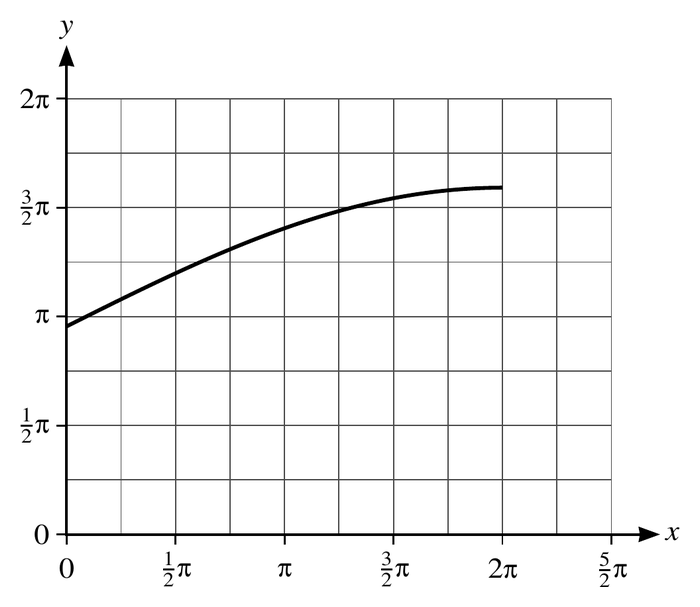
The diagram shows the graph of y=f(x) where the function f is defined by
f(x)=3+2sin41xfor 0≤x≤2π.
(a) On the diagram above, sketch the graph of y=f−1(x).
[2]
(b) Find an expression for f−1(x).
[2]
(c)
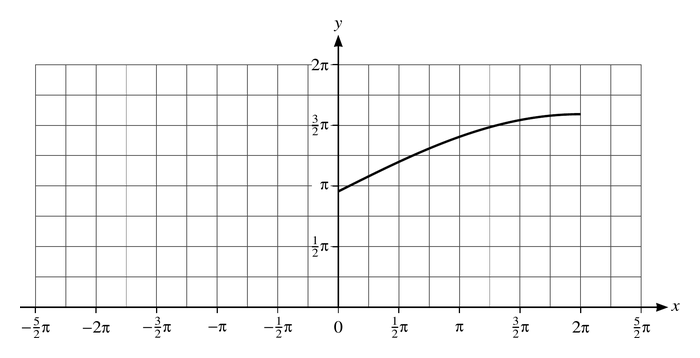
The diagram above shows part of the graph of the function g(x)=3+2sin41x for −2π≤x≤2π.
Complete the sketch of the graph of g(x) on the diagram above and hence explain whether the function g has an inverse.
[2]
(d) Describe fully a sequence of three transformations which can be combined to transform the graph of y=sinx for 0≤x≤21π to the graph of y=f(x), making clear the order in which the transformations are applied.
[6]
题目中文翻译
图中显示 y=f(x) 的图像,其中函数 f 定义为
f(x)=3+2sin41x其中 0≤x≤2π.
(a) 在上图中,画出 y=f−1(x) 的图像。
[2]
(b) 求 f−1(x) 的表达式。
[2]
(c)
上图显示函数 g(x)=3+2sin41x 在 −2π≤x≤2π 上的部分图像。
在上图中补全 g(x) 的图像,并由此说明函数 g 是否有反函数。
[2]
(d) 完整描述一组三个变换,它们可以组合起来把 0≤x≤21π 上的 y=sinx 图像变换为 y=f(x) 的图像,并清楚说明这些变换的应用顺序。
[6]
解答
(a)
解法一
思路
展开
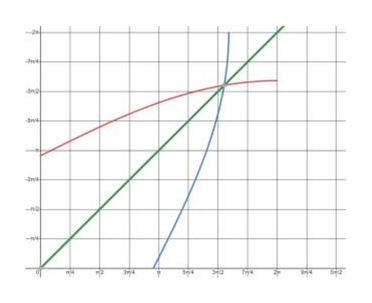
将原曲线关于 y=x 反射。原图的两个端点交换横纵坐标后,给出反函数曲线的起点和终点。
答题过程
展开
Sketch the reflection of y=f(x) in the line y=x. The endpoint (0,3) maps to (3,0), and (2π,5) maps to (5,2π). The reflected branch increases and becomes steeper as it approaches the upper endpoint.
(b)
解法一
思路
展开
反解时先分离正弦。原来的角 x/4 位于反正弦的主值区间内。
答题过程
展开
From y=3+2sin(x/4), we obtain sin(x/4)=(y−3)/2. Since 0≤x/4≤π/2,
f−1(x)=4sin−1(2x−3),3≤x≤5.
(c)
解法一
思路
展开
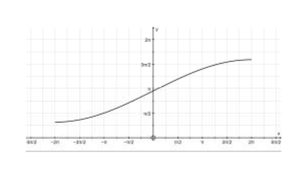
把图像向左延伸到 −2π。减去中线高度 3 后,剩下的是奇函数,因此左右两段关于 (0,3) 中心对称。
答题过程
展开
The missing portion runs from (−2π,1) to (0,3), joining the given portion smoothly. Since x/4 ranges from −π/2 to π/2, the sine function is strictly increasing throughout this interval. Thus g is one-to-one and has an inverse.
(d)
解法一
思路
展开
横向伸缩把定义域的长度变成四倍,纵向伸缩把振幅变成两倍。最后把中线抬高 3。
答题过程
展开
Start with y=sinx on [0,π/2]. Apply these transformations in order:
- Stretch by scale factor 4 in the x-direction, giving y=sin(x/4) on [0,2π].
- Stretch by scale factor 2 in the y-direction, giving y=2sin(x/4).
- Translate by (03), giving y=3+2sin(x/4).
解法二
思路
展开
若先平移再纵向伸缩,平移量也会被放大。因此先上移 3/2,再把纵坐标变为两倍。
答题过程
展开
Starting with y=sinx on [0,π/2], apply these transformations in order:
- Stretch by scale factor 4 in the x-direction, giving y=sin(x/4) on [0,2π].
- Translate by (03/2), giving y=sin(x/4)+3/2.
- Stretch by scale factor 2 in the y-direction, giving y=2(sin(x/4)+3/2)=3+2sin(x/4).
