Skip to content
CalcGospel 國際數學圖譜
返回

CIE 9709 2024 June Paper 12 Q4

A Level / CIE / P1

CIE 9709 2024 June Paper 12 Paper · Question 4

题目

Problem

The function ff is defined as follows:

f(x)=x−1for x>1.f(x) = \sqrt{x} - 1 \quad \text{for } x > 1.

(a) Find an expression for f−1(x)f^{-1}(x).

[1]

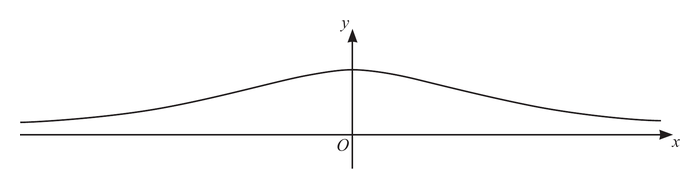
The diagram shows the graph of y=g(x)y = g(x) where g(x)=1x2+2g(x) = \frac{1}{x^2 + 2} for x∈Rx \in \mathbb{R}.

(b) State the range of gg and explain whether g−1g^{-1} exists.

[2]

The function hh is defined by h(x)=1x2+2h(x) = \frac{1}{x^2 + 2} for x≥0x \geq 0.

(c) Solve the equation hf(x)=f(2516)hf(x) = f\big(\frac{25}{16}\big). Give your answer in the form a+bca + b\sqrt{c}, where aa, bb and cc are integers.

[4]
题目中文翻译

函数 ff 定义如下:

f(x)=x−1其中 x>1.f(x) = \sqrt{x} - 1 \quad \text{其中 } x > 1.

(a) 求 f−1(x)f^{-1}(x) 的表达式。

[1]

图中显示 y=g(x)y = g(x) 的图像,其中 g(x)=1x2+2g(x) = \frac{1}{x^2 + 2},x∈Rx \in \mathbb{R}。

(b) 写出 gg 的值域,并说明 g−1g^{-1} 是否存在。

[2]

函数 hh 定义为 h(x)=1x2+2h(x) = \frac{1}{x^2 + 2},其中 x≥0x \geq 0。

(c) 解方程 hf(x)=f(2516)hf(x) = f\big(\frac{25}{16}\big)。答案写成 a+bca + b\sqrt{c} 的形式,其中 aa、bb 和 cc 是整数。

[4]

解答

(a)

解法一

思路

展开

把 y=x−1y=\sqrt{x}-1 中的平方根单独留在一边,再反解 xx。

答题过程

展开

The relation y+1=xy+1=\sqrt{x} gives x=(y+1)2x=(y+1)^2. Since x>1x>1 in the original function, its range is (0,∞)(0,\infty). Thus f−1(x)=(x+1)2f^{-1}(x)=(x+1)^2 for x>0x>0.

(b)

解法一

思路

展开

分母最小为 22,但可以任意大。再看图像关于 yy 轴的对称性。

答题过程

展开

Since x2+2x^2+2 takes every value in [2,∞)[2,\infty), the range is (0,1/2](0,1/2]. The function is even, so g(x)=g(−x)g(x)=g(-x) for every xx, including pairs of distinct inputs. Thus gg is not one-to-one and has no inverse on its stated domain.

(c)

解法一

思路

展开

先算右边的函数值,再把 hf(x)hf(x) 看成 hh 作用在 f(x)f(x) 上。由于 x>1x>1,f(x)f(x) 必须为正。

答题过程

展开

We have f(25/16)=5/4−1=1/4f(25/16)=5/4-1=1/4. Hence

1(x−1)2+2= 14⟹ (x−1)2=2.\begin{align*} \frac{1}{(\sqrt{x}-1)^2+2}=&\,\frac14\\ \quad\Longrightarrow\quad&\, (\sqrt{x}-1)^2=2. \end{align*}

As x−1>0\sqrt{x}-1>0, x=1+2\sqrt{x}=1+\sqrt2. Therefore x=(1+2)2=3+22x=(1+\sqrt2)^2=3+2\sqrt2.