题目
Problem
Functions f and g are defined as follows.
f(x)=cosxfor 0≤x≤π
g(x)=3cos(x−π)+2for π≤x≤2π
(a) Describe fully the transformations that have been combined to transform the graph of y=f(x) to the graph of y=g(x).
[4]
(b) On the given axes, sketch the graphs of y=f(x) and y=g(x).
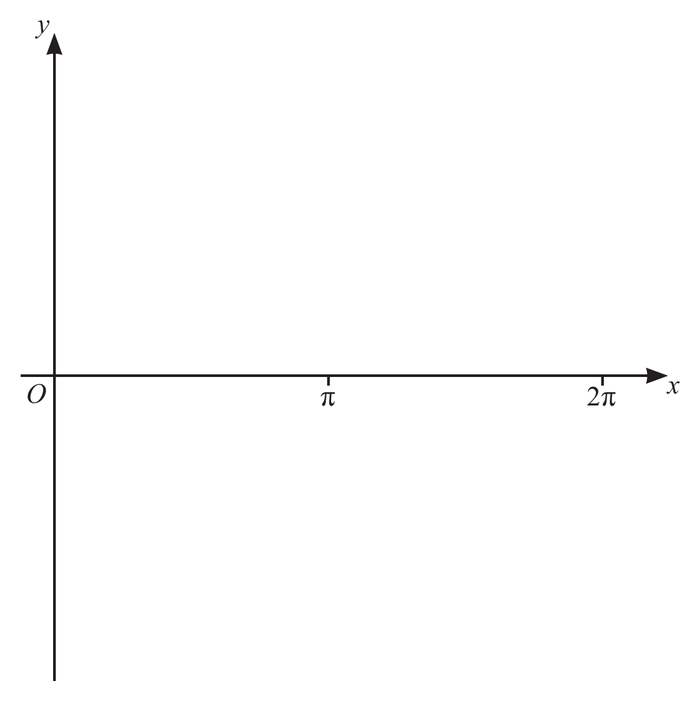
[4]
(c) Find g−1f(31π).
[4]
(d) Explain why the composite function fg cannot be formed.
[1]
题目中文翻译
函数 f 和 g 定义如下。
f(x)=cosx其中 0≤x≤π
g(x)=3cos(x−π)+2其中 π≤x≤2π
(a) 完整描述将 y=f(x) 的图像变换为 y=g(x) 的组合变换。
(b) 在给定坐标轴上画出 y=f(x) 和 y=g(x) 的图像草图。
(c) 求 g−1f(31π)。
(d) 解释为什么复合函数 fg 不能形成。
解答
(a)
解法一
思路
展开
cos(x−π) 表示向右平移 π。外面的系数与常数分别改变纵向比例和高度。
答题过程
展开
First stretch by scale factor 3 in the y-direction. Then translate by (π2). This sends (u,cosu) to (u+π,3cosu+2), as required.
解法二
思路
展开
如果先平移再伸缩,要把预先增加的高度除以 3,因为伸缩也会放大这段竖直位移。
答题过程
展开
Translate by (π2/3) and then stretch by scale factor 3 in the y-direction. The resulting expression is 3(cos(x−π)+2/3)=3cos(x−π)+2.
(b)
解法一
思路
展开
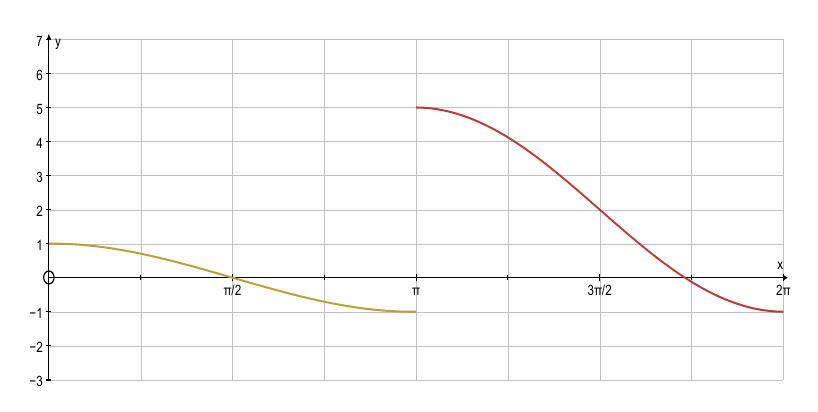
两段都是递减的半个余弦周期。先标出每段的两个端点和中点,再画平滑曲线。
答题过程
展开
Sketch f through (0,1), (π/2,0) and (π,−1) on [0,π]. Sketch g through (π,5), (3π/2,2) and (2π,−1) on [π,2π]. Each curve decreases smoothly and has horizontal tangents at its endpoints.
(c)
解法一
思路
展开
先求 f(π/3)。再反解 g(x),角 x−π 的范围正好是反余弦的主值区间。
答题过程
展开
We have f(3π)=21. On π≤x≤2π, solving y=3cos(x−π)+2 gives
g−1(y)=π+cos−1(3y−2)(−1≤y≤5).
Hence
g−1(f(3π))=π+cos−1(−21)=35π.
(d)
解法一
思路
展开
要对 g 的每个输入计算 f(g(x)),g 的输出都必须落在 f 的定义域内。
答题过程
展开
The range of g is [−1,5], which is not contained in the domain [0,π] of f. For example, g(2π)=−1 and f(−1) is undefined. Thus fg cannot be formed on the given domain of g.
