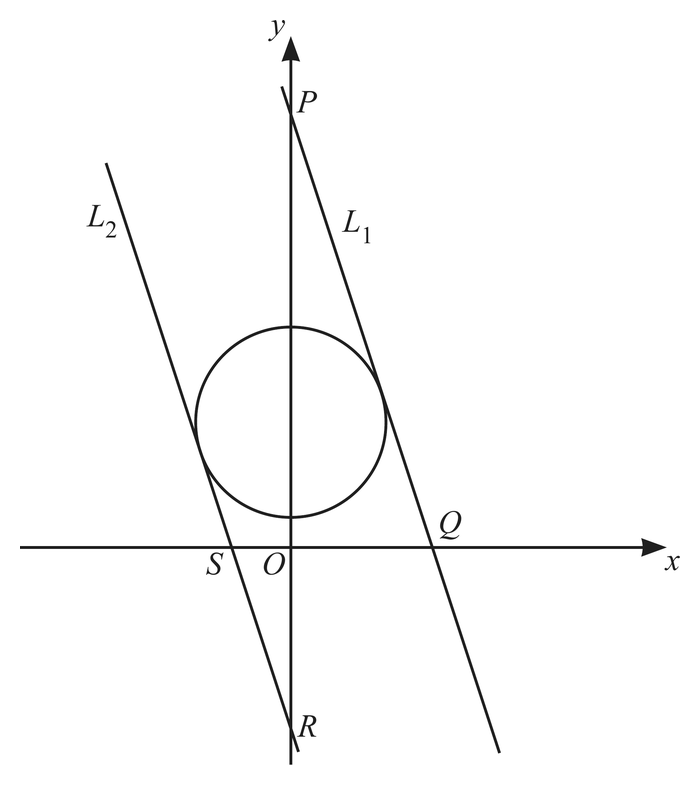
The diagram shows a circle with two tangents, L1 and L2. The tangent L1 intersects the x-axis at Q and the y-axis at P. The tangent L2 intersects the x-axis at S and the y-axis at R.
(a) The end-points of a diameter of the circle are (0,4−10) and (0,4+10).
Show that the equation of the circle can be expressed as
x2+y2−8y+6=0.
(3)
(b) The two tangents, L1 and L2, have equations of the form y=−3x+c.
Show that c2−8c−84=0.
(4)
(c) Find the exact area of quadrilateral PQRS.
(5)
题目中文翻译
图中所示的是一个圆及其两条切线 L1 和 L2。切线 L1 与 x 轴交于 Q,与 y 轴交于 P;切线 L2 与 x 轴交于 S,与 y 轴交于 R。
(a) 圆的一条直径的两个端点为 (0,4−10) 和 (0,4+10)。
证明该圆的方程可写为
x2+y2−8y+6=0.
(3)
(b) 两条切线 L1 和 L2 的方程均具有 y=−3x+c 的形式。
证明 c2−8c−84=0。
(4)
(c) 求四边形 PQRS 面积的精确值。
(5)
原卷通用作答要求
Answer all questions. You should use a calculator where appropriate.
You must show all necessary working clearly; no marks will be given for unsupported answers from a calculator.
Give non-exact numerical answers correct to 3 significant figures, or 1 decimal place for angles in degrees, unless a different level of accuracy is specified in the question.
The given endpoints have midpoint (0,4) and are separated by 210. Thus the radius is 10 and the equation is x2+(y−4)2=10. Expanding and rearranging gives
x2+y2−8y+6=0.
(b)
解法一
思路
展开
把切线的表达式代入圆。相切时,关于 x 的二次方程有一个重根。
答题过程
展开
Substitution of y=−3x+c gives
10x2+(24−6c)x+c2−8c+6=0.
Since the line is tangent, the discriminant vanishes:
=(24−6c)2−40(c2−8c+6)−4c2+32c+336=0.
Dividing by −4 yields c2−8c−84=0.
解法二
思路
展开
也可以用圆心到切线的距离等于半径来建立方程。
答题过程
展开
The line is 3x+y−c=0. Its distance from (0,4) is ∣4−c∣/10. Equating this to the radius 10 gives ∣4−c∣=10. Thus (c−4)2=100, which expands to c2−8c−84=0.
解法三
思路
展开
过切点的半径斜率为 1/3。先把这条直径与圆联立,得到两个切点,再求各自的切线截距。
答题过程
展开
The circle has centre (0,4) and radius 10. A tangent with slope −3 has a perpendicular radius with slope 1/3. The diameter through the points of contact is therefore y=x/3+4. Substituting into x2+(y−4)2=10 gives
x2+9x2=10⟹x=±3.
The points of contact are (3,5) and (−3,3). In y=−3x+c, they give c=5+9=14 and c=3−9=−6, respectively. Thus the two possible values of c satisfy
Setting the gradient equal to −3 gives x=310−x2>0. Squaring gives x2=9(10−x2), hence x=3 and y=5. This gives c=5+3(3)=14.
For the lower branch, y=4−10−x2 and
dxdy=10−x2x.
The gradient equation is x=−310−x2<0. It again gives x2=9, but now x=−3 and y=3. Thus c=3+3(−3)=−6. Both points satisfy their unsquared gradient equations. Therefore
(c−14)(c+6)=0⟹c2−8c−84=0.
(c)
解法一
思路
展开
用 (b) 求两条切线的截距。以 PR 为公共底,将四边形分成左右两个三角形。
答题过程
展开
Factoring gives (c−14)(c+6)=0. From the diagram, the positive intercept belongs to L1, so
P=(0,14),Q=(14/3,0),R=(0,−6),S=(−2,0).
The base PR has length 20. The perpendicular distances of Q and S from the base line are 14/3 and 2, respectively. Therefore the exact area is