
题目
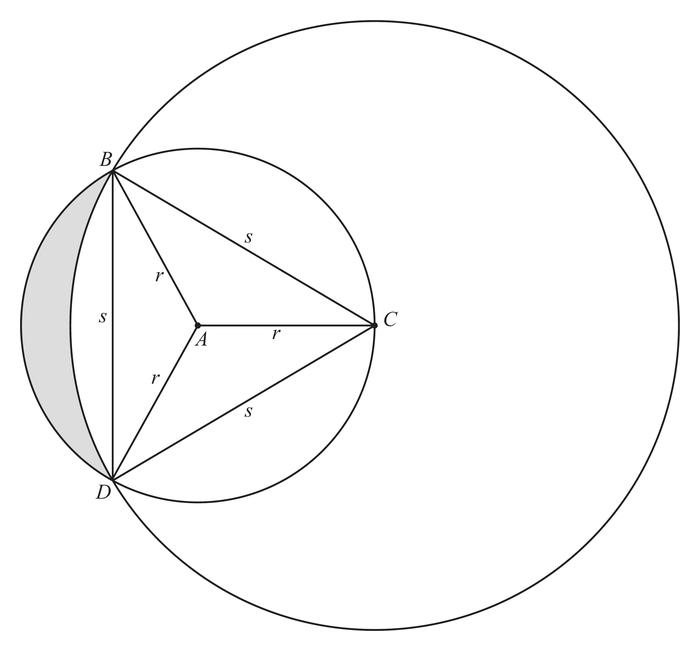
The diagram shows a circle with centre and radius passing through points , and . A larger circle of radius has centre and passes through and . The length is also .
(a) Show that .
(b) Find an expression for the area of the shaded region. Give your answer in the form , where and are constants to be found.
题目中文翻译
图中显示一个圆,圆心为 ,半径为 ,并经过点 、 和 。一个较大的圆半径为 ,圆心为 ,并经过点 和 。线段 的长度也为 。
(a) 证明 。
(b) 求阴影区域面积的表达式。答案写成 的形式,其中 和 是待求常数。
解答
(a)
解法一
思路
展开
大圆的三条长度 、 和 都是 ,所以 是等边三角形。小圆中同一弦 所对的圆心角是圆周角的两倍。
答题过程
展开
Since , angle is . By the centre-angle theorem in the smaller circle, angle is . Applying the cosine rule in triangle gives
As , .
解法二
思路
展开
也可用弦长与圆心角的关系。过 作弦 的垂线,得到一个直角三角形。
答题过程
展开
The equilateral triangle gives angle . Therefore the smaller circle subtends angle at its centre. The perpendicular from to bisects both the chord and this angle. Its right triangle has hypotenuse and opposite side , so
Thus .
(b)
解法一
思路
展开
两条弧有同一条弦 。阴影等于小圆的弓形减去大圆的弓形,每个弓形都等于扇形减三角形。
答题过程
展开
The smaller circle has sector angle and radius , so its segment on the shaded side of has area
For the larger circle, the sector angle is and , so its segment on that side has area
Subtracting the second segment from the first gives the shaded area
Hence and .