
题目
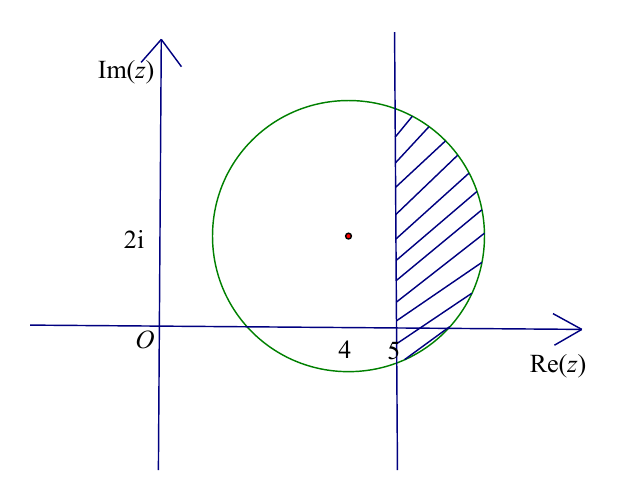
(a) On a sketch of an Argand diagram, shade the region whose points represent complex numbers satisfying the inequalities and .
(b) Find the greatest value of for points in this region.
题目中文翻译
(a) 在 Argand 图的草图中,用阴影标出满足不等式 和 的复数 所对应的点组成的区域。
(b) 求此区域内各点所对应的 的最大值。
原卷通用作答要求
Answer all questions. You should use a calculator where appropriate.
You must show all necessary working clearly; no marks will be given for unsupported answers from a calculator.
Give non-exact numerical answers correct to 3 significant figures, or 1 decimal place for angles in degrees, unless a different level of accuracy is specified in the question.
请回答所有题目。适当时应使用计算器。必须清楚展示所有必要的计算过程;仅给出计算器答案而没有过程,不予评分。除非题目另有精度要求,非精确数值答案保留 3 位有效数字,以度为单位的角度保留 1 位小数。
解答
(a)
解法一
思路
展开
第一个条件是闭圆盘。第二个条件表示到原点的距离不小于到 的距离,可平方化成半平面。
答题过程
展开
Write . The first inequality gives
the closed disc with centre and radius .
For the second inequality, both moduli are non-negative, so it is equivalent to
Draw the circle and the vertical line . Shade the part inside the circle and on or to the right of , including the boundaries.
(b)
解法一
思路
展开
涂色部分在 ,最大辐角出现在直线 与圆的上方交点。须使用涂色区域,不能直接取整个圆的切线方向。
答题过程
展开
On , the circle gives
The upper intersection is .
For , the upper boundary is
As increases, this positive decreases while increases, so decreases. Points below this boundary have smaller arguments. Thus the greatest argument occurs at :