题目
Problem
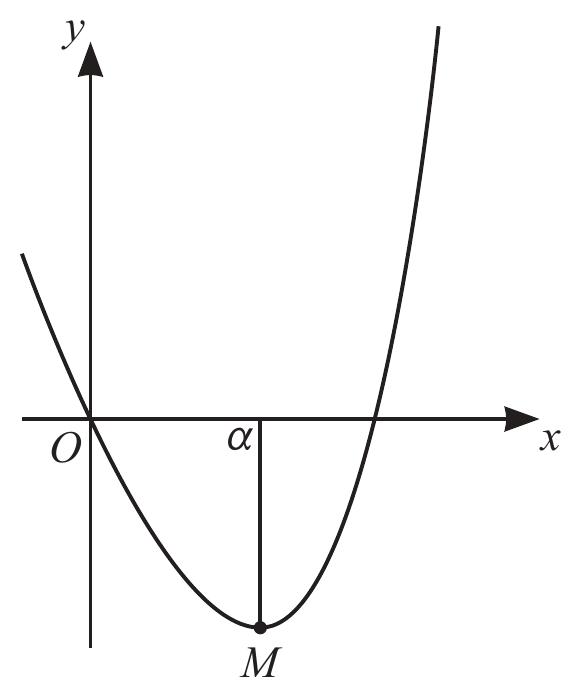
The diagram shows the curve y=xe2x−5x and its minimum point M, where x=α.
(a) Show that α satisfies the equation α=21ln(1+2α5).
(3)
(b) Verify by calculation that α lies between 0.4 and 0.5.
(2)
(c) Use an iterative formula based on the equation in part (a) to determine α correct to 2 decimal places. Give the result of each iteration to 4 decimal places.
(3)
题目中文翻译
图中显示了曲线 y=xe2x−5x 及其极小值点 M,该点的 x 坐标为 α。
(a) 证明 α 满足方程 α=21ln(1+2α5)。
(3)
(b) 通过计算验证 α 位于 0.4 与 0.5 之间。
(2)
(c) 使用基于 (a) 问方程的迭代公式求 α,结果保留 2 位小数。每次迭代的结果保留 4 位小数。
(3)
原卷通用作答要求
Answer all questions. You should use a calculator where appropriate.
You must show all necessary working clearly; no marks will be given for unsupported answers from a calculator.
Give non-exact numerical answers correct to 3 significant figures, or 1 decimal place for angles in degrees, unless a different level of accuracy is specified in the question.
请回答所有题目。适当时应使用计算器。必须清楚展示所有必要的计算过程;仅给出计算器答案而没有过程,不予评分。除非题目另有精度要求,非精确数值答案保留 3 位有效数字,以度为单位的角度保留 1 位小数。
解答
(a)
解法一
思路
展开
在极小点导数为零。用乘积法则求导后,先把指数函数单独移到一边,再取对数得到指定形式。
答题过程
展开
For y=xe2x−5x,
dxdy=e2x+2xe2x−5.
At x=α, the derivative is zero, so
(1+2α)e2α=e2α=5,1+2α5.
Taking logarithms,
2α=ln(1+2α5),
hence
α=21ln(1+2α5).
(b)
解法一
思路
展开
把驻点条件写成连续函数的零点条件,计算区间两端的符号变化。
答题过程
展开
Let g(x)=(1+2x)e2x−5, which is continuous. Then
g(0.4)=g(0.5)=1.8e0.8−5=−0.994026…<0,2e−5=0.436563…>0.
Therefore there is a zero between 0.4 and 0.5. Also
g′(x)=4(1+x)e2x>0(0.4≤x≤0.5),
so this zero is unique there. Hence 0.4<α<0.5.
(c)
解法一
思路
展开
采用(a)给出的迭代式。计算时保留内部精度,表中列到四位小数;继续到数值稳定于同一个两位小数结果。
答题过程
展开
Use
αn+1=21ln(1+2αn5),α0=0.4.
Keeping unrounded values in the calculation gives:
| n | αn to 4 decimal places |
|---|
| 0 | 0.4000 |
| 1 | 0.5108 |
| 2 | 0.4528 |
| 3 | 0.4823 |
| 4 | 0.4671 |
| 5 | 0.4749 |
| 6 | 0.4709 |
| 7 | 0.4729 |
| 8 | 0.4719 |
| 9 | 0.4724 |
| 10 | 0.4721 |
The values converge to a number which rounds to 0.47. Therefore
α=0.47 to 2 decimal places.
