Skip to content
CalcGospel 國際數學圖譜
返回

CIE 9709 2022 June Paper 31 Q9

A Level / CIE / P3

CIE 9709 2022 June Paper 31 Paper · Question 9

题目

Problem

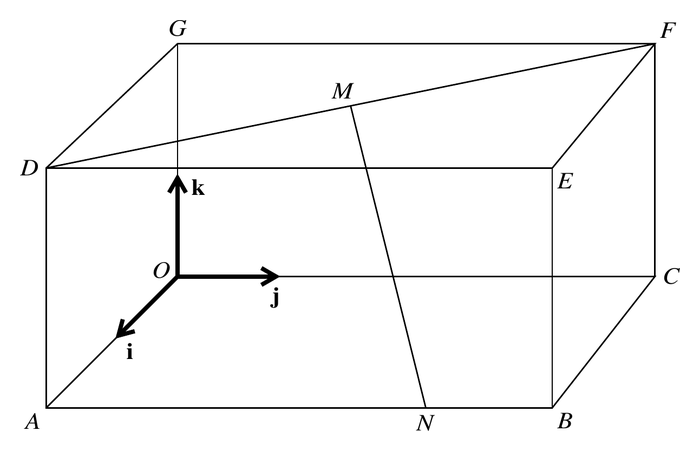
In the diagram, OABCDEFGOABCDEFG is a cuboid in which OA=2OA=2 units, OC=4OC=4 units and OG=2OG=2 units. Unit vectors i\mathbf{i}, j\mathbf{j} and k\mathbf{k} are parallel to OAOA, OCOC and OGOG respectively. The point MM is the midpoint of DFDF. The point NN on ABAB is such that AN=3NBAN=3NB.

(a) Express the vectors OM→\overrightarrow{OM} and MN→\overrightarrow{MN} in terms of i\mathbf{i}, j\mathbf{j} and k\mathbf{k}.

(3)

(b) Find a vector equation for the line through MM and NN.

(2)

(c) Show that the length of the perpendicular from OO to the line through MM and NN is 536\sqrt{\dfrac{53}{6}}.

(4)
题目中文翻译

如图,OABCDEFGOABCDEFG 为长方体,其中 OA=2OA=2 个单位,OC=4OC=4 个单位,OG=2OG=2 个单位。单位向量 i\mathbf{i}、j\mathbf{j} 和 k\mathbf{k} 分别平行于 OAOA、OCOC 和 OGOG。点 MM 是 DFDF 的中点。点 NN 位于 ABAB 上,且满足 AN=3NBAN=3NB。

(a) 用 i\mathbf{i}、j\mathbf{j} 和 k\mathbf{k} 表示向量 OM→\overrightarrow{OM} 和 MN→\overrightarrow{MN}。

(3)

(b) 求过 MM 和 NN 的直线的向量方程。

(2)

(c) 证明从 OO 到过 MM 和 NN 的直线的垂线段长度为 536\sqrt{\dfrac{53}{6}}。

(4)
原卷通用作答要求

Answer all questions. You should use a calculator where appropriate.

You must show all necessary working clearly; no marks will be given for unsupported answers from a calculator.

Give non-exact numerical answers correct to 3 significant figures, or 1 decimal place for angles in degrees, unless a different level of accuracy is specified in the question.

请回答所有题目。适当时应使用计算器。必须清楚展示所有必要的计算过程;仅给出计算器答案而没有过程,不予评分。除非题目另有精度要求,非精确数值答案保留 3 位有效数字,以度为单位的角度保留 1 位小数。

解答

(a)

解法一

思路

展开

从长方体的单位向量方向确定 D,FD,F 坐标,再取中点。AN=3NBAN=3NB 表示 NN 位于从 AA 到 BB 的四分之三处。

答题过程

展开

From the dimensions,

D=(2,0,2),F=(0,4,2).D=(2,0,2),\qquad F=(0,4,2).

Their midpoint is M=(1,2,2)M=(1,2,2), so

OM→=i+2j+2k.\boxed{\overrightarrow{OM}=\mathbf i+2\mathbf j+2\mathbf k}.

Also A=(2,0,0)A=(2,0,0) and B=(2,4,0)B=(2,4,0). Since AN=3NBAN=3NB,

N=A+34(B−A)=(2,3,0).N=A+\frac34(B-A)=(2,3,0).

Therefore

MN→= (2,3,0)−(1,2,2)= i+j−2k.\begin{align*} \overrightarrow{MN} =&\,(2,3,0)-(1,2,2)\\[4mm] =&\,\boxed{\mathbf i+\mathbf j-2\mathbf k}. \end{align*}

(b)

解法一

思路

展开

用(a)的方向向量与直线上的点 NN 写向量方程。

答题过程

展开

A point on the line is N=(2,3,0)N=(2,3,0) and a direction vector is (1,1,−2)(1,1,-2). Hence

r=(230)+λ(11−2).\boxed{\mathbf r= \begin{pmatrix}2\\3\\0\end{pmatrix} +\lambda\begin{pmatrix}1\\1\\-2\end{pmatrix}}.

(c)

解法一

思路

展开

设垂足在线上,位置向量与直线方向垂直。由点积为零求参数,再计算原点到垂足的距离。

答题过程

展开

Let the perpendicular foot be PP, with

OP→=(2+λ,3+λ,−2λ).\overrightarrow{OP}=(2+\lambda,3+\lambda,-2\lambda).

Since OP⊥MNOP\perp MN,

(2+λ)+(3+λ)+4λ=0.(2+\lambda)+(3+\lambda)+4\lambda=0.

Thus λ=−5/6\lambda=-5/6, giving

P=(76,136,53).P=\bigg(\frac76,\frac{13}{6},\frac53\bigg).

Therefore

OP2= 4936+16936+259= 31836=536.\begin{align*} OP^2 =&\,\frac{49}{36}+\frac{169}{36}+\frac{25}{9}\\[4mm] =&\,\frac{318}{36}=\frac{53}{6}. \end{align*}

Hence OP=53/6\boxed{OP=\sqrt{53/6}}.

解法二

思路

展开

也可将 OM→\overrightarrow{OM} 分成平行与垂直于 MNMN 的分量。点积求出平行投影长度,再用勾股定理求垂直距离。

答题过程

展开

Take OM→=(1,2,2)\overrightarrow{OM}=(1,2,2) and a direction vector d=(1,1,−2)\mathbf d=(1,1,-2). Then

∣OM→∣2= 9,∣d∣2= 6,OM→⋅d= 1+2−4=−1.\begin{align*} |\overrightarrow{OM}|^2=&\,9,\\[4mm] |\mathbf d|^2=&\,6,\\[4mm] \overrightarrow{OM}\cdot\mathbf d=&\,1+2-4=-1. \end{align*}

The squared projection length onto the line direction is (−1)2/6=1/6(-1)^2/6=1/6. Therefore the squared perpendicular distance from OO to the line through MM is

9−16=536.9-\frac16=\frac{53}{6}.

Thus the distance is 53/6\boxed{\sqrt{53/6}}.