题目
Problem
The complex number 3 − i 3-\mathrm{i} 3 − i u u u
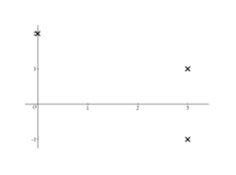
(a) Show, on an Argand diagram with origin O O O A A A B B B C C C u u u u ∗ u^* u ∗ u ∗ − u u^*-u u ∗ − u
State the type of quadrilateral formed by the points O O O A A A B B B C C C
(3)
(b) Express u ∗ u \dfrac{u^*}{u} u u ∗ x + i y x+\mathrm{i}y x + i y x x x y y y
(3)
(c) By considering the argument of u ∗ u \dfrac{u^*}{u} u u ∗ tan − 1 ( 3 4 ) = 2 tan − 1 ( 1 3 ) \tan^{-1}\big(\tfrac34\big)=2\tan^{-1}\big(\tfrac13\big) tan − 1 ( 4 3 ) = 2 tan − 1 ( 3 1 )
(2)
题目中文翻译
复数 3 − i 3-\mathrm{i} 3 − i u u u
(a) 在以 O O O u u u u ∗ u^* u ∗ u ∗ − u u^*-u u ∗ − u A A A B B B C C C
写出由点 O O O A A A B B B C C C
(3)
(b) 将 u ∗ u \dfrac{u^*}{u} u u ∗ x + i y x+\mathrm{i}y x + i y x x x y y y
(3)
(c) 通过考虑 u ∗ u \dfrac{u^*}{u} u u ∗ tan − 1 ( 3 4 ) = 2 tan − 1 ( 1 3 ) \tan^{-1}\big(\tfrac34\big)=2\tan^{-1}\big(\tfrac13\big) tan − 1 ( 4 3 ) = 2 tan − 1 ( 3 1 )
(2)
原卷通用作答要求
Answer all questions. You should use a calculator where appropriate.
You must show all necessary working clearly; no marks will be given for unsupported answers from a calculator.
Give non-exact numerical answers correct to 3 significant figures, or 1 decimal place for angles in degrees, unless a different level of accuracy is specified in the question.
请回答所有题目。适当时应使用计算器。必须清楚展示所有必要的计算过程;仅给出计算器答案而没有过程,不予评分。除非题目另有精度要求,非精确数值答案保留 3 位有效数字,以度为单位的角度保留 1 位小数。
解答
(a)
解法一
思路
展开
共轭改变虚部符号,因此三点坐标可直接写出。比较两组对边向量,判断四边形类型。
答题过程
展开
Since u = 3 − i u=3-\mathrm{i} u = 3 − i
u ∗ = 3 + i , u ∗ − u = 2 i . u^*=3+\mathrm{i},\qquad u^*-u=2\mathrm{i}. u ∗ = 3 + i , u ∗ − u = 2 i . Plot
A = ( 3 , − 1 ) , B = ( 3 , 1 ) , C = ( 0 , 2 ) A=(3,-1),\qquad B=(3,1),\qquad C=(0,2) A = ( 3 , − 1 ) , B = ( 3 , 1 ) , C = ( 0 , 2 ) on the Argand diagram.
The opposite sides satisfy
O A → = ( 3 , − 1 ) = C B → , A B → = ( 0 , 2 ) = O C → . \begin{align*}
\overrightarrow{OA}=&\,(3,-1)=\overrightarrow{CB},\\[4mm]
\overrightarrow{AB}=&\,(0,2)=\overrightarrow{OC}.
\end{align*} O A = A B = ( 3 , − 1 ) = C B , ( 0 , 2 ) = O C . Therefore O A B C is a parallelogram \boxed{OABC\text{ is a parallelogram}} O A B C is a parallelogram
(b)
解法一
思路
展开
将商的分子分母乘以分母的共轭,分母变成实数。
答题过程
展开
We have
u ∗ u = 3 + i 3 − i = ( 3 + i ) 2 ( 3 − i ) ( 3 + i ) = 9 + 6 i − 1 10 = 4 5 + 3 5 i . \begin{align*}
\frac{u^*}{u}
=&\,\frac{3+\mathrm{i}}{3-\mathrm{i}}
=\frac{(3+\mathrm{i})^2}{(3-\mathrm{i})(3+\mathrm{i})}\\[4mm]
=&\,\frac{9+6\mathrm{i}-1}{10}\\[4mm]
=&\,\boxed{\frac45+\frac35\mathrm{i}}.
\end{align*} u u ∗ = = = 3 − i 3 + i = ( 3 − i ) ( 3 + i ) ( 3 + i ) 2 10 9 + 6 i − 1 5 4 + 5 3 i .
解法二
思路
展开
也可设商为 s + t i s+t\mathrm{i} s + t i
答题过程
展开
Let u ∗ / u = s + t i u^*/u=s+t\mathrm{i} u ∗ / u = s + t i
( s + t i ) ( 3 − i ) = ( 3 s + t ) + ( 3 t − s ) i = 3 + i . \begin{align*}
(s+t\mathrm{i})(3-\mathrm{i})
=&\,(3s+t)+(3t-s)\mathrm{i}\\[4mm]
=&\,3+\mathrm{i}.
\end{align*} ( s + t i ) ( 3 − i ) = = ( 3 s + t ) + ( 3 t − s ) i 3 + i . Thus
3 s + t = 3 , − s + 3 t = 1. \begin{align*}
3s+t=&\,3,\\[4mm]
-s+3t=&\,1.
\end{align*} 3 s + t = − s + 3 t = 3 , 1. The first gives t = 3 − 3 s t=3-3s t = 3 − 3 s
− s + 9 − 9 s = 1 , s = 4 5 . -s+9-9s=1,\qquad s=\frac45. − s + 9 − 9 s = 1 , s = 5 4 . Then t = 3 / 5 t=3/5 t = 3/5
u ∗ u = 4 5 + 3 5 i . \boxed{\frac{u^*}{u}=\frac45+\frac35\mathrm{i}}. u u ∗ = 5 4 + 5 3 i .
(c)
解法一
思路
展开
设 u ∗ u^* u ∗ ϕ \phi ϕ u u u − ϕ -\phi − ϕ
答题过程
展开
Let ϕ = tan − 1 ( 1 / 3 ) \phi=\tan^{-1}(1/3) ϕ = tan − 1 ( 1/3 )
arg u ∗ = ϕ , arg u = − ϕ . \arg u^*=\phi,\qquad \arg u=-\phi. arg u ∗ = ϕ , arg u = − ϕ . Since 0 < ϕ < π / 4 0<\phi<\pi/4 0 < ϕ < π /4 0 < 2 ϕ < π / 2 0<2\phi<\pi/2 0 < 2 ϕ < π /2 2 π 2\pi 2 π
arg u ∗ u = ϕ − ( − ϕ ) = 2 ϕ . \arg\frac{u^*}{u}=\phi-(-\phi)=2\phi. arg u u ∗ = ϕ − ( − ϕ ) = 2 ϕ . By part (b), the quotient is in the first quadrant and has argument tan − 1 ( 3 / 4 ) \tan^{-1}(3/4) tan − 1 ( 3/4 )
tan − 1 3 4 = 2 tan − 1 1 3 . \boxed{\tan^{-1}\frac34=2\tan^{-1}\frac13}. tan − 1 4 3 = 2 tan − 1 3 1 .
解法二
思路
展开
也可使用正切二倍角公式。得到相同正切值后,必须说明两个角在同一个单调区间内,才能判定角相等。
答题过程
展开
Let ϕ = tan − 1 ( 1 / 3 ) \phi=\tan^{-1}(1/3) ϕ = tan − 1 ( 1/3 ) 0 < ϕ < π / 4 0<\phi<\pi/4 0 < ϕ < π /4
tan 2 ϕ = 2 tan ϕ 1 − tan 2 ϕ = 2 / 3 1 − 1 / 9 = 3 4 . \tan2\phi=\frac{2\tan\phi}{1-\tan^2\phi}
=\frac{2/3}{1-1/9}=\frac34. tan 2 ϕ = 1 − tan 2 ϕ 2 tan ϕ = 1 − 1/9 2/3 = 4 3 . Since 0 < 2 ϕ < π / 2 0<2\phi<\pi/2 0 < 2 ϕ < π /2
2 ϕ = tan − 1 3 4 . 2\phi=\tan^{-1}\frac34. 2 ϕ = tan − 1 4 3 . Thus tan − 1 ( 3 / 4 ) = 2 tan − 1 ( 1 / 3 ) \boxed{\tan^{-1}(3/4)=2\tan^{-1}(1/3)} tan − 1 ( 3/4 ) = 2 tan − 1 ( 1/3 )